 India · 18th century
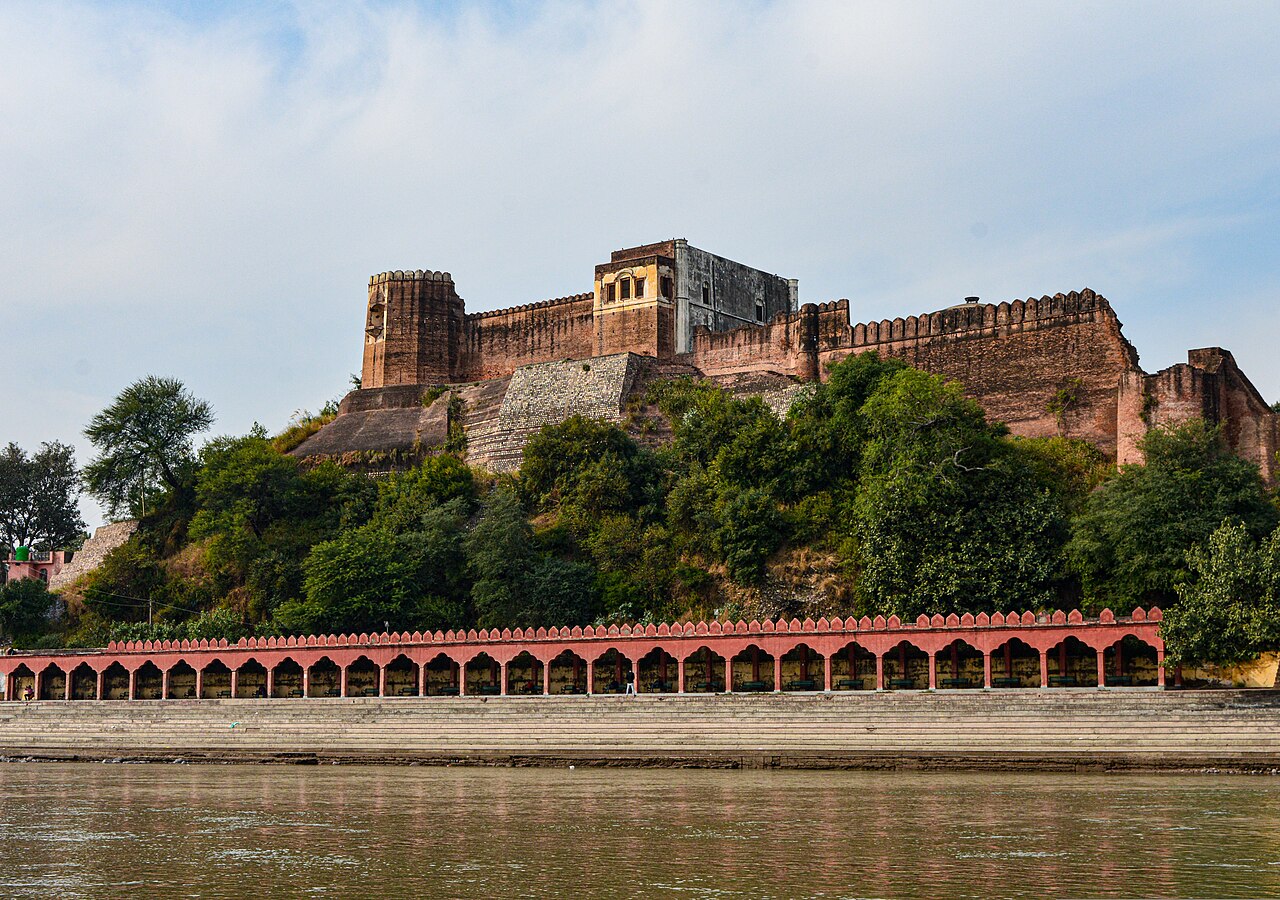
Akhnoor Fort is a fort on the right bank of the Chenab River (ancient name Asikni), 28 km from Jammu City.
Construction of the fort was started by Raja Tej Singh in 1762 CE and completed by his successor Raja Dhian Singh in 1802. On 17 June 1822, Maharaja Ranjit Singh crowned Maharaja Gulab Singh at the fort's Jia Pota ghat on Chenab's riverbank.
The fort has high fortification walls with bastions at regular intervals and is crowned with battlements. There are two-storeyed watch-towers at the corners, which are crowned by battlements and merlons. The fort has two parts which are bifurcated by a wall with a gate leading to the palace on the southern side. The palace is two-storeyed, and the walls facing the courtyard have decorated arches, some of which contain mural paintings.
Access to Akhnoor Fort is obtained through both the riversides and the northern side. Formerly, a large part of the fort was in ruins; conservation work is in progress.
The fort was declared a National Monument in 1982 under the Ancient Monuments and Archaeological Sites and Remains Act, 1958 and is under the Archaeological Survey of India’s jurisdiction.
Text adapted from “Akhnoor Fort” on Wikipedia, CC BY-SA 4.0.
Akhnoor Fort ranks #2,659 of 9,035 worldwide in the atlas's castle fame ranking, and #102 of the 223 mapped in India. Founded 1762, it is older than 15% of the atlas's dated landmarks, one of 685 atlas entries founded in the 18th century. Its Wikipedia articles were opened 1,489 times in the last 60 days, more than 62% of the atlas. 1 more atlas landmarks stand within 25 km. See how India compares in the castle statistics.
View on the interactive castle map →