Fortress
Mainz Citadel
🇩🇪 Germany · 17th century
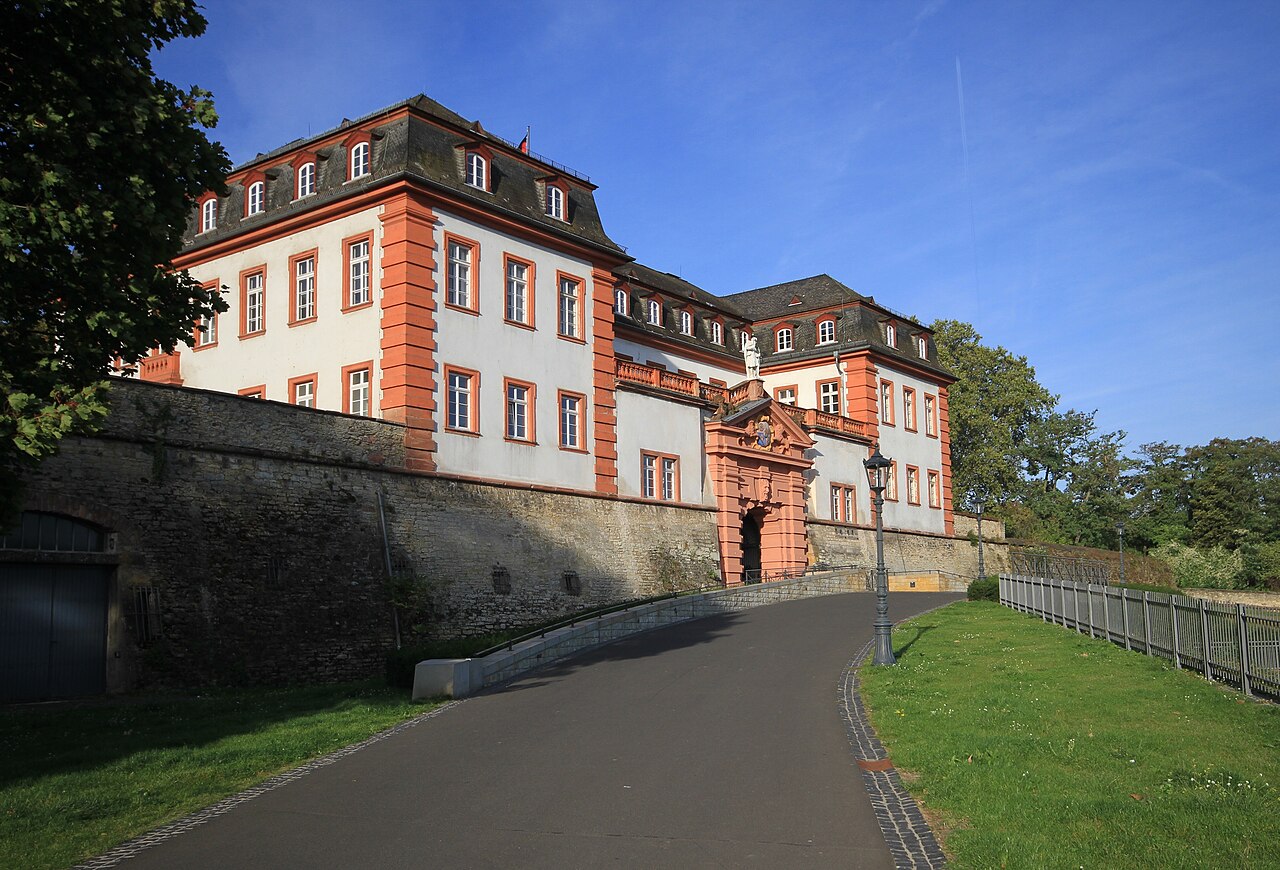
The Mainzer Zitadelle (Citadel of Mainz) is situated at the fringe of Mainz Old Town, near Mainz Römisches Theater station. The fortress was constructed in 1660 and was an important part of the Fortress Mainz.
The Jakobsberg hill, where the citadel was constructed, had been occupied by a Benedictine abbey during the Middle Ages (since 1050). Halfway up the hill, the amphitheater of the Roman settlement of Mogontiacum, must also have been visible at that time. The Jakobsberg hill, however, had not been integrated in the ring of the defensive city walls of the town and this flank of the city was therefore only slightly protected. This position immediately at the gates of the town opened a strategic gap, as an aggressor could use the hill for a raid into Mainz or for a cannonade. The construction of the "Schweickhardtsburg" fortress under the supervision of cathedral vicar Adolph von Waldenburg during the years 1620-29 provisionally filled this gap and integrated the hill into the system of city walls. The name of the irregularly pentagonal fortification honors the reigning monarch of that time, the prince-elector Johann Schweikhard von Kronberg.
Around 1655 prince-elector Johann Philipp von Schönborn initiated an improvement of the fortification of the entire town comprising bastions according to French type. Within this modification of the fortress, the Schweickhardtsburg was converted into the regular, quadrangular citadel, as it is today. St. Jacobs abbey and the Roman cenotaph, the Drususstein, remained untouched within the fortress.
Above the gate in direction to the town, a building for the commander of the citadel was erected in 1696 by the order of Lothar Franz von Schönborn. The gateway, existing since 1660 was skillfully integrated in the new building.
During the siege of Mainz (1793) St. Jacobs abbey was destroyed largely by Prussian shelling. The remainings of the abbots and guest house had been used only for military purposes since then. In the south of the courtyard a Baroque garden existed, which can be seen on a map dated 1804.
After the Napoleonic Wars Mainz became in 1816 a fortress of the German Confederation. Prussians and Austrians settled in the citadel and used it as barracks. For this purpose, the Austrians erected 1861 the shellproof Citadel Barracks; the small side building was used as casino and kitchen.
Text adapted from “Mainz Citadel” on Wikipedia, CC BY-SA 4.0.
Mainz Citadel ranks #2,336 of 8,134 worldwide in the atlas's castle fame ranking, and #175 of the 505 mapped in Germany. Founded 1660, it is older than 26% of the atlas's dated landmarks — one of 626 atlas entries founded in the 17th century. Its Wikipedia articles were opened 2,068 times in the last 60 days, more than 68% of the atlas. 8 more atlas landmarks stand within 25 km. The nearest day-trip guide is Wiesbaden, 10 km away. See how Germany compares in the castle statistics.
View on the interactive castle map →Frequently asked questions
Where is Mainz Citadel?
Mainz Citadel stands in Germany, at 49.9931°, 8.27417°.
When was Mainz Citadel built?
The atlas dates its founding to 1660. Earlier structures may have stood on the site; this is the earliest documented founding year.
How famous is Mainz Citadel?
In this atlas's fame ranking: #2,336 of 8,134 worldwide, and #175 in Germany. Fame here combines how many Wikipedia language editions cover a landmark with how many people read them.
What is the nearest castle to Mainz Citadel?
Fortress of Mainz, about 1 km away.
More castles in Germany
- Residenz Ansbach Germany · 16th century
- Schloss Jägerhof Germany · 18th century
- Granitz Hunting Lodge Germany
- Schloss Favorite Germany · 18th century
More fortresses
- Panopeus Greece
- Torre de la Malmuerta Spain · 15th century
- Arco de Santa María Spain · 16th century
- Puerta Bab al-Mardum Spain · 10th century