 Russia · 19th century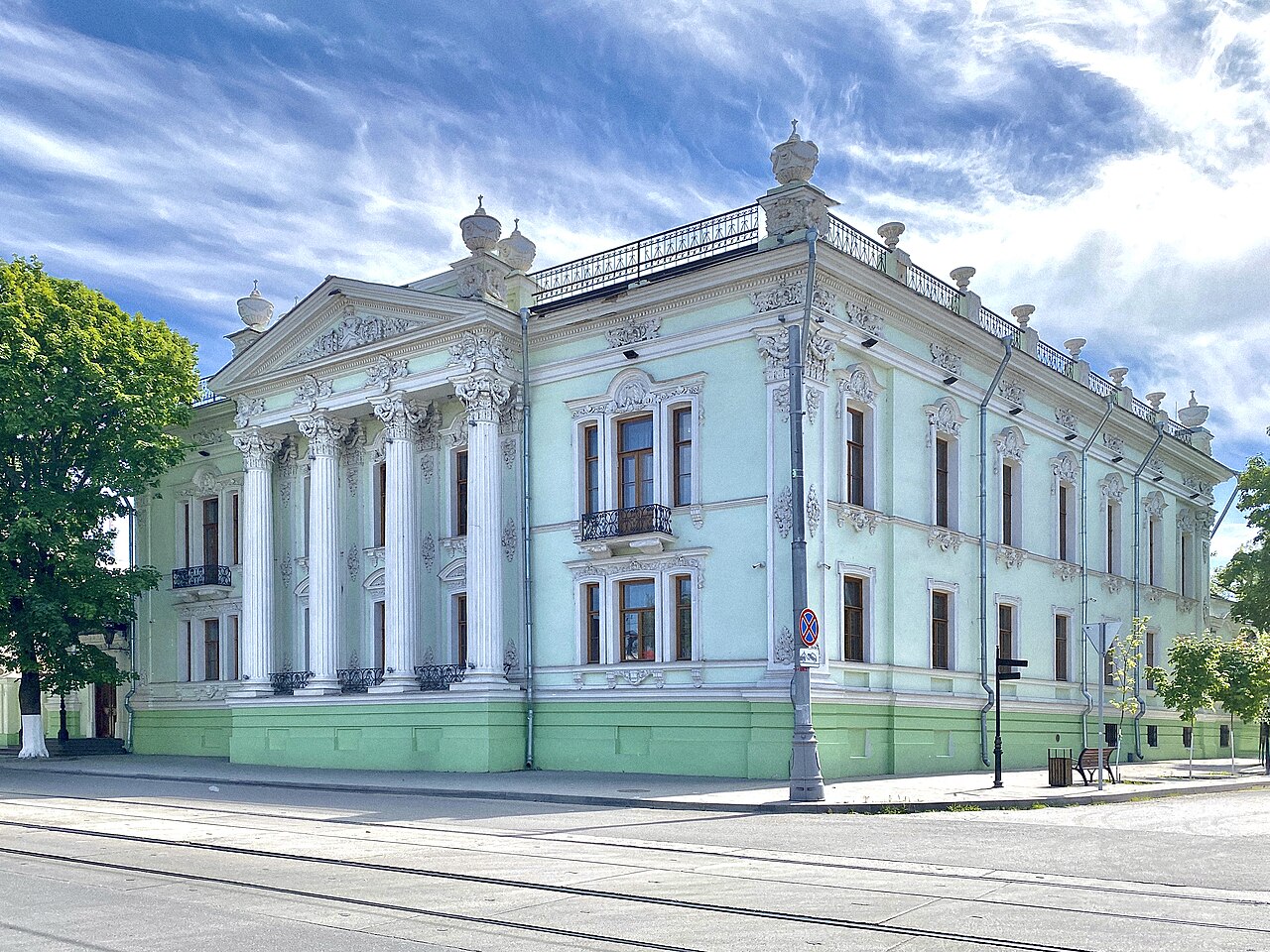
Alferaki Palace is a museum in Taganrog, Russia, originally the home of the wealthy merchant Nikolay Alferaki. It was built in 1848 by the architect Andrei Stackenschneider on Frunze Street (formerly Katolicheskaya), in downtown Taganrog.
The first owners of the palace were Nikos Alferakis, who was born in Taganrog, and his family. In the 1870s, after the Alferaki family went bankrupt, the palace was sold to the Greek merchant Negroponte. Its garden was sold to the merchant community. It re-opened as the Commercial Assembly. Anton Chekhov (as a student of The Boys Gymnasium) mentioned the palace in his stories Ionych, Mask and My life. From February to April 1918, the mansion became the headquarters of the Soviet Workers' council of Taganrog.
Later during occupation in 1918 it housed the German war hospital, and in 1919 – Anton Ivanovich Denikin's staff.
After the establishment of Soviet power in Taganrog, after 1927 it housed the Museum of Regional Studies.
During the Occupation of Taganrog, the whole collection of Russian art, as well as 339 other art objects were looted by German occupation authorities Alferaki Palace was renovated in 1991–1996 and is now open to public as the Museum of Regional Studies, though it is more commonly known under the name Alferaki Palace.
The basis of museum collections is formed with funds related to historical or artistic personalities.
Text adapted from “Alferaki Palace” on Wikipedia, CC BY-SA 4.0.
Alferaki Palace ranks #2,110 of 9,079 worldwide in the atlas's castle fame ranking, and #66 of the 146 mapped in Russia. Founded 1848, it is older than 8% of the atlas's dated landmarks — one of 717 atlas entries founded in the 19th century. Its Wikipedia articles were opened 1,541 times in the last 60 days, more than 63% of the atlas. 1 more atlas landmarks stand within 25 km. See how Russia compares in the castle statistics.
View on the interactive castle map →