Ruin
Taganrog Fortress
🇷🇺 Russia · 17th century
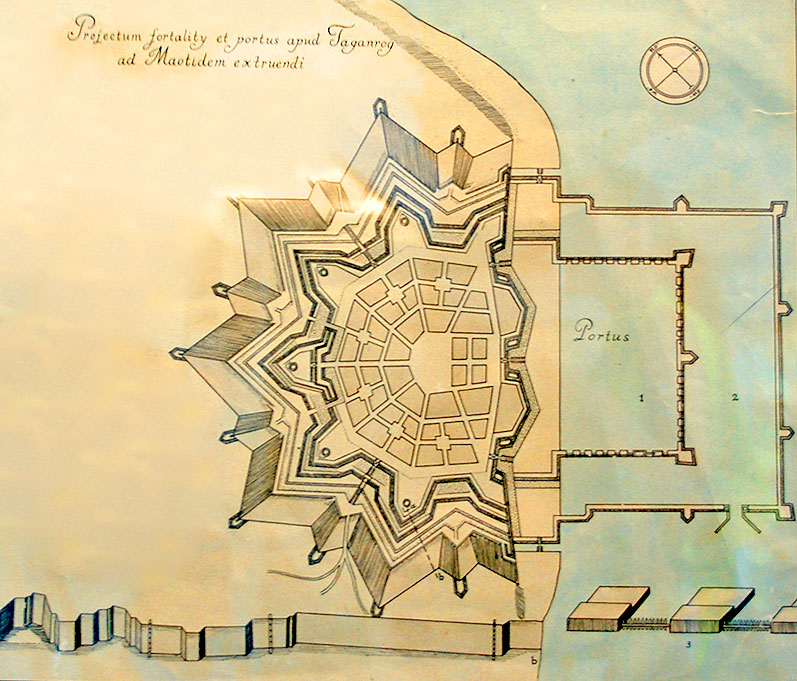
Taganrog Fortress (also The Saint Trinity fortress on Tagan-Rog Cape) was a star fort-style fortress built during the reign of Peter the Great and re-constructed by the order of Catherine the Great.
Peter the Great tried to conquer the Turkish fortress of Azov to get an entrance to the Sea of Azov and the Black Sea. His first Azov campaigns in 1695 failed, but his second attempt the next year led to victory.
To ensure Russian positions in the South, and to shelter the Russian Navy, Peter the Great needed a new haven for the Azov Flotilla, and a fortress to protect it. Azov could not serve as naval base because of shallow waters of the river Don. That is why, a few days after Turkish capitulation, on July 27, 1696 the Russian tsar set out for an expedition to explore the coastline of Azov Sea. The expedition stopped at the cape Tagan-Rog on July 27, where Peter the Great spent the night of July 27–28, 1696. The cape was selected as the perfect place for the harbour, since the sea around the cape was deep enough for sea boats; there was enough room for a haven with solid stone soil; and the expedition found a small water spring.
The first Russian Navy base, Taganrog (Taygan for Turkish in Ottoman sources) was officially founded by Peter the Great on September 12, 1698. Vice-Admiral Cornelis Cruys, who is regarded as the architect of the Russian Navy, became the first Head of Taganrog city in 1698-1702 and in 1711, and produced the first maps of Azov Sea and Don River.
The project for planning and building works in the city was established in 1698 by Austrian engineer Baron Ernst Friedrich von Borgsdorf, basing on the instructions provided by Peter the Great. Taganrog is one of the first Russian cities, which was built according to a detailed pre-established plan. It was also the first artificial haven, and the first fortress made of earth as primary material. The construction was generally completed by 1709.
The Saint Trinity fortress was situated on the horn-shaped territory of the cape, earth mounds around 8 metres high, a 5-metre-deep moat that stretched for about 2 miles. Within fortress ramparts were other defensive constructions - three bastions, two demi-bastions, three ravelins armed with cannons and howitzers. Alongside the rampart were casemates, powder magazines, barracks.
Text adapted from “Taganrog Fortress” on Wikipedia, CC BY-SA 4.0.
Taganrog Fortress ranks #6,191 of 8,134 worldwide in the atlas's castle fame ranking, and #121 of the 145 mapped in Russia. Founded 1696, it is older than 23% of the atlas's dated landmarks — one of 626 atlas entries founded in the 17th century. 1 more atlas landmarks stand within 25 km. See how Russia compares in the castle statistics.
View on the interactive castle map →Frequently asked questions
Where is Taganrog Fortress?
Taganrog Fortress stands in Russia, at 47.20353°, 38.94154°.
When was Taganrog Fortress built?
The atlas dates its founding to 1696. Earlier structures may have stood on the site; this is the earliest documented founding year.
How famous is Taganrog Fortress?
In this atlas's fame ranking: #6,191 of 8,134 worldwide, and #121 in Russia. Fame here combines how many Wikipedia language editions cover a landmark with how many people read them.
What is the nearest castle to Taganrog Fortress?
Alferaki Palace, about 1 km away.
More castles in Russia
- Trångsund Fortress Russia · 19th century
- Schloss Tilsit Russia · 15th century
- Tapiau castle Russia · 13th century
- Citadelle Pillau Russia · 17th century
More ruins
- Burgruine Reinegg Austria
- Murray Battery China · 19th century
- Waqrapukara Peru
- Korolevo Castle Ukraine · 13th century