 Spain · 12th century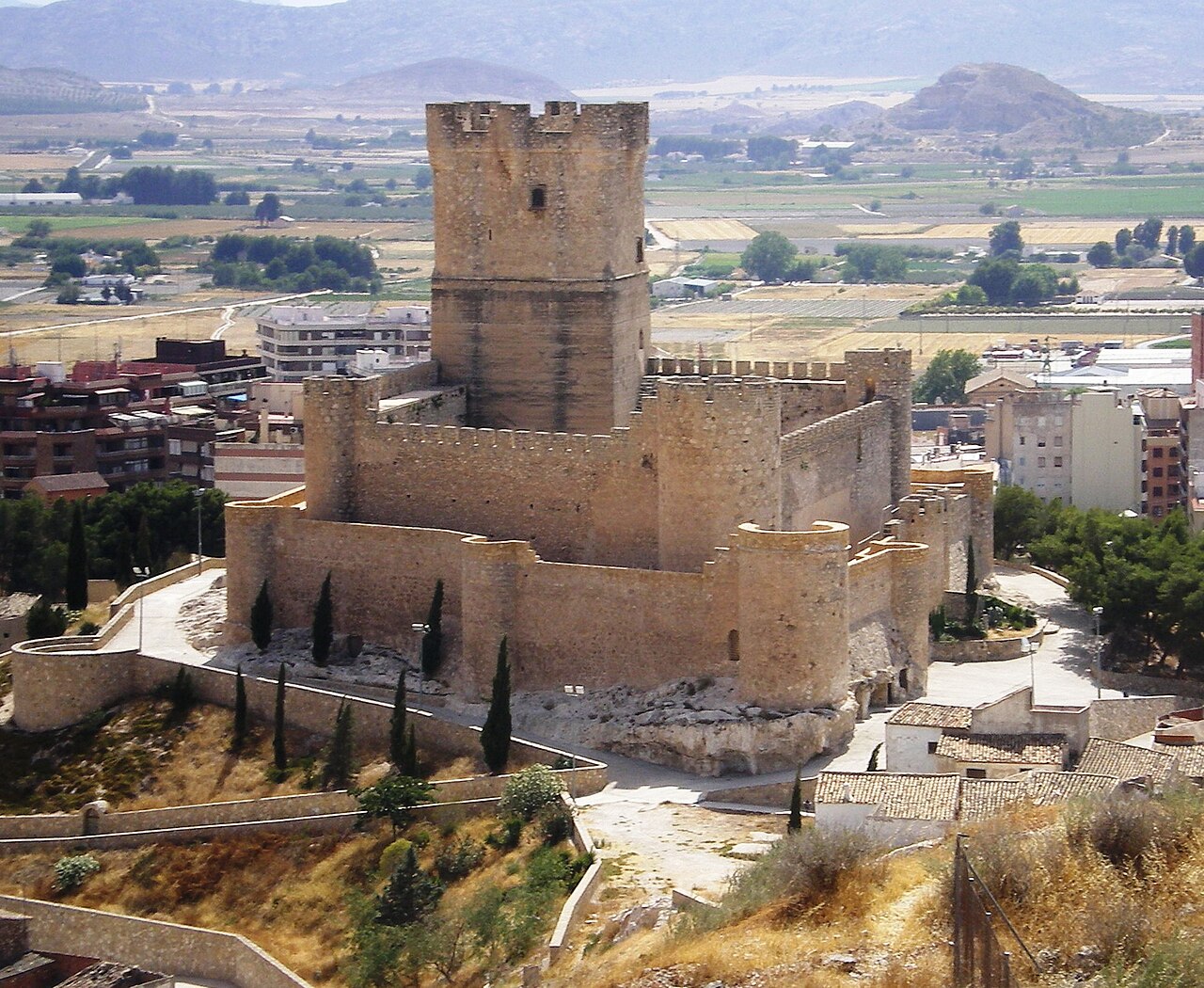
The Atalaya Castle (Spanish: Castillo de la Atalaya or Castillo de Villena, English: Castle of the Watch) is a fortress in Villena, province of Alicante, southern Spain. Located over a spur of the Sierra de la Villa, in the north-western part of the province of Alicante, it commands the former frontier between Castile and Kingdom of Aragon.
The fortress was built in an unknown age, although not after the 12th century, since Arab sources mention it in 1172. It has been speculated that the fortification could have been built over a Roman castrum or villa, but no proof of this has been found.
The fortress was an important stronghold on the northern frontier of the Islamic emirate of Iberia, and proof of its robustness is the fact that the fortification resisted to three different sieges laid by James I of Aragon. He was finally able to conquer it in 1240, sending an army led by the knights of the Order of Calatrava, with almogavar mercenaries, under the command of Ruy Pérez Ponce de León, Commander of Alcañiz. These incursions involved a violation of the Treaty of Cazola, according to which Villena belonged to the Castilian conquest. The castle would definitely be in hands of the Kingdom of Castile after the Treaty of Almizra of 1244.
It was first given to the Order of Calatrava, but was soon acquired by Infante Manuel when he became lord of Villena. Here resided his son, writer Juan Manuel, Prince of Villena, who made reforms to improve the security of the fortress, in order to defend his fiancee, the princess Constanza of Aragon. In the XIV century, the Lords of Villena were succeeded as proprietors by Alfonso of Aragon and Foix, the first Marquis of Villena.
In 1476 the citizens of Villena, encouraged by the Catholic Monarchs, rebelled against the marquesses. After this event, the castle stopped to be residence of the marquisses, and, together with the city, became a royal possession.
During the Revolt of the Brotherhoods (1519–1523), viceroy Diego Mendoza took refuge in the fortress after his defeat at Gandía, and from here set out the troops which restored the royal power in Spain. During the War of Spanish Succession (1701–1713), 50 Bourbon loyalist troops sustained a siege of 8 days from the biggest part of the Austrian army.
Text adapted from “Atalaya Castle (Spain)” on Wikipedia, CC BY-SA 4.0.
Atalaya Castle ranks #1,918 of 9,079 worldwide in the atlas's castle fame ranking, and #68 of the 607 mapped in Spain. Founded 1172, it is older than 79% of the atlas's dated landmarks — one of 756 atlas entries founded in the 12th century. Its Wikipedia articles were opened 1,753 times in the last 60 days, more than 66% of the atlas. 8 more atlas landmarks stand within 25 km. The nearest day-trip guide is Elche, 43 km away. See how Spain compares in the castle statistics.
View on the interactive castle map →