Ruin
Basing House
ENG England · 16th century
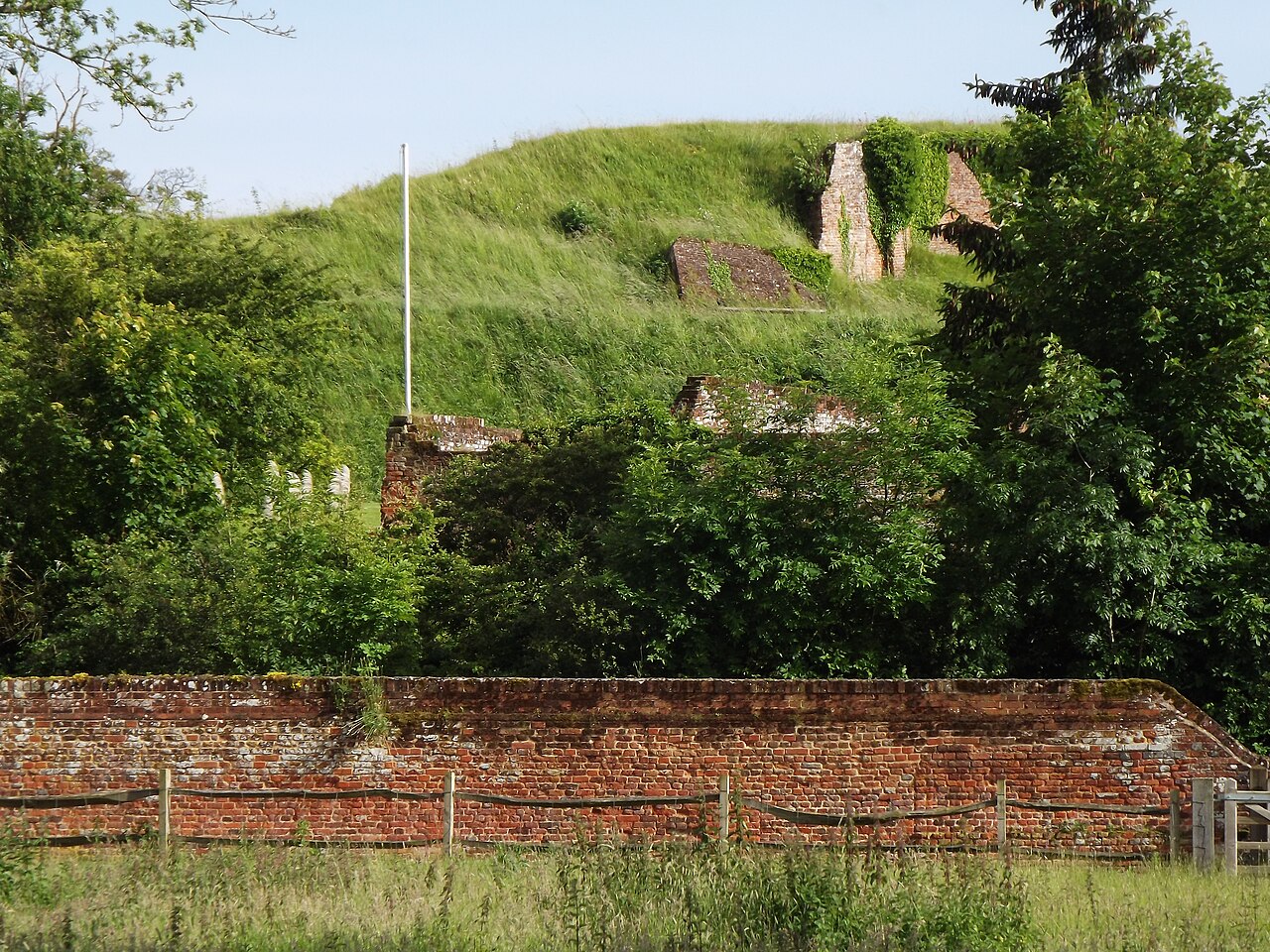
Basing House was a Tudor palace and castle in the village of Old Basing in the English county of Hampshire. It once rivalled Hampton Court Palace in its size and opulence. Today only parts of the basement or lower ground floor, plus the foundations and earthworks, remain. The ruins are a Grade II listed building and a scheduled monument.
Basing House was built from 1531 as a new palace for William Paulet, 1st Marquess of Winchester, treasurer to King Edward VI, Queen Mary I, and Queen Elizabeth I. The nearby 'Great Barn' was completed in 1534, just before a visit from Henry VIII and Anne Boleyn.
In its final form, Basing House comprised two linked houses. The "Old House" replaced the keep of an older ringwork castle, so was located within a defensive ring of earthworks and walls, whilst the slightly later "New House" was located outside the defences. A bridge and gateway linked the two across and through the defences, a link that was to prove fatal in the final battle for the fortress. The "New House" 'annex' in itself had approximately 360 rooms and was built primarily to accommodate the multitude of people that accompanied royalty when they visited.
Edward VI visited on 7 September 1552 and went on to Donnington Castle after three days. Elizabeth I came in August 1560 and so liked the house and entertainment that she said she would have married Lord Treasurer Paulet if he had been a younger man. She returned in August 1569. In September 1601 she entertained the French ambassador, the Duke de Biron, at the expense of the Marquess of Winchester. She hunted in the park with visiting French noblemen and killed 20 deer, and knighted 11 men. King James visited in August 1603. Anne of Denmark stayed in September 1603. There was dancing, and the elderly Earl of Nottingham was betrothed to the much younger Margaret Stewart.
On taking the title in February 1629, the 5th Marquess downsized, moved the family out and waited until returns from his extensive estates all over England allowed him to start restorations. For the first half of the 1630s, the house was closed and the windows boarded over after the family relocated to its other houses.
Text adapted from “Basing House” on Wikipedia, CC BY-SA 4.0.
Basing House ranks #4,875 of 8,764 worldwide in the atlas's castle fame ranking, and #307 of the 356 mapped in England. Founded 1531, it is older than 44% of the atlas's dated landmarks — one of 827 atlas entries founded in the 16th century. Its Wikipedia articles were opened 1,812 times in the last 60 days, more than 65% of the atlas. 4 more atlas landmarks stand within 25 km. The nearest day-trip guide is Basingstoke, 2 km away. See how England compares in the castle statistics.
View on the interactive castle map →Frequently asked questions
Where is Basing House?
Basing House stands in England, at 51.2686°, -1.05197°.
When was Basing House built?
The atlas dates its founding to 1531. Earlier structures may have stood on the site; this is the earliest documented founding year.
How famous is Basing House?
In this atlas's fame ranking: #4,875 of 8,764 worldwide, and #307 in England. Fame here combines how many Wikipedia language editions cover a landmark with how many people read them.
What is the nearest castle to Basing House?
Odiham Castle, about 6 km away.
More castles in England
- Caerhays Castle England · 19th century
- Chiddingstone Castle England · 19th century
- Danby Castle England · 14th century
- Hornby Castle (North Yorkshire) England
More ruins
- Dunure Castle Scotland · 13th century
- Eglinton Castle Scotland · 18th century
- Hallforest Castle Scotland · 14th century
- Invermark Castle Scotland · 16th century