 Ukraine · 13th century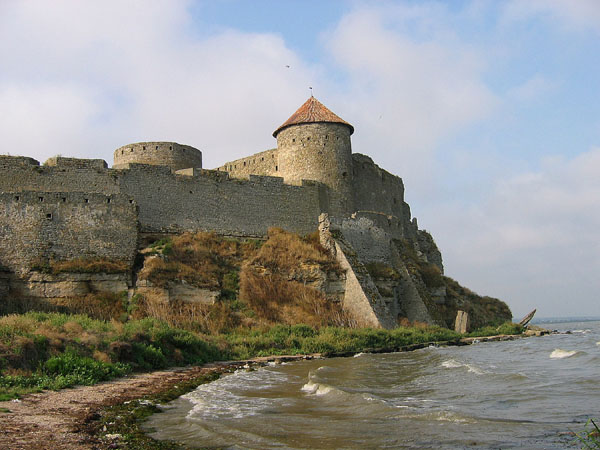
The Bilhorod-Dnistrovskyi fortress or Akkerman fortress (Білгород-Дністровська фортеця, or Акерманська фортеця; Romanian: Cetatea-Albă; also known as Kokot) is a historical and architectural monument of the 13th–14th centuries. It is located in Bilhorod-Dnistrovskyi in the Odesa Oblast of southwestern Ukraine, in the Budjak, the historical region of Bessarabia.
The fortress was built on the remains of Tyras, an ancient Greek city on the northern coast of the Black Sea which existed until the 4th century. Frequent attacks by invaders (Goths and Huns) destroyed the city. Antes, Slavs, and Bulgarians lived on the site of Tyras after the Greeks. In the 10th century, Bilhorod was part of Kievan Rus'. Later it was owned by the Kingdom of Hungary, then the Principality of Galicia–Volhynia, where it stayed until the invasion of the Mongols.
It is not known when construction began on the fortress. Most historians today believe that it was a trading exclave of the Republic of Genoa on the Black Sea, first established in the 13th century. The territory was surrendered to the Golden Horde, but the Genoese managed to ally with the Mongols.
Bilhorod was officially a Tatar city, but ruled by the Genoese; the fortress controlled the estuary of the Dniester.
In the second half of the 14th century, the Genoese lost their influence in the Black Sea region and secure passage across the Aegean Sea, because of increasing military pressure from the Ottomans. According to most historians, Lithuania came to replace Genoa. In the 14th century, the Principality of Moldavia gained control over the Lithuanians.
After the territory came under the control of the Principality of Moldova, the Moldavians called it Cetatea Albă (literally White Citadel). In the 15th century the city was a metropolis with about 20,000 inhabitants - Moldavians, Greeks, Genoese, Armenians, Jews, Tatars. It was the start of the greatest development period in the city's history. The city was based on a fortress, which had already grown significantly. Its main elements had been constructed by 1440. The fortress had 34 towers, some as much as 20 meters tall. Outside, the fortress was surrounded by a deep moat. The fortress was built of white limestone, for which a mortar made of eggs, crushed marble, carbon, and silicon was used.
In 1440 one portion which was neither a wall nor a castle tower was completed.
Text adapted from “Bilhorod-Dnistrovskyi fortress” on Wikipedia, CC BY-SA 4.0.
Bilhorod-Dnistrovskyi Fortress ranks #637 of 9,079 worldwide in the atlas's castle fame ranking, and #13 of the 195 mapped in Ukraine. Founded c. 1250, it is older than 67% of the atlas's dated landmarks — one of 1080 atlas entries founded in the 13th century. Its Wikipedia articles were opened 7,275 times in the last 60 days, more than 91% of the atlas. See how Ukraine compares in the castle statistics.
View on the interactive castle map →