 Slovenia · 16th century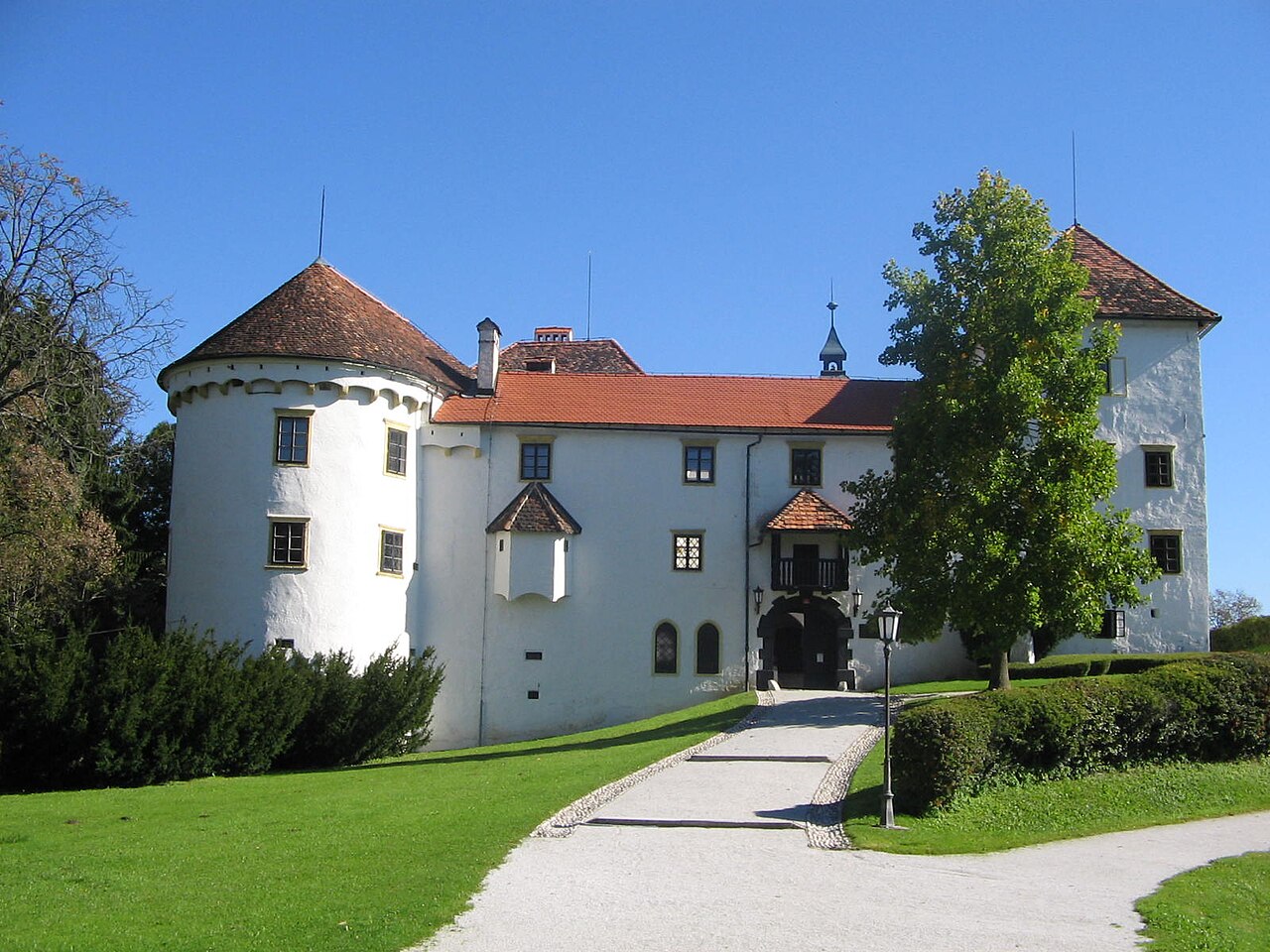
Bogenšperk Castle (pronounced [ˈboːɡɛnʃpɛɾk]; Slovene: Grad Bogenšperk, German: Schloss Wagensperg) is a 16th-century castle located in the Municipality of Šmartno pri Litiji in central Slovenia. It is best known for its association with the 17th-century scientist and natural historian Johann Weikhard von Valvasor, a fellow of the Royal Society in London.
Standing on a low hill at an elevation of 412 m, the Renaissance castle is fully restored, and is listed as an important cultural monument of Slovenia. The three-story building consists of four tracts from several time periods, connecting four towers and surrounding an arcaded inner courtyard. The oldest part of the castle is the north tower, which originally stood as a standalone fortification. A wooden bridge was later added, linking it to the south-east tower, which originally served a defensive purpose and was once much higher than the rest of the building; however, since a 1759 fire caused by a lightning-strike heavily damaged the castle, the tower was never rebuilt to its original level. The castle stands on bedrock; one of its attractions is a deep well carved directly into the rock.
In its current form, the castle was likely begun by the noble house of Wagen as a replacement for Boltežar Wagen's nearby Lihtenberk Castle, already in disrepair and severely damaged by a major earthquake in 1511. After the 1630 death of Jurij Wagen, the last member of the family, the castle changed several owners until it was in 1672 finally bought by Johann Weikhard von Valvasor after his return from abroad. Thoroughly renovated, it was furnished with a graphic studio, a library, printing press and collection of curiosities. Due to the enormous cost of issuing Valvasor's book, The Glory of the Duchy of Carniola, Valvasor became heavily indebted, and was forced to sell first his valuable library and, in 1692, his estates.
His family moved to Krško, while the castle again changed several owners, the last being the noble family Windischgrätz, who abandoned the castle in 1943. While its interior furnishings were destroyed or looted, the castle itself survived the war intact and was in its immediate aftermath turned into a military hospital.
Text adapted from “Bogenšperk Castle” on Wikipedia, CC BY-SA 4.0.
Bogenšperk Castle ranks #3,610 of 9,079 worldwide in the atlas's castle fame ranking, and #16 of the 50 mapped in Slovenia. Founded c. 1550, it is older than 37% of the atlas's dated landmarks — one of 891 atlas entries founded in the 16th century. 4 more atlas landmarks stand within 25 km. The nearest day-trip guide is Ljubljana, 27 km away. See how Slovenia compares in the castle statistics.
View on the interactive castle map →