 England · 12th century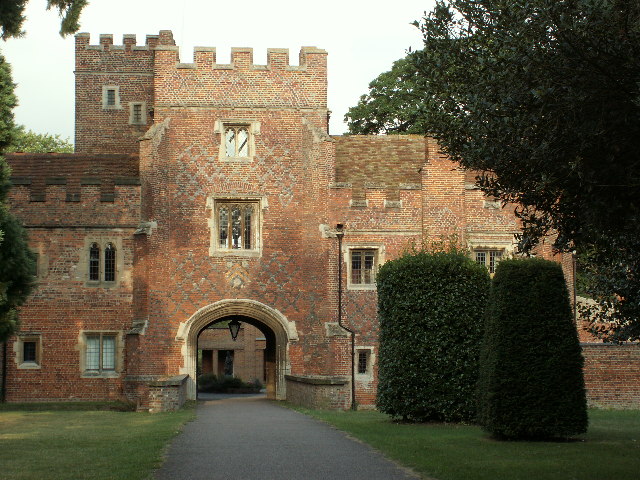
Buckden Towers, formerly known as Buckden Palace, is a medieval fortified house and bishop's palace in Buckden, Cambridgeshire, England. It is now a conference and retreat centre operated by the Claretian missionaries.
The 15th-century buildings are the remains of the palace of the bishop of Lincoln. Although it is often stated as being built in the 15th century, the first (wooden) Palace was built in the late 12th century, when records show it as being used by the bishops of Lincoln. The wooden structure was replaced by more substantial buildings and a tall brick tower was added in 1475, protected by walls and a moat, and surrounded by an outer bailey. Parts of the complex were demolished in 1632 on the orders of the Ecclesiastical Commissioners. The Victorian house now present on the site was built in 1872. The remains of the bishops' moated palace consist of the great tower, the inner gatehouse, part of the battlemented wall, which used to surround the inner court within the moat, and the outer gate and wall.
The antiquary Edward John Rudge published a history, Illustrated and Historical Account of Buckden Palace, in 1839.
The site is a scheduled monument and the great tower, inner gatehouse and curtain walls are Grade I listed buildings.
The Claretian Missionaries were given the site by the Catholic Bishop of Northampton in 1956. Initially it was used as a junior seminary carrying out the preliminary training of 11- to 18-year-olds aspiring to become Claretian Missionary priests or brothers. The junior seminary closed in July 1965. Since then the Towers complex has been developed by the Claretians as a retreat and conference centre. Also on the site is the Catholic Church of St Hugh of Lincoln, which stands on the site of the great chamber of the medieval palace and was built as the chapel for the junior seminary. The grounds, but not the buildings, of the Towers are open to visitors at all reasonable times but dogs are not permitted.
Henry III in 1248 Edward I in 1291 Richard III in 1483 Lady Margaret Beaufort (mother of Henry VII) in 1501 Queen Catherine of Aragon – resided here from July 1533 to May 1534 until she was transferred a few miles away to Kimbolton Castle, where she died in 1536. She was buried at Peterborough Cathedral. Henry VIII and Queen Catherine Howard in 1541.
Text adapted from “Buckden Towers” on Wikipedia, CC BY-SA 4.0.
Buckden Towers ranks #2,702 of 9,079 worldwide in the atlas's castle fame ranking, and #182 of the 360 mapped in England. Founded 1175, it is older than 79% of the atlas's dated landmarks — one of 756 atlas entries founded in the 12th century. Its Wikipedia articles were opened 1,462 times in the last 60 days, more than 61% of the atlas. 4 more atlas landmarks stand within 25 km. The nearest day-trip guide is Cambridge (England), 27 km away. See how England compares in the castle statistics.
View on the interactive castle map →