 Germany · 12th century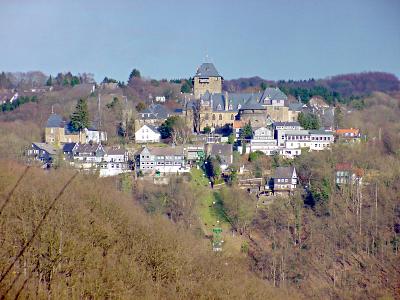
Burg Castle (German: Schloss Burg), located in Burg an der Wupper (Solingen), is the largest reconstructed castle in North Rhine-Westphalia, Germany and a popular tourist attraction. Its early history is closely connected to the rise of the Duchy of Berg.
At the beginning of the 12th century (after 1133), Count Adolf III of Berg built Schloss Burg on a mountain overlooking the river Wupper. The old castle of the counts, Castle Berge in Odenthal near Altenberg, was abandoned. The original name of the new castle was Castle Neuenberge (Newmountain), or in Latin, novus mons, novum castrum, or novi montis castrum. Not until the 15th century, after significant reconstruction as a hunting castle, did it receive its current name reflecting its palatial extension.
His great-grandson, Count Adolf VI of Berg took part in the Fifth Crusade and died during the siege of Damietta in Egypt in 1218. Since the late count had no male descendants his younger brother, Archbishop Engelbert I of Cologne, took over the reign of the county needing two feuds to win the inheritance dispute with Duke Waleran III of Limburg. As count Engelbert II of Berg he built the palas of Burg castle 1218–1225. Engelbert was a very powerful man, not only archbishop and count, but also advisor and chief administrator to the Holy Roman Emperor Frederick II, and guardian and tutor of the later king Henry (VII) of Germany. But he also made enemies and on 7 November 1225, he was murdered by his nephew Friedrich von Isenberg.
The War of succession for the Duchy of Limburg influenced the history of the castle. Count Adolf VIII of Berg participated successfully in the decisive battle of Worringen on 5 June 1288. After the battle, the opposing archbishop of Cologne, Siegfried II of Westerburg, was kept prisoner in the castle. Adolf VIII now was able to proceed to elevate his town, Düsseldorf, to a city and was able to control traffic on the Rhine river. In the 13th and 14th centuries Schloss Burg remained the main residence of the counts of Berg. Five years after King Wenzel elevated Count William to the position of a duke in 1380, Düsseldorf became the capital of the Duchy of Berg. Schloss Burg continued to serve as a hunting castle and was used for ceremonial events, hence it became a "Schloss" (representative castle).
Text adapted from “Burg Castle (Solingen)” on Wikipedia, CC BY-SA 4.0.
Burg Castle ranks #978 of 9,079 worldwide in the atlas's castle fame ranking, and #77 of the 711 mapped in Germany. Founded 1133, it is older than 84% of the atlas's dated landmarks — one of 756 atlas entries founded in the 12th century. Its Wikipedia articles were opened 9,690 times in the last 60 days, more than 93% of the atlas. 6 more atlas landmarks stand within 25 km. The nearest day-trip guide is Wuppertal, 15 km away. See how Germany compares in the castle statistics.
View on the interactive castle map →