 Palestine · 13th century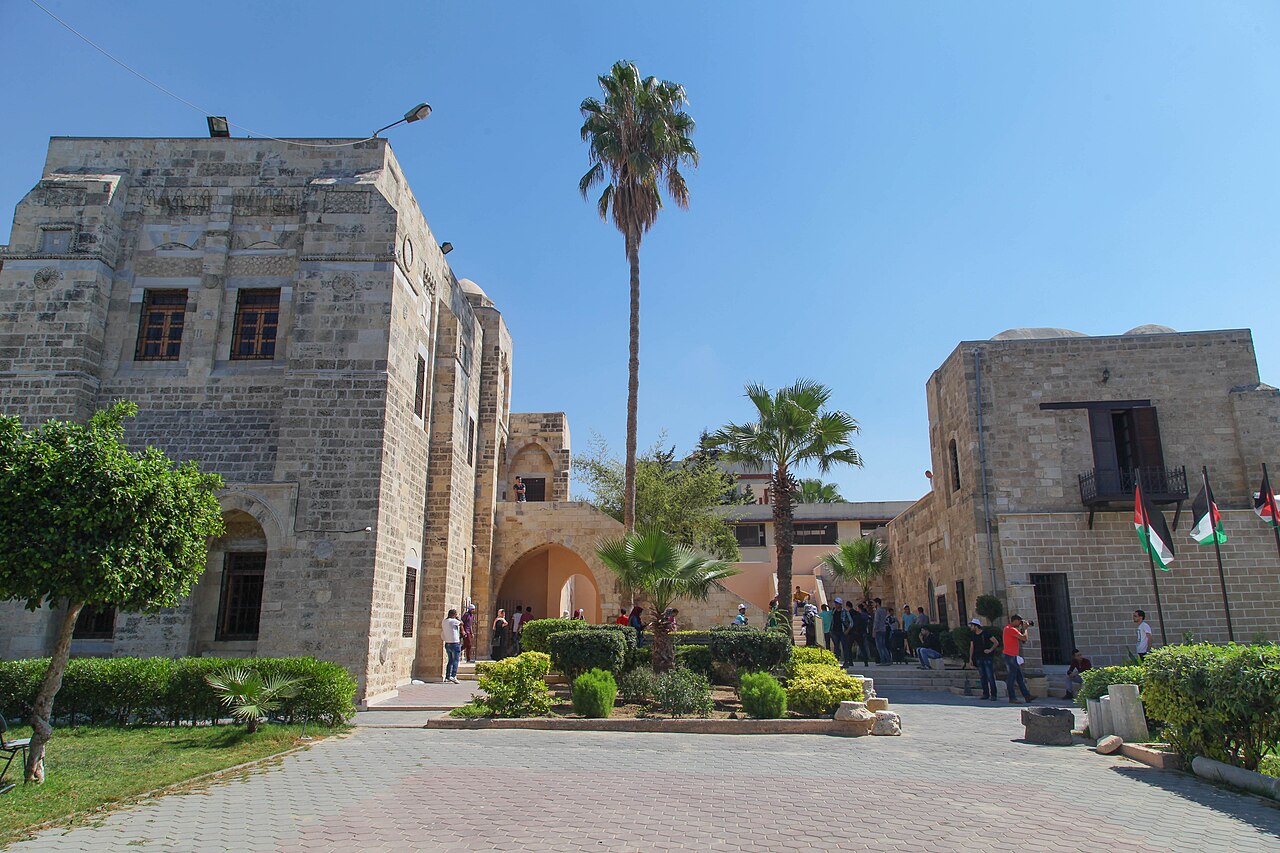
Qasr al-Basha (Arabic: قصر الباشا), also known as Pasha's Palace Museum, Radwan Castle, and Napoleon's Fort, was a historic building in the Old City of Gaza, Palestine. At the time of its destruction, it housed a museum. It served as a seat of power in the Mamluk and Ottoman periods and as a police station during the British Mandate. It was destroyed in the Israeli invasion of Gaza in 2024.
The first floor of Qasr al-Basha was built by the Mamluk sultan Zahir Baibars in the mid-13th century. The façade bore the symbol of Baibars which is a relief sculpture of two lions facing each other. The geometrical patterns and domes, fan and cross vaults were typical Mamluk architecture under Bahri rule. According to local legend, in the 13th century CE, when Baibars was still a general fighting the Crusaders and Mongols throughout the Levant, he passed through Gaza on several occasions. During one of his visits, Baibars is believed to have married in Gaza and built a grand mansion for his Gazan wife and children. It is said that Qasr al-Basha is what remains of this home.
The second floor of the building was largely of Ottoman-era construction. In the 17th century, Qasr al-Basha served as the fortress home of the ruling Radwan dynasty (hence the name "Radwan Castle") and later pashas of Gaza, who were governors appointed by the Ottoman governor of the Damascus Province. During this era, the fortress was provided with arrow slits and underground passages as means of defense. Within the complex were soldier's lodgings, a mosque, granary, an armory, and cannons. The height of the structure made Qasr al-Basha a strategic point in Gaza. This, along with its fortifications, was the probable reason Napoleon Bonaparte spent three nights at the palace during his invasion that ended at Acre in 1799, hence the name "Napoleon's Fort".
Turkish traveller Evliya Çelebi wrote of Qasr al-Basha in 1649, saying "the Citadel was built in ancient times and destroyed by Nebuchadnezzar. The present citadel derives from a later time. It is small and rectangular and lies one hour distant, east of the sea. Its walls are twenty yards high. It has a metal door which opens in the direction of the qibla. The commander and the garrison must always be present here to fulfill their guard duties because it is in a dangerous place, here the Arab tribes and the enemy are numerous.
Text adapted from “Qasr al-Basha” on Wikipedia, CC BY-SA 4.0.
Qasr al-Basha ranks #1,700 of 9,079 worldwide in the atlas's castle fame ranking, and #4 of the 5 mapped in Palestine. Founded c. 1270, it is older than 66% of the atlas's dated landmarks — one of 1080 atlas entries founded in the 13th century. Its Wikipedia articles were opened 2,681 times in the last 60 days, more than 75% of the atlas. The nearest day-trip guide is Ashkelon, 20 km away. It is one of the 106 landmarks on the atlas's regional map of the Levant. See how Palestine compares in the castle statistics.
View on the interactive castle map →