 Portugal · 14th century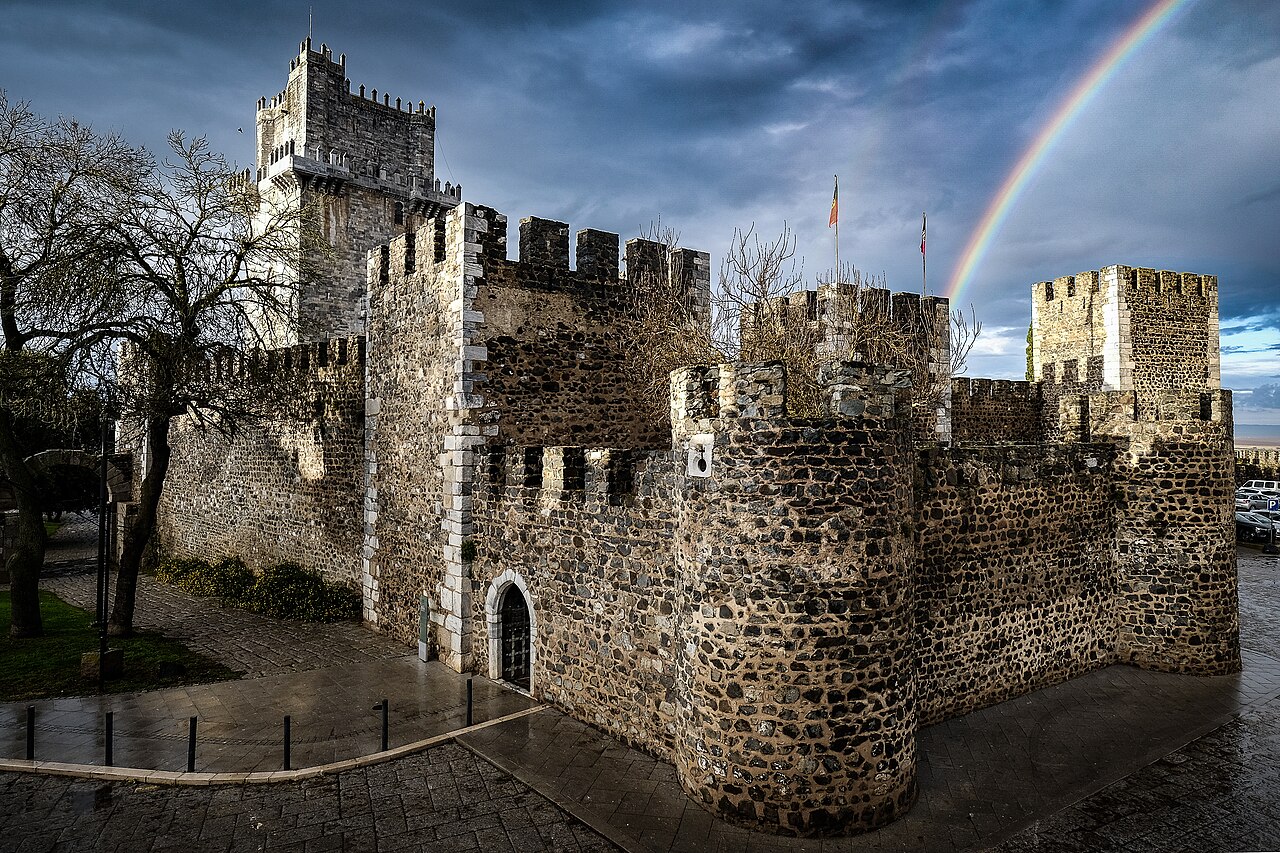
The Castle of Beja (Portuguese: Castelo de Beja) is a medieval castle in the civil parish of Beja, municipality of Beja, Portuguese district of Beja.
This region of the Alentejo had been settled since pre-history by disperse tribes, but it was first mentioned in the writings of Ptolemy and Polybius. But, it was sometime between the beginning of the 3rd century and the end of the 4th century, that the walls of Pax Julia were constructed; part of the Roman arch (Évora Gate) dated from this general construction in the Roman provinces. Its importance within the region continued during the Suebi era, Visigothic settlement and Moors occupation of the Iberian peninsula.
During the Reconquista from the Moors, the region was first conquered in 1159 by the forces of King Afonso Henriques (1112-1185), but it was abandoned four months later by his forces.
In 1253, King D. Afonso III began work on reconstructing the fortress, which was already a severe stage of degradation. A foral (charter) was issued to Beja in 1254.
Around 1307, a tower was constructed along the wall, as indicated in an inscription carved into decorated ashlar masonry, in the form of a Portuguese shield, and dating to the Visigoth occupation.
King D. Dinis ordered the construction of the keep tower in 1310, following the issue of new charter. Work on the walls proceed from 1347, under the overseer João Domingues de Beja and Afonso Mendes (from an inscription).
The village supported the King John I during 1383-1385 Portuguese succession crisis.
At the beginning of the 16th century, King D. Manuel I began a project to improve the fortification, that possibly included the construction of the vaulted ceiling in the keep tower. During this time, a second larger gate was constructed between the Roman arch (which had disappeared) and the Hospital of Misericórdia. A project to reinforce the bastions was initiated in 1664 by Nicolau de Langres, approved by Luís Serrão Pimentel (Royal engineer and cosmographer) and General Agostinho de Andrade Freire. Between 1669 and 1679, the endeavour was supervised by engineers João Coutinho, Diogo de Brito de Castanheda and Manuel Almeida Falcão.
In 1790, part of the fortifications were demolished in order to construct the new church of the (extinct) Colégio dos Jesuítas, for the Episcopal See.
Text adapted from “Castle of Beja” on Wikipedia, CC BY-SA 4.0.
Castle of Beja ranks #3,810 of 9,035 worldwide in the atlas's castle fame ranking, and #47 of the 212 mapped in Portugal. Founded 1310, it is older than 60% of the atlas's dated landmarks, one of 757 atlas entries founded in the 14th century. 2 more atlas landmarks stand within 25 km. The nearest day-trip guide is Évora, 62 km away. It is one of the 48 landmarks on the atlas's regional map of the Alentejo. See how Portugal compares in the castle statistics.
View on the interactive castle map →