Palace & château
Wrocław Palace
🇵🇱 Poland · 18th century
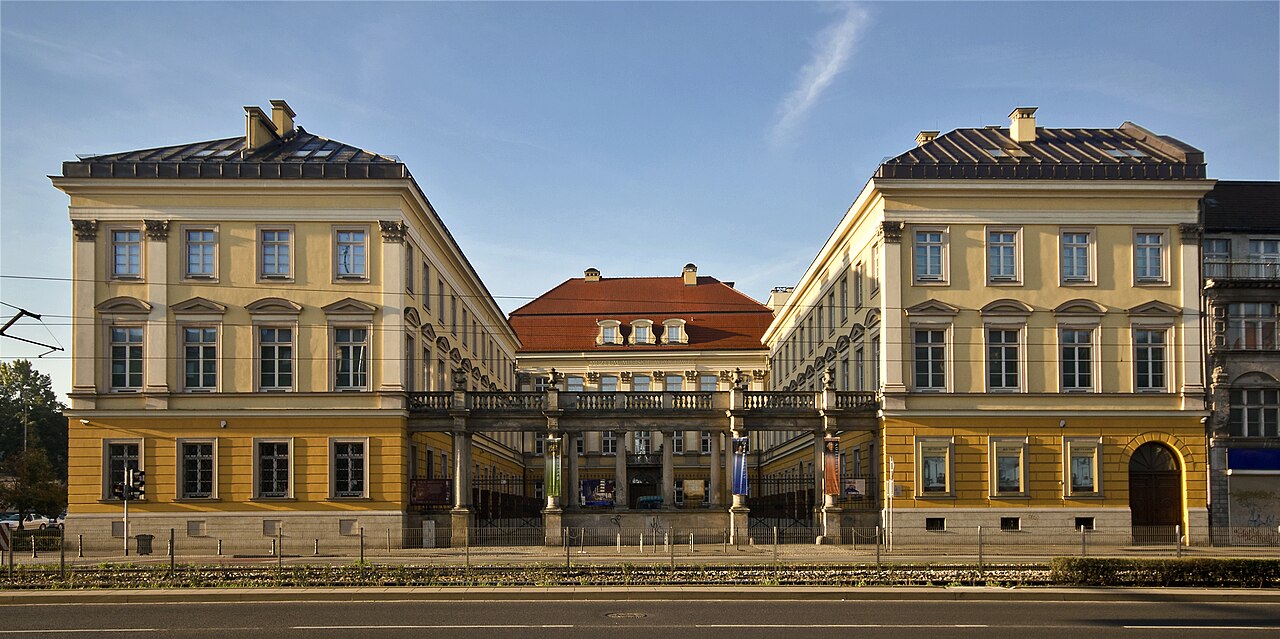
The Royal Palace (Polish: Pałac Królewski; German: Stadtschloss) is a palace in Wrocław, Poland. Originally a palace of the Prussian monarchy, it now houses the city museum.
Initially a Baroque palace of Heinrich Gottfried von Spätgen, chancellor of Bishop Francis Louis of Neuburg, it was built in 1717 in a Viennese style. In 1750, after Prussia took control over Silesia from Austria in the First Silesian War, the palace was purchased by the Prussian king Frederick the Great and was converted into his residence. The palace was extended from 1751 to 1753 in the Baroque style with Rococo interiors designed by the royal architect Johann Boumann. Boumann's additions included a transverse wing with a festive hall, throne hall and Frederick the Great's private quarters.
The successor of Frederick the Great, who died in 1786, was his nephew Frederick William II of Prussia (1744–1797). He performed remodelling of the royal palace according to the design of Karl Gotthard Langhans (1732–1808). The remodelling took place in 1795 to 1796 in the classical style. As a result, the wings surrounding the northern courtyard, a new staircase and utility rooms were added.
In March 1813, during the War of the Sixth Coalition with Napoleon, King Frederick William III of Prussia announced two famous manifestos: "To My People" and “To My Military Commanders”. In April 1813, in the Yellow Living Room of the Palace, the king proclaimed the Iron Cross as a war medal.
In the middle of the 19th century, drawing on a Florentine Renaissance style, architect Friedrich August Stüler added a new southern wing (1844–1846) and a new courtyard wings along with the gate and railing (1858).
In 1918 the palace was donated to the city of Breslau. On 20 September 1926 the Palace Museum (Schlossmuseum) was opened, displaying an exposition devoted to Frederick the Great, reconstruction of original interiors, and a collection of Silesian art.
In May 1945 the palace was heavily damaged during the siege of the city at the end of the Second World War. Breslau was transferred from Germany to Poland after the war and renamed Wrocław. In the 1960s the palace was partially demolished, while the remaining wings were adapted to host the Archaeological Museum (until 1999) and the Ethnographic Museum (until 2004).
Text adapted from “Royal Palace, Wrocław” on Wikipedia, CC BY-SA 4.0.
Wrocław Palace ranks #2,314 of 8,134 worldwide in the atlas's castle fame ranking, and #78 of the 374 mapped in Poland. Founded 1717, it is older than 21% of the atlas's dated landmarks — one of 556 atlas entries founded in the 18th century. Its Wikipedia articles were opened 2,970 times in the last 60 days, more than 75% of the atlas. 8 more atlas landmarks stand within 25 km. The nearest day-trip guide is Świdnica, 48 km away. It is one of the 72 landmarks on the atlas's regional map of Lower Silesia. See how Poland compares in the castle statistics.
View on the interactive castle map →Frequently asked questions
Where is Wrocław Palace?
Wrocław Palace stands in Poland, at 51.1074°, 17.02888°.
When was Wrocław Palace built?
The atlas dates its founding to 1717. Earlier structures may have stood on the site; this is the earliest documented founding year.
How famous is Wrocław Palace?
In this atlas's fame ranking: #2,314 of 8,134 worldwide, and #78 in Poland. Fame here combines how many Wikipedia language editions cover a landmark with how many people read them.
What is the nearest castle to Wrocław Palace?
Imperial Castle in Wrocław, about 1 km away.
More castles in Poland
- Tykocin Castle Poland · 15th century
- Blank Palace Poland · 18th century
- Pałac Biskupów Krakowskich w Warszawie Poland · 17th century
- Primate's Palace (Warsaw) Poland · 16th century
More palaces & châteaux
- Palais Esterházy Austria · 17th century
- Palazzo Doria d'Angri Italy · 18th century
- Palazzo Valentini Italy · 16th century
- Prince Henry Palace Germany · 18th century