Castle
Castle Pinckney
🇺🇸 United States · 18th century
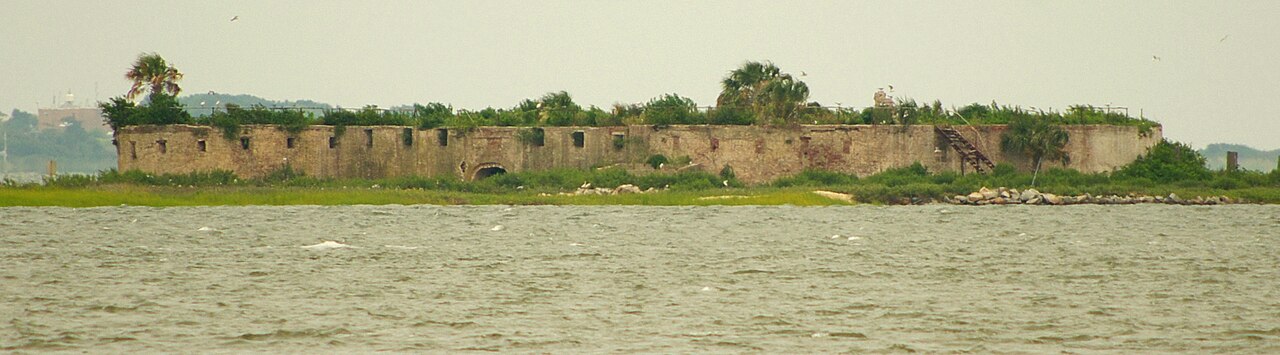
Castle Pinckney is a small masonry fortification constructed by the United States government, in the harbor of Charleston, South Carolina, in 1810. It was used very briefly as a prisoner-of-war camp (six weeks) and artillery position during the American Civil War. It was named to the National Register of Historic Places in 1970.
Located on Shutes Folly, a small island about one mile off the Charleston shore in the harbor, the fort was built over the ruins of an older fortification called "Fort Pinckney". The original log and earthen fort, named after the Revolutionary War hero Charles Cotesworth Pinckney, was built beginning in 1797 and was intended to protect the city from a possible naval attack when war with France seemed imminent. Completed in 1804, it saw no hostilities and was virtually destroyed by a severe hurricane in September of that year. A replacement brick-and-mortar structure called "Castle Pinckney" was erected in 1809–1810 and was garrisoned throughout the War of 1812, but it saw no action during the two-and-a-half-year conflict. Afterwards, Castle Pinckney was abandoned and fell into disrepair.
Two decades later, a sea wall was completed and the fort was re-garrisoned during the Nullification Crisis of 1832, when President Andrew Jackson prepared to collect a controversial tariff using military force if necessary. After that brief period of activity, the fort again fell into disuse and was primarily a storehouse for gunpowder and other military supplies.
By the late 1850s, Castle Pinckney was part of a network of defensive positions in the harbor, which included the larger and more strategically placed Forts Sumter and Moultrie, and other, smaller earthworks and fortifications. In 1860, Castle Pinckney's armament consisted of fourteen 24-pounders, four 42-pounders, four 8-inch howitzers, one 10-inch and one 8-inch mortar, and four light field pieces to protect its flanks.
On December 27, 1860, one week after South Carolina seceded from the Union, the fort was surrendered to South Carolina (S.C.) militia by its small U.S. Army garrison, which retired to Fort Sumter to join Major Robert Anderson. Castle Pinckney became the first Federal military installation seized forcefully by a Southern state government. Three days later, the Union's Charleston Arsenal also fell to S.C. forces.
Text adapted from “Castle Pinckney” on Wikipedia, CC BY-SA 4.0.
Castle Pinckney ranks #3,678 of 8,134 worldwide in the atlas's castle fame ranking, and #70 of the 103 mapped in United States. Founded 1797, it is older than 13% of the atlas's dated landmarks — one of 556 atlas entries founded in the 18th century. Its Wikipedia articles were opened 2,362 times in the last 60 days, more than 70% of the atlas. 2 more atlas landmarks stand within 25 km. See how United States compares in the castle statistics.
View on the interactive castle map →Frequently asked questions
Where is Castle Pinckney?
Castle Pinckney stands in the United States, at 32.77361°, -79.91139°.
When was Castle Pinckney built?
The atlas dates its founding to 1797. Earlier structures may have stood on the site; this is the earliest documented founding year.
How famous is Castle Pinckney?
In this atlas's fame ranking: #3,678 of 8,134 worldwide, and #70 in the United States. Fame here combines how many Wikipedia language editions cover a landmark with how many people read them.
What is the nearest castle to Castle Pinckney?
Fort Sumter, about 4 km away.
More castles in the United States
- Fort Washakie United States · 19th century
- Fort Boise United States · 19th century
- Fort McClary United States · 19th century
- Fort Fisher United States · 19th century
More castles
- Trazegnies Castle Belgium · 11th century
- Reinhardstein Castle Belgium · 14th century
- Geeraard de Duivelsteen Belgium · 13th century
- Kasteel van Laarne Belgium · 17th century