 Czech Republic · 16th century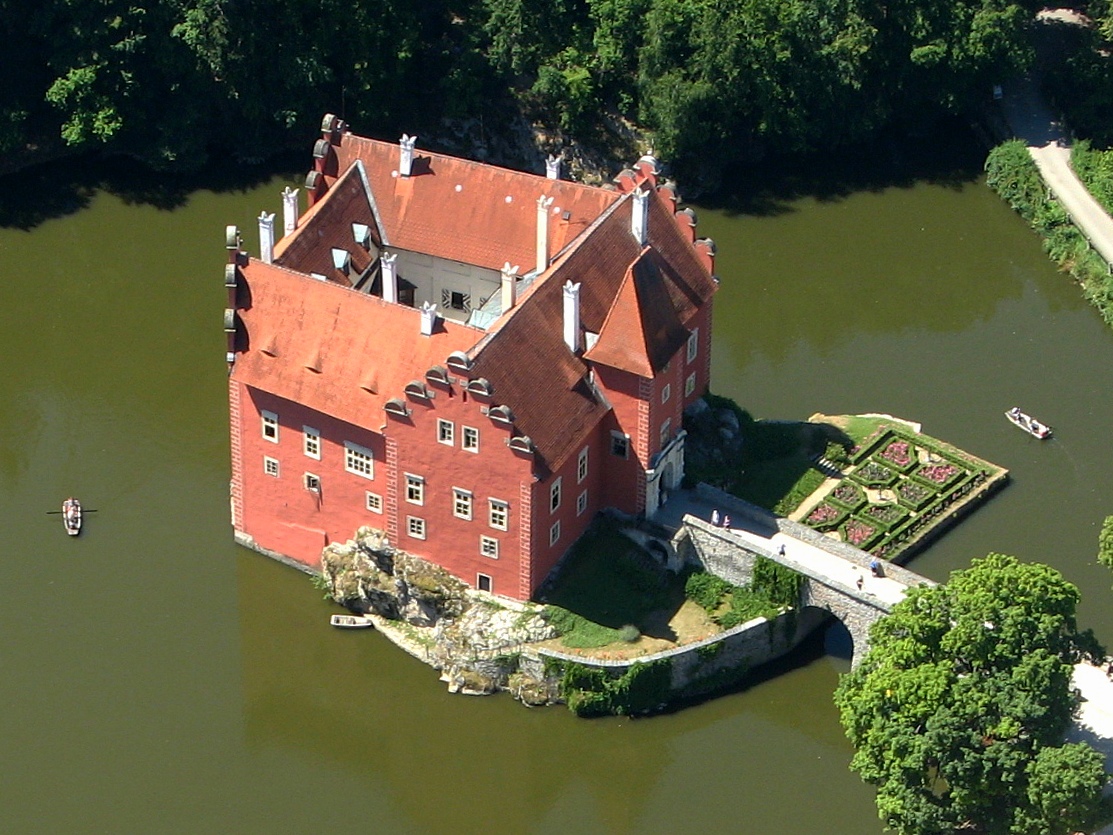
Červená Lhota (German: Roth-Lhotta) is a Renaissance castle in the South Bohemian Region, Czech Republic. It lies in the village of Červená Lhota in the Pluhův Žďár municipality, about 20 kilometres (12 mi) northwest of Jindřichův Hradec. It stands in the middle of a lake on a rocky island. There is also a park, where the Chapel of the Holy Trinity is located.
The village where the castle is located was originally called just Lhota. In the 16th century, it was called Nová Lhota ("new Lhota"). From the 17th century, it was called Nová Červená Lhota ("new red Lhota") after the castle, and then just Červená Lhota ("red lhota"). The castle's name Červená Lhota is explained by the colour of the castle's bright-red roof tiles.
The existence of an original fortress on the site of today's castle is assumed from sometime around the middle of the 14th century. It was built on a rocky granite outcrop, which, after the damming of a stream and the filling up of a fishpond, became an island. The first written record is an entry in the land records from 1465, mentioning the division of the property of the deceased Ctibor of Zásmuk between his two sons, Petr and Václav. The fortress might then have been sold to Diviš Boubínský of Újezd, who in turn sold it to the knightly family of Káb of Rybňan sometime around 1530. The family had the original Gothic castle rebuilt and the basic Renaissance remodelling carried out between 1542 and 1555, and the castle acquired the name Nová Lhota.
In 1597, it was sold to Vilém Růt of Dírná, who had the building rendered with red plaster, from which it got its name Červená Lhota. The last of the Ruts, Bohuslav, had to leave the Bohemian lands as an Utraquist after the 1620 Battle of White Mountain.
In 1621, Červená Lhota was inhabited by Antonio Bruccio, who died in 1639 without an heir. With his death, Lhota lost its function as a residence, and it was used by his successors as occasional cottage. In 1641, it was acquired by the aristocrat Vilém Slavat of Chlum and Košumberk, and later it passed into the hands of the Windisch-Graetz family. Bedřich Arnošt Windisch-Graetz and his son Leopold dragged the dominion into great debts due to their outdated style of economics, so the custodian of his under-aged successor Joseph Nicholas recommended the sale of the dominion. In 1755 the castle then was obtained by the Barons of Gudenus.
Text adapted from “Červená Lhota Castle” on Wikipedia, CC BY-SA 4.0.
Červená Lhota Castle ranks #1,779 of 9,079 worldwide in the atlas's castle fame ranking, and #40 of the 243 mapped in Czech Republic. Founded 1530, it is older than 41% of the atlas's dated landmarks — one of 891 atlas entries founded in the 16th century. Its Wikipedia articles were opened 2,794 times in the last 60 days, more than 76% of the atlas. Wikidata records about 46,000 visitors in 2022. 6 more atlas landmarks stand within 25 km. The nearest day-trip guide is Prague, 99 km away. It is one of the 189 landmarks on the atlas's regional map of Bohemia. See how Czech Republic compares in the castle statistics.
View on the interactive castle map →