 France · 13th century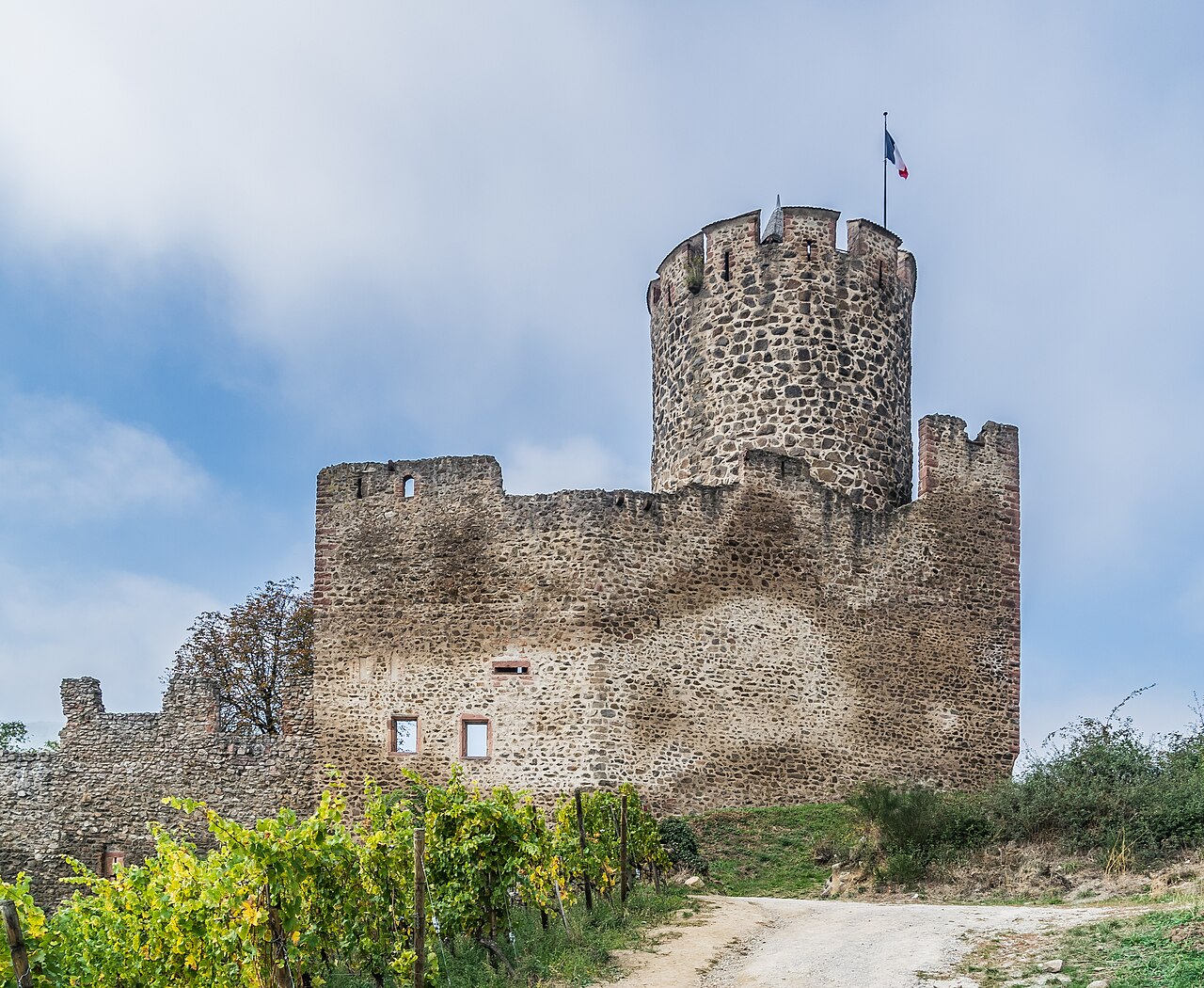
The Château de Kaysersberg (also: Schlossberg) is a ruined castle in the commune of Kaysersberg in the Haut-Rhin département of France.
The castle was built for Albin Woelflin, imperial bailiff for Frederick II, Holy Roman Emperor, around 1220. The site was acquired in 1227 by the lords of Horbourg and Ribeaupierre. It had an important strategic role as it allowed the Empire to close off one of the routes across the Vosges Mountains towards Lorraine. The circular keep is the oldest part of the castle and one of the first of this type in the upper Rhine valley. It was designed at the same time as the keep at the Château de Pflixbourg. The first curtain wall, which included the keep, was replaced after 1261 by a wall enclosing the keep, according to a contemporary plan, which allowed an uninterrupted circuit of the walls and strengthened defences on the side likely to be attacked.
In the 14th century, the castle was the residence of the imperial provost or bailiff. Following a fire, the enceinte was raised to 4 m. In the second half of the 15th century, the castle defences were modernised in response to developments in artillery and firearms; the crenels were closed with wooden shutters, the merlons were equipped with firing slits and the round walk was completely covered. In this period, the castle was merely a sub-bailliage and personnel were heavily reduced. During the German Peasants' War (1524/5), the castle was besieged. It was restored by Lazarre de Schwendi in 1583.
According to archaeological excavations and studies, the castle was abandoned at the end of the 16th century. After the French Revolution, it was declared a national asset and sold to François Joseph Boecklin de Boecklinsau, who planted vines, and later passed to the Bastard family.
The castle is largely built from granite. It stands at an altitude of 295 m (approx. 975 ft) and dominates from 50m the north side of the town. The castle has a triangular plan dominated by the circular keep in the highest point. The keep is 11 m (36 ft) in diameter with walls 4.42 m (14+1⁄2 ft) thick. The original parapet has been kept to a height of 0.55 m, with the crenels and merlons restored. The spiral staircase is concrete. Access is to the first floor, through an arched doorway. The spacious third floor served as a storeroom and provided access to the platform which was originally covered.
Text adapted from “Château de Kaysersberg” on Wikipedia, CC BY-SA 4.0.
Château de Kaysersberg ranks #5,091 of 9,079 worldwide in the atlas's castle fame ranking, and #442 of the 793 mapped in France. Founded 1227, it is older than 73% of the atlas's dated landmarks — one of 1080 atlas entries founded in the 13th century. Its Wikipedia articles were opened 1,410 times in the last 60 days, more than 60% of the atlas. 19 more atlas landmarks stand within 25 km. The nearest day-trip guide is Colmar, 10 km away. It is one of the 63 landmarks on the atlas's regional map of Alsace. It is stop 28 of 32 on the Alsace castle route, Wissembourg to Mulhouse. See how France compares in the castle statistics.
View on the interactive castle map →