 France · 12th century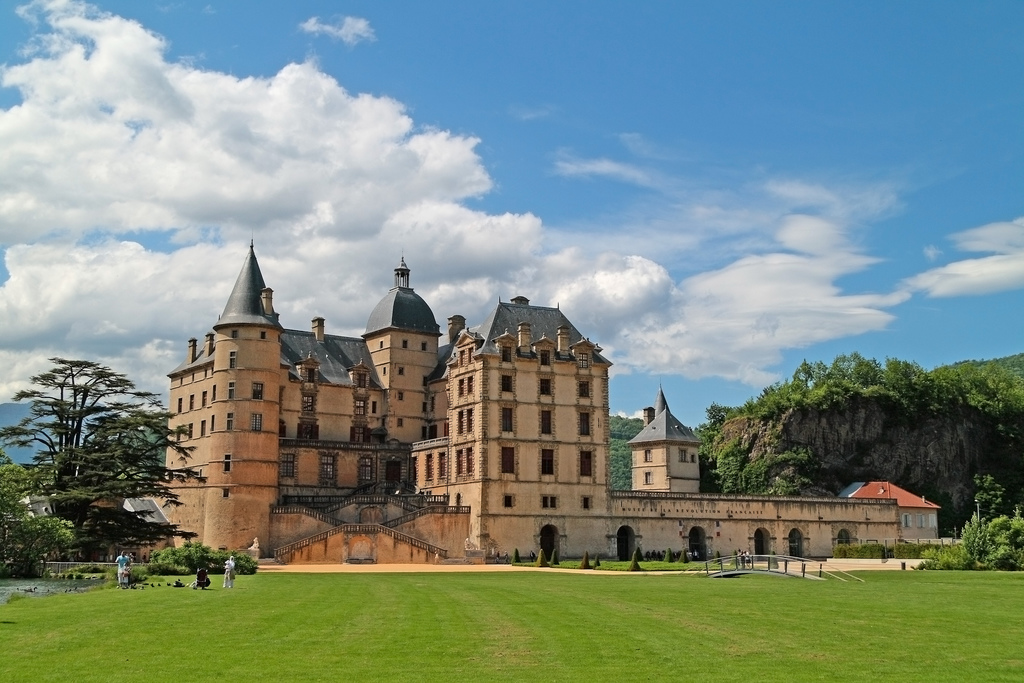
The Château de Vizille is a castle in the French town of Vizille near Grenoble. It is one of the most prestigious and important castles of the Dauphiné Region. Traditionally, from the 14th century, the Dauphiné was the homeland of the inheritor of the French throne. Today the Château de Vizille houses the Musée de la Révolution française.
The former castle was held during the French Wars of Religion by the Catholics. With the peace settlement in 1593, the property was bought by the leader of the Protestant Army, François de Bonne, duc de Lesdiguières.
From 1604 till 1619 the Duke, who became a Peer and the last Grand Constable of France, had his castle built to highlight his important role in the French court. The castle is surrounded by a wall of seven kilometers in length.
In 1780 the Duke of Villeroy, Gabriel Louis de Neufville, sold the Chateau de Vizille and areas around it to Claude Perier for approximately 1,0254,000 livres. About a decade later, Claude had over 400 workers at the Château creating printed cotton. This building would end up playing an important role in the beginning of the French Revolution.
May 1788 King Louis XVI decided to set a boundary on the amount of power of the Parliament of Dauphiné in Grenoble. The Parliament openly expressed how dissatisfied they were with this decision and on June 7, 1788, they were not allowed to meet together. In return, the inhabitants of Grenoble threw tiles from the roofs onto the King's Guard. This event is known as "Tile Day" or "Day of the Tiles" in Grenoble.
In July, Claude Perier, inspired by all of the Liberal ideas around him, invited delegates from the Clergy, the Nobility and the Third-Estate, to assemble the meeting, which had been previously prohibited in Grenoble, in the room of the Jeu de Paume of the castle. Almost 500 men gathered that day at the banquet hosted by Claude Périer. In attendance there were many "notables" including churchmen, businessmen, doctors, notaries, municipal officials, lawyers, and landed nobility. This event is known as the Assembly of Vizille.
Demanded at this meeting: the Convocation in Paris of the Estates-General, where the Third Estate has double representation and where votes are by head, not by order. This meeting marked the first portion of the French Revolution.
Text adapted from “Château de Vizille” on Wikipedia, CC BY-SA 4.0.
Château de Vizille ranks #2,800 of 9,035 worldwide in the atlas's castle fame ranking, and #219 of the 787 mapped in France. Founded c. 1200, it is older than 75% of the atlas's dated landmarks, one of 763 atlas entries founded in the 12th century. Its Wikipedia articles were opened 3,512 times in the last 60 days, more than 81% of the atlas. 2 more atlas landmarks stand within 25 km. The nearest day-trip guide is Annecy, 96 km away. See how France compares in the castle statistics.
View on the interactive castle map →