 Italy · 16th century
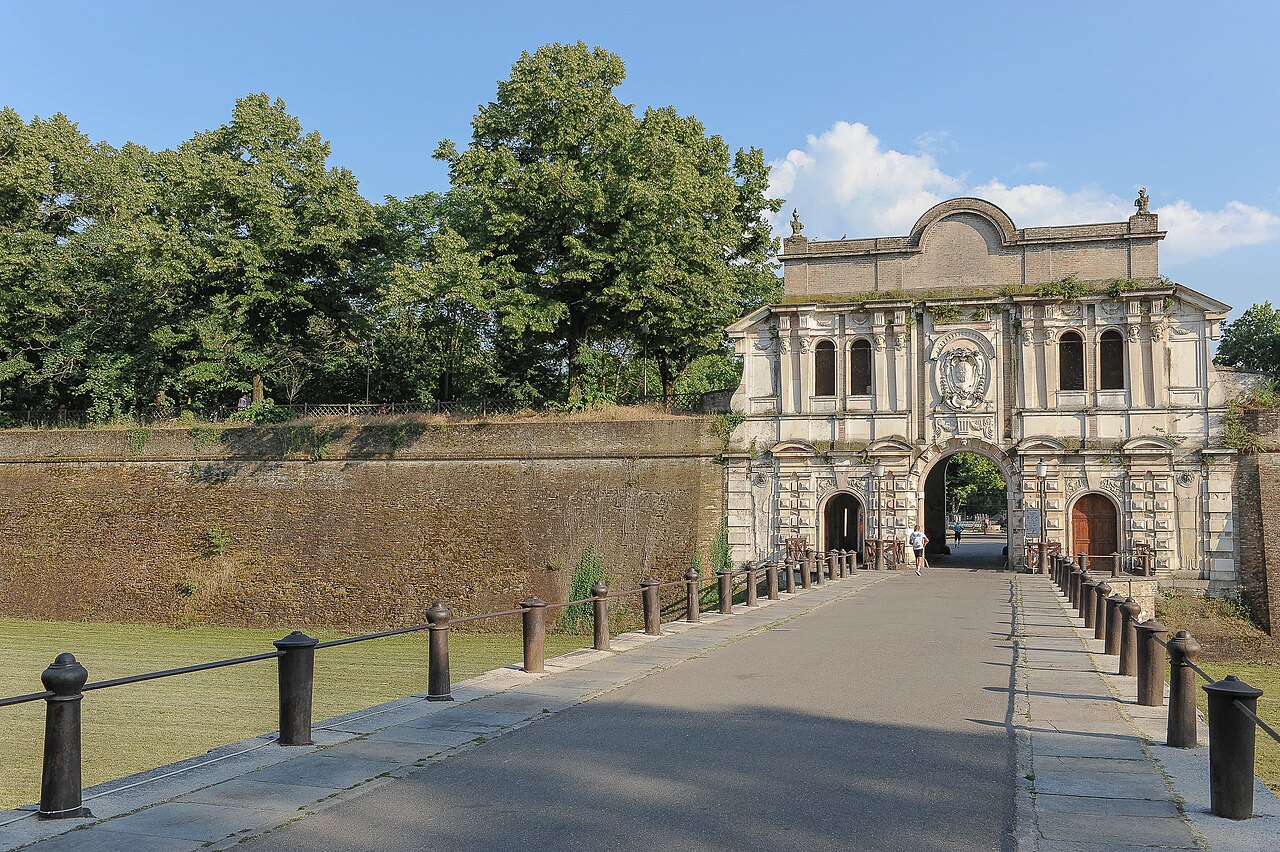
The Citadel of Parma (Italian: Cittadella di Parma) is a pentagonal fortress built in the Emilian city in the last years of the 16th century.
The structure was erected at the behest of the Duke of Parma and Piacenza Alessandro Farnese and entrusted to the engineers Giovanni Antonio Stirpio de' Brunelli and Genesio Bresciani with the collaboration of Smeraldo Smeraldi. To build it, the Maggiore canal was diverted, whose course was joined with that of the Comune canal up to the Porta Nuova (today's Barriera Farini).
Created for defensive purposes, and for this reason equipped with ramparts and moats, it was later used as barracks, as a prison for political crimes and as a place for executions. Between the late 20th and early 21st centuries, the fortress, which retains its original pentagonal shape, was renovated and used as a public park, with spaces dedicated to sports and children's activities.
The structure has five bastions. The main entrance, characterized by a monumental facade in Angera stone, is to the north, while the other, the Porta del Soccorso, is to the south. The main entrance gate, designed by Simone Moschino and built by Giambattista Carra in 1596, has been preserved without later modifications.
Text adapted from “Citadel of Parma” on Wikipedia, CC BY-SA 4.0.
Cittadella di Parma ranks #4,318 of 9,035 worldwide in the atlas's castle fame ranking, and #322 of the 555 mapped in Italy. Founded c. 1550, it is older than 36% of the atlas's dated landmarks, one of 886 atlas entries founded in the 16th century. 7 more atlas landmarks stand within 25 km. The nearest day-trip guide is Brescia, 83 km away. See how Italy compares in the castle statistics.
View on the interactive castle map →