 France · 15th century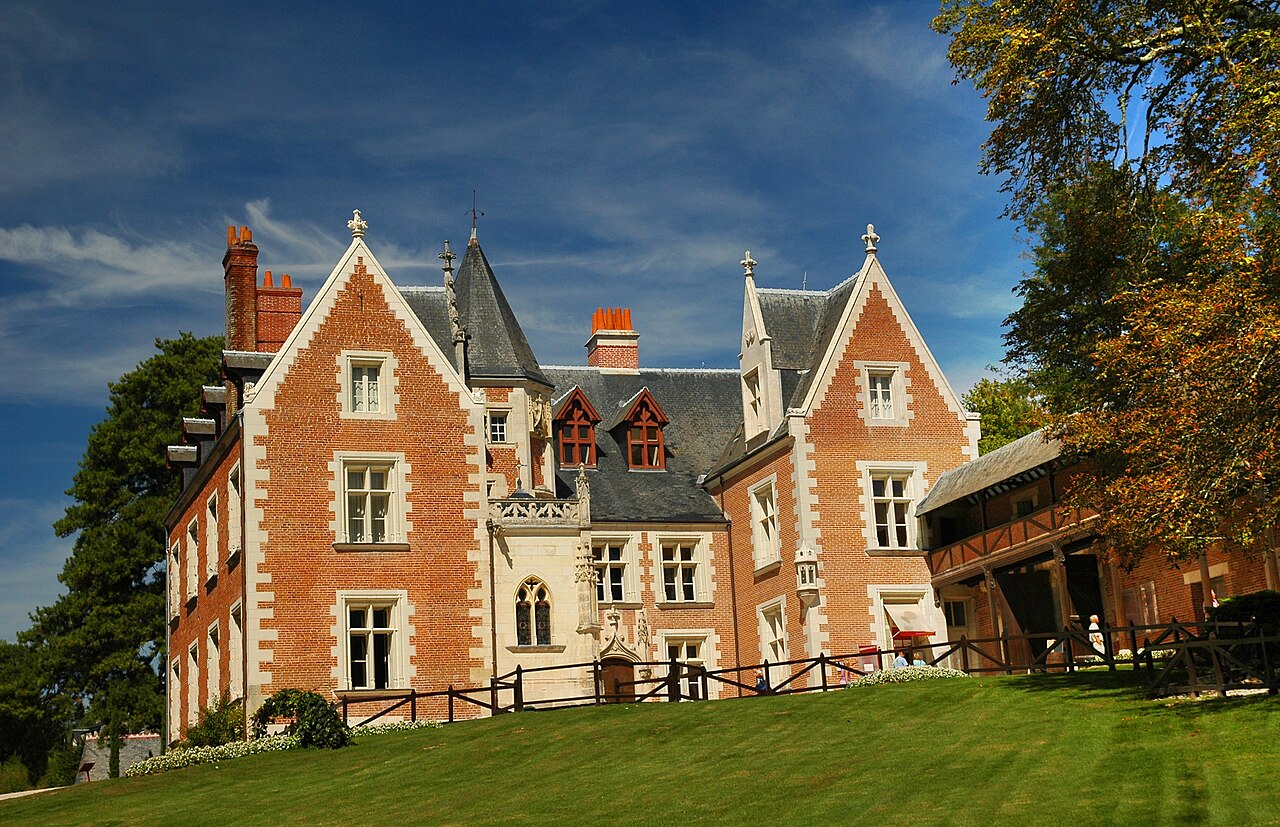
The Château du Clos Lucé (French pronunciation: [ʃato dy klo lyse]; or simply Clos Lucé), formerly called Manoir du Cloux, is a large château located in the center of Amboise, in the department of Indre-et-Loire, in the Centre-Val de Loire region of France. It is located in the Val de Loire (formerly called Touraine) region. Built by Hugues d'Amboise in 1471, the palace has known several famous owners such as the French king Charles VIII and Leonardo da Vinci. Clos Lucé is 500 metres from the royal Château d'Amboise, to which it is connected by an underground passageway.
King Charles VIII bought the home from Étienne Le Loup in 1490 and during this time it became known as the ‘summer house’, housing French royalty. After a few decades Francis I gave it to Leonardo da Vinci when he invited him to live in France in 1516. The ageing polymath lived his last years in this house until his death on 2 May 1519.
The Death of Leonardo da Vinci, an 1818 oil painting by the French artist Jean-Auguste-Dominique Ingres, depicts Leonardo da Vinci on his deathbed at Clos Lucé on May 2, 1519, with Francis I of France holding his head. Another version of the painting created c. 1851 is held by the Smith College Museum of Art.
Thanks to its famous owners, this house today ranks as an ‘historic monument’ and therefore is protected from demolition or reconstruction. After 1855 it became a well-known museum about Leonardo da Vinci's life, work and memory, which was put together and directed by The Saint-Bris family, the current owners of the property.
Text adapted from “Clos Lucé” on Wikipedia, CC BY-SA 4.0.
Clos Lucé ranks #246 of 9,079 worldwide in the atlas's castle fame ranking, and #28 of the 793 mapped in France. Founded 1471, it is older than 46% of the atlas's dated landmarks — one of 554 atlas entries founded in the 15th century. Its Wikipedia articles were opened 17,150 times in the last 60 days, more than 97% of the atlas. 8 more atlas landmarks stand within 25 km. The nearest day-trip guide is Tours, 23 km away. It is one of the 73 landmarks on the atlas's regional map of the Loire Valley. It is stop 20 of 32 on the Loire Valley château route, Angers to Orléans. See how France compares in the castle statistics.
View on the interactive castle map →