 Scotland · 15th century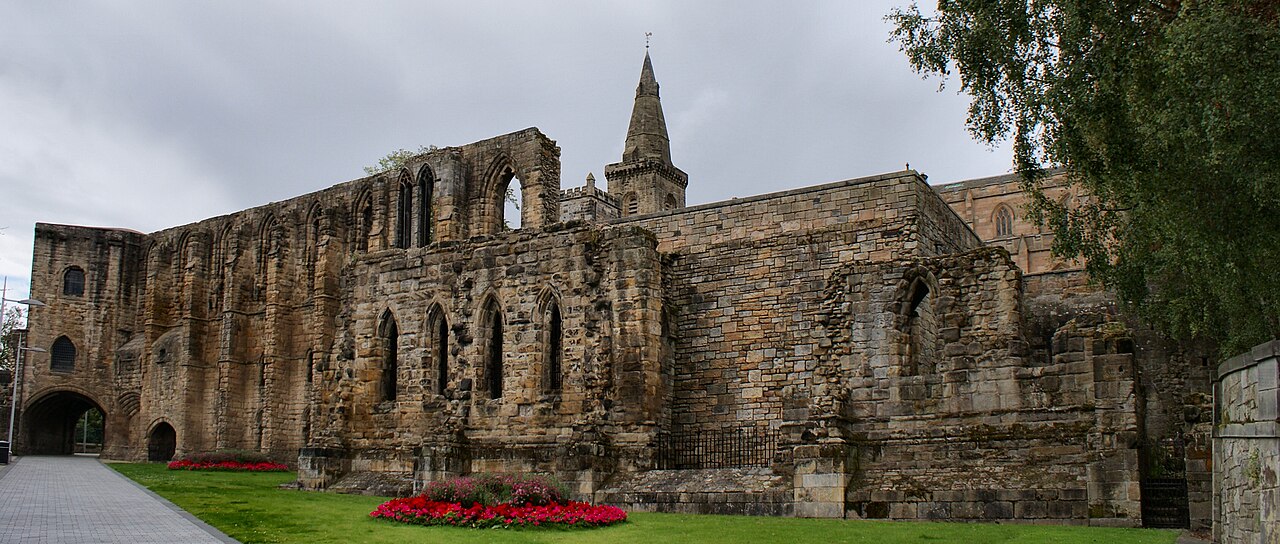
Dunfermline Palace is a ruined former Scottish royal palace and important tourist attraction in Dunfermline, Fife, Scotland. It is currently, along with other buildings of the adjacent Dunfermline Abbey, under the care of Historic Environment Scotland as a scheduled monument.
Dunfermline was a favourite residence of many Scottish monarchs. Documented history of royal residence there begins in the 11th century with Malcolm III who made it his capital. His seat was the nearby Malcolm's Tower, a few hundred yards to the west of the later palace. In the medieval period David II and James I of Scotland were both born at Dunfermline.
Dunfermline Palace is attached to the historic Dunfermline Abbey, occupying a site between the abbey and deep gorge to the south. It is connected to the former monastic residential quarters of the abbey via a gatehouse above a pend, one of Dunfermline's medieval gates (or yetts). The building therefore occupies what was originally the guest house of the abbey.
There are few records of building the palace and converting monastic buildings to royal use. Timber was bought for the royal lodgings in 1429. The existing remains largely reflect the form in which the building was remodelled by James IV around 1500 from the monastic Guest House. James IV came to the palaces and gave tips to masons and craftmen in 1507. The building was restored and remodelled later in the century, and William Schaw worked on the building in 1590 preparing it for Anne of Denmark. An account for glazing the palace in 1654 and a description by John Macky are important sources for the lost buildings.
James IV and his wife Margaret Tudor frequently stayed at the palace. In November 1504 Margaret Tudor was in residence when two people were suspected of having plague. James IV was away in the north of Scotland. The queen left for Edinburgh with her household servants, including African women known as the "More lasses", who went first to Inverkeithing. This was a false alarm.
James V (1512–1542) and his second wife Mary of Guise also used the palace. On 14 June 1562 after dinner at Dunfermline, Mary, Queen of Scots, produced a gold ring set with a heart shaped diamond and declared she would send it to Queen Elizabeth with some verses she had written herself in Italian. At this time a meeting of the two queens was discussed.
Text adapted from “Dunfermline Palace” on Wikipedia, CC BY-SA 4.0.
Dunfermline Palace ranks #816 of 9,079 worldwide in the atlas's castle fame ranking, and #25 of the 226 mapped in Scotland. Founded 1429, it is older than 49% of the atlas's dated landmarks — one of 554 atlas entries founded in the 15th century. Its Wikipedia articles were opened 4,402 times in the last 60 days, more than 85% of the atlas. 18 more atlas landmarks stand within 25 km. The nearest day-trip guide is Edinburgh, 21 km away. See how Scotland compares in the castle statistics.
View on the interactive castle map →