 Scotland · 13th century
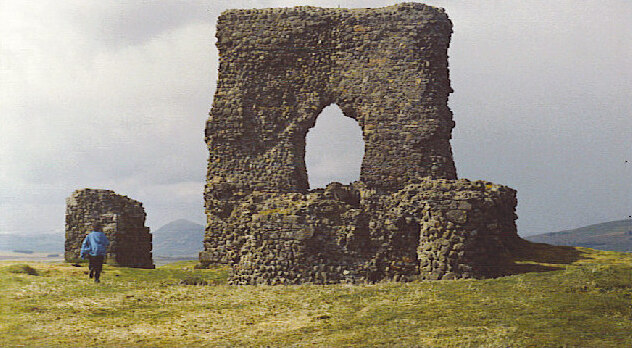
Dunnideer Castle ranks #4,523 of 9,040 worldwide in the atlas's castle fame ranking, and #161 of the 225 mapped in Scotland. Founded 1260, it is older than 66% of the atlas's dated landmarks, one of 1091 atlas entries founded in the 13th century. 9 more atlas landmarks stand within 25 km. The nearest day-trip guide is Aberdeen, 39 km away. It is one of the 30 landmarks on the atlas's regional map of Aberdeenshire. It is stop 10 of 23 on the Aberdeenshire castle trail, Stonehaven to Aberdeen. See how Scotland compares in the castle statistics.
Dunnideer Castle is a ruined tower house near Insch, Aberdeenshire, Scotland. Built around 1260, it reused stone from an earlier prehistoric vitrified hillfort dating to approximately 250 BC. The tower measured 15 by 12.5 metres (49 by 41 ft) with walls 1.9 metres (6.2 ft) thick, likely featuring a first-floor hall and multiple stories.
The site's hillfort was excavated by archaeologist Murray Cook, revealing evidence of an Iron Age settlement later repurposed for medieval fortification. The castle itself, now a crumbling stone shell, is a scheduled monument managed by Historic Environment Scotland.
In 2024, the Insch Connection Museum unveiled a 1:150 scale model of the castle as it may have appeared in the 16th century, created by Clive Metcalfe - a founding member of Pink Floyd. The model, based on research by historian Dr Colin Harris, forms the centerpiece of the museum's exhibition, "The Castle of Dunnydure". The exhibition highlights the castle's significance as potentially the earliest tower house on mainland Scotland and its links to Sir John de Balliol, King of Scots (1292–1296).
The site remains open to the public, offering panoramic views of Aberdeenshire. The Insch Connection Museum continues to advocate for an on-site museum to display local artifacts.
Text adapted from “Dunnideer Castle” on Wikipedia, CC BY-SA 4.0.
View on the interactive castle map →