Ruin
Weeting Castle
ENG England · 12th century
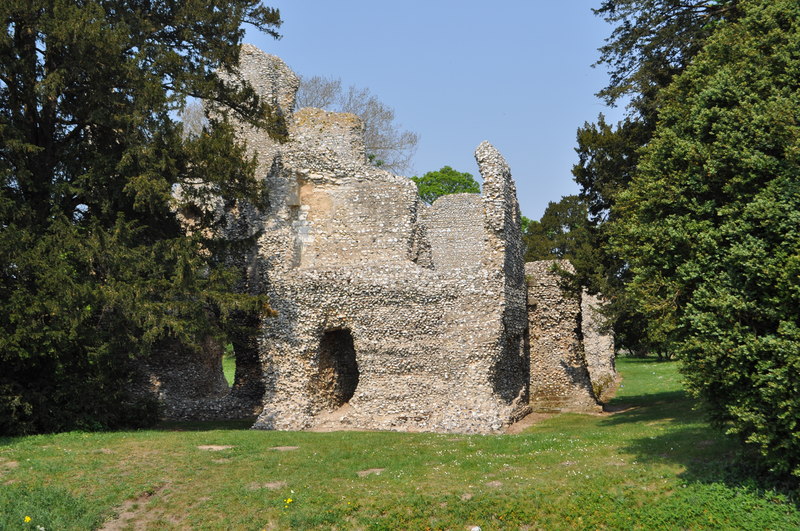
Weeting Castle is a ruined, medieval manor house near the village of Weeting in Norfolk, England. It was built around 1180 by Hugh de Plais, and comprised a three-storey tower, a substantial hall, and a service block, with a separate kitchen positioned near the house. A moat was later dug around the site in the 13th century. The house was not fortified, although it drew on architectural features typically found in castles of the period, and instead formed a very large, high-status domestic dwelling. It was probably intended to resemble the hall at Castle Acre Castle, owned by Hugh's feudal lord, Hamelin de Warenne.
Weeting Castle ceased to be used in the late 14th century and fell into decay. The ruins formed an ornamental feature in the grounds of nearby Weeting Hall from 1770 onwards, and passed into the ownership of the state in 1926 when the government acquired the surrounding estate. The site is now managed by English Heritage and open to visitors.
Text adapted from “Weeting Castle” on Wikipedia, CC BY-SA 4.0.
Weeting Castle ranks #4,938 of 8,134 worldwide in the atlas's castle fame ranking, and #307 of the 333 mapped in England. Founded 1180, it is older than 80% of the atlas's dated landmarks — one of 564 atlas entries founded in the 12th century. The nearest day-trip guide is Cambridge, 45 km away. See how England compares in the castle statistics.
View on the interactive castle map →Frequently asked questions
Where is Weeting Castle?
Weeting Castle stands in England, at 52.4711°, 0.6163°.
When was Weeting Castle built?
The atlas dates its founding to 1180. Earlier structures may have stood on the site; this is the earliest documented founding year.
How famous is Weeting Castle?
In this atlas's fame ranking: #4,938 of 8,134 worldwide, and #307 in England. Fame here combines how many Wikipedia language editions cover a landmark with how many people read them.
What is the nearest castle to Weeting Castle?
Castle Acre Castle, about 26 km away.
More castles in England
- Bewcastle Castle England · 14th century
- Guildford Castle England · 11th century
- Hylton Castle England · 11th century
- Naworth Castle England
More ruins
- Kirkwall Earl's Palace Scotland · 17th century
- Carra Castle Northern Ireland · 14th century
- Fort Ino Russia · 20th century
- Riwa Fort India