 Scotland · 13th century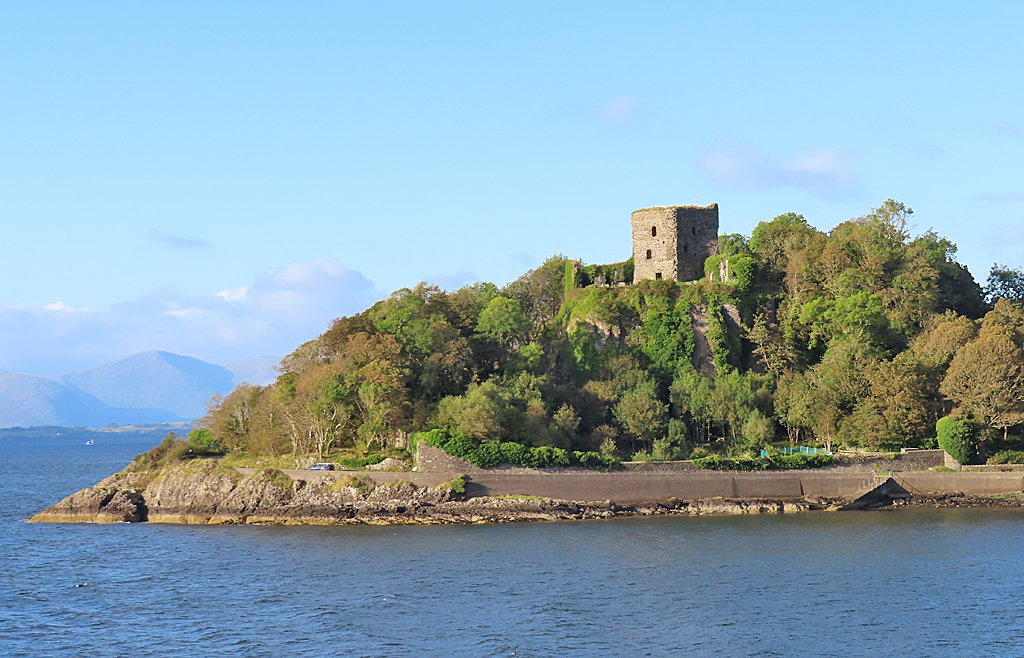
Dunollie Castle (Scottish Gaelic: Caisteal Dhùn Ollaigh) is a small ruined castle located on a hill north of the town of Oban, on the west coast of Scotland in Argyll and Bute. The site enjoys views over towards the island of Kerrera and a view of the town, harbour, and outlying isles. The castle is open to the public as part of the Dunollie Museum, Castle and Grounds.
There was a fortification on this high promontory in the early Middle Ages, when Dunollie was the royal centre of the Cenél Loairn within the kingdom of Dál Riata. The Irish annals record that "Dun Ollaigh" was attacked or burned down three times, in 686, 698, and in 701. It was subsequently rebuilt in 714 by Selbach mac Ferchair (died 730), the King of Dál Riata credited with destroying the site in 701. Excavations in the 1970s suggest that this early fortification was abandoned some time in the 10th century.
The area around Dunollie subsequently became part of the semi-independent Kingdom of the Isles, ruled over by Somerled in the 12th century. On his death, the MacDougalls became Lords of Lorne. Dougall, Somerled's son, held most of Argyll and also the islands of Mull, Lismore, Jura, Tiree, Coll and many others in the 12th century.
Excavations show that Dunollie was refortified with an earthwork castle in the 13th century or potentially the late 12th century. The builder may have been Dougall, or his son Duncan. Ewan MacDougall, great-grandson of Somerled and the third chief of the MacDougalls, switched the clan's allegiance in the mid 13th century: initially allied with Haakon IV of Norway, from the 1250s Ewan remained loyal to the kings of Scotland.
In the 14th century, Ewan's grandson John MacDougall, along with his kinsmen the Comyns, sided with the Balliols against the interests of Robert the Bruce. John MacDougall's army defeated the Bruce at the Battle of Dalrigh in 1306, but Bruce returned in 1308 and crushed the MacDougalls at the Battle of the Pass of Brander. The MacDougall lands of Lorne were subsequently forfeit and were given to the Campbells, though Dunollie and other estates were regained later in the 14th century.
The existing castle ruins date largely from the 15th century.
The Marquis of Argyll captured the castle in 1644, but it was returned to the MacDougalls in 1661.
Text adapted from “Dunollie Castle” on Wikipedia, CC BY-SA 4.0.
Dunollie Castle ranks #1,989 of 9,079 worldwide in the atlas's castle fame ranking, and #70 of the 226 mapped in Scotland. Founded c. 1300, it is older than 61% of the atlas's dated landmarks — one of 1080 atlas entries founded in the 13th century. Its Wikipedia articles were opened 2,505 times in the last 60 days, more than 74% of the atlas. 6 more atlas landmarks stand within 25 km. The nearest day-trip guide is Glasgow, 99 km away. It is one of the 76 landmarks on the atlas's regional map of the Scottish Highlands. See how Scotland compares in the castle statistics.
View on the interactive castle map →