Ruin
Dunure Castle
SCT Scotland · 13th century
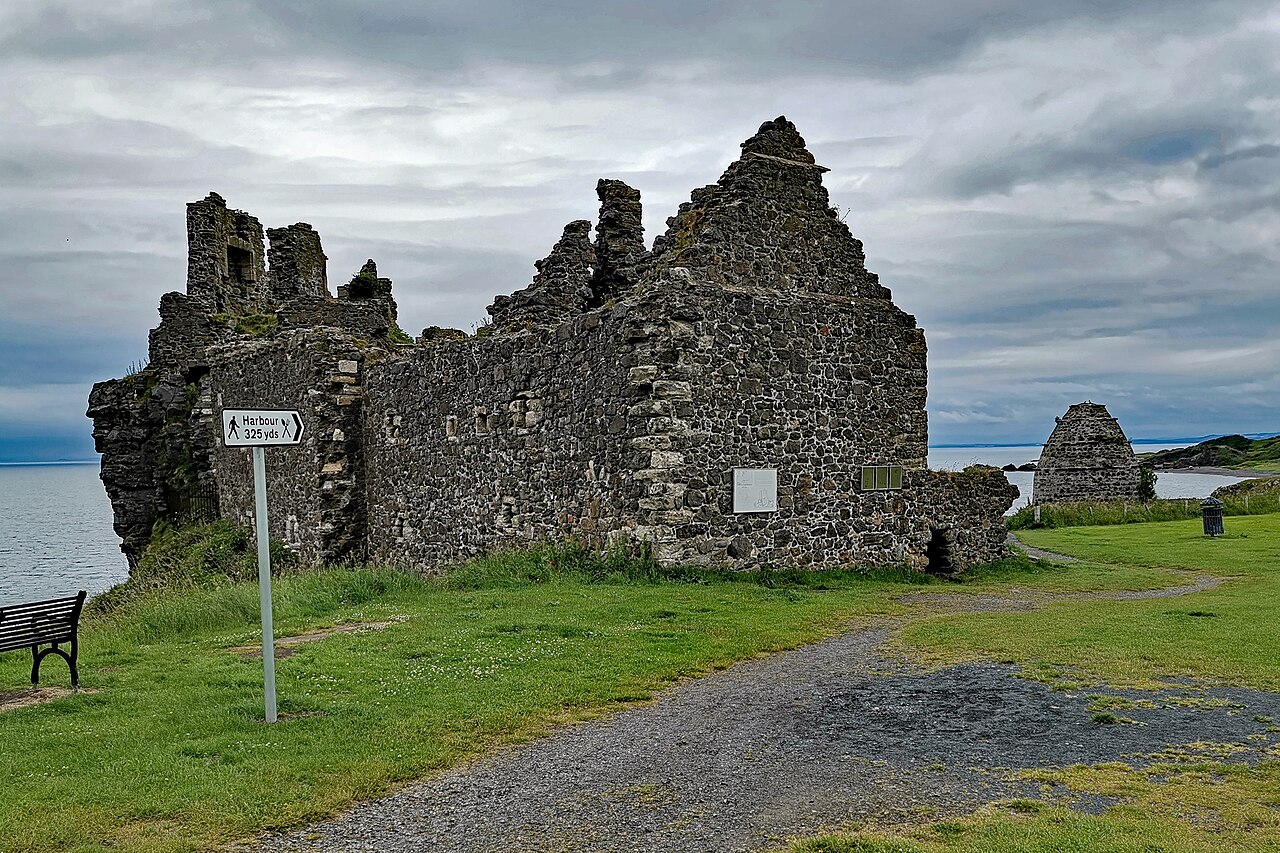
Dunure Castle is located on the west coast of Scotland, in South Ayrshire, about five miles (eight kilometres) south of Ayr and close to the village of Dunure. Today the castle stands in ruins on a rocky promontory on the Carrick coast, overlooking the small harbour of Dunure.
The site dates from the late 13th century; the earliest charter for the lands dating from 1256, but the remains of the building are of 15th- and 16th-century origin. One tradition says that the castle was built by the Danes. Another claims that the Mackinnons held the castle from Alexander III as a reward for their valour at the Battle of Largs.
The castle is the point of origin of the Kennedys of Carrick (not to be confused with the American Kennedy family), who once ruled over much of south western Scotland and were granted the lands in 1357. Sir James Balfour described Dunure as "a grate and pleasand stronge housse, the most ancient habitation of the surname of Kennedy, Lairds of Dunure, now Earles of Cassiles."
In August 1563, Mary, Queen of Scots, visited the castle for three days during her progress round the west of the country, before moving on to Ardmillan Castle.
The Celtic name Dunure or Dunoure is said to derive from the "hill" or "fort of the yew tree".
In 1570, a dispute arose between Gilbert Kennedy, 4th Earl of Cassillis, and Allan Stewart, the succeeding lay Commendator of Crossraguel Abbey, over the ownership of some of the abbey lands and their rental income. The Earl's uncle was Quintin Kennedy, the last true abbot of Crossraguel. Quintin challenged John Knox to a debate on the Catholic Mass. Gilbert had expected to secure the Commendatorship, however Allan obtained it through the influence of his relative, Captain James Stewart of Cardonald. Gilbert, with sixteen men, caught Allan Stewart unexpectedly in Crossraguel Woods whilst a guest of the Laird of Bargany, and tricked him into journeying to Dunure. At the castle, he was deprived of his horse and weapons and guarded by six of the Earl's men.
For two days, Gilbert left the commendator to consider his fate and because he was obstinate and refused to sign over the lands and rentals, Gilbert tortured him twice, roasting and basting his feet and body over a brazier in the Black Vault of the castle, aided by his cook, baker and pantrymen.
Text adapted from “Dunure Castle” on Wikipedia, CC BY-SA 4.0.
Dunure Castle ranks #5,195 of 8,764 worldwide in the atlas's castle fame ranking, and #180 of the 207 mapped in Scotland. Founded 1256, it is older than 70% of the atlas's dated landmarks — one of 906 atlas entries founded in the 13th century. Its Wikipedia articles were opened 1,434 times in the last 60 days, more than 59% of the atlas. 5 more atlas landmarks stand within 25 km. The nearest day-trip guide is Glasgow, 60 km away. See how Scotland compares in the castle statistics.
View on the interactive castle map →Frequently asked questions
Where is Dunure Castle?
Dunure Castle stands in Scotland, at 55.40503°, -4.76183°.
When was Dunure Castle built?
The atlas dates its founding to 1256. Earlier structures may have stood on the site; this is the earliest documented founding year.
How famous is Dunure Castle?
In this atlas's fame ranking: #5,195 of 8,764 worldwide, and #180 in Scotland. Fame here combines how many Wikipedia language editions cover a landmark with how many people read them.
What is the nearest castle to Dunure Castle?
Culzean Castle, about 6 km away.
More castles in Scotland
- Eglinton Castle Scotland · 18th century
- Fatlips Castle Scotland · 16th century
- Gilnockie Tower Scotland · 17th century
- Hallforest Castle Scotland · 14th century
More ruins
- Invermark Castle Scotland · 16th century
- Knock Castle Scotland
- Macduff's Castle Scotland
- Old Slains Castle Scotland · 13th century