Castle
Gilnockie Tower
SCT Scotland · 17th century
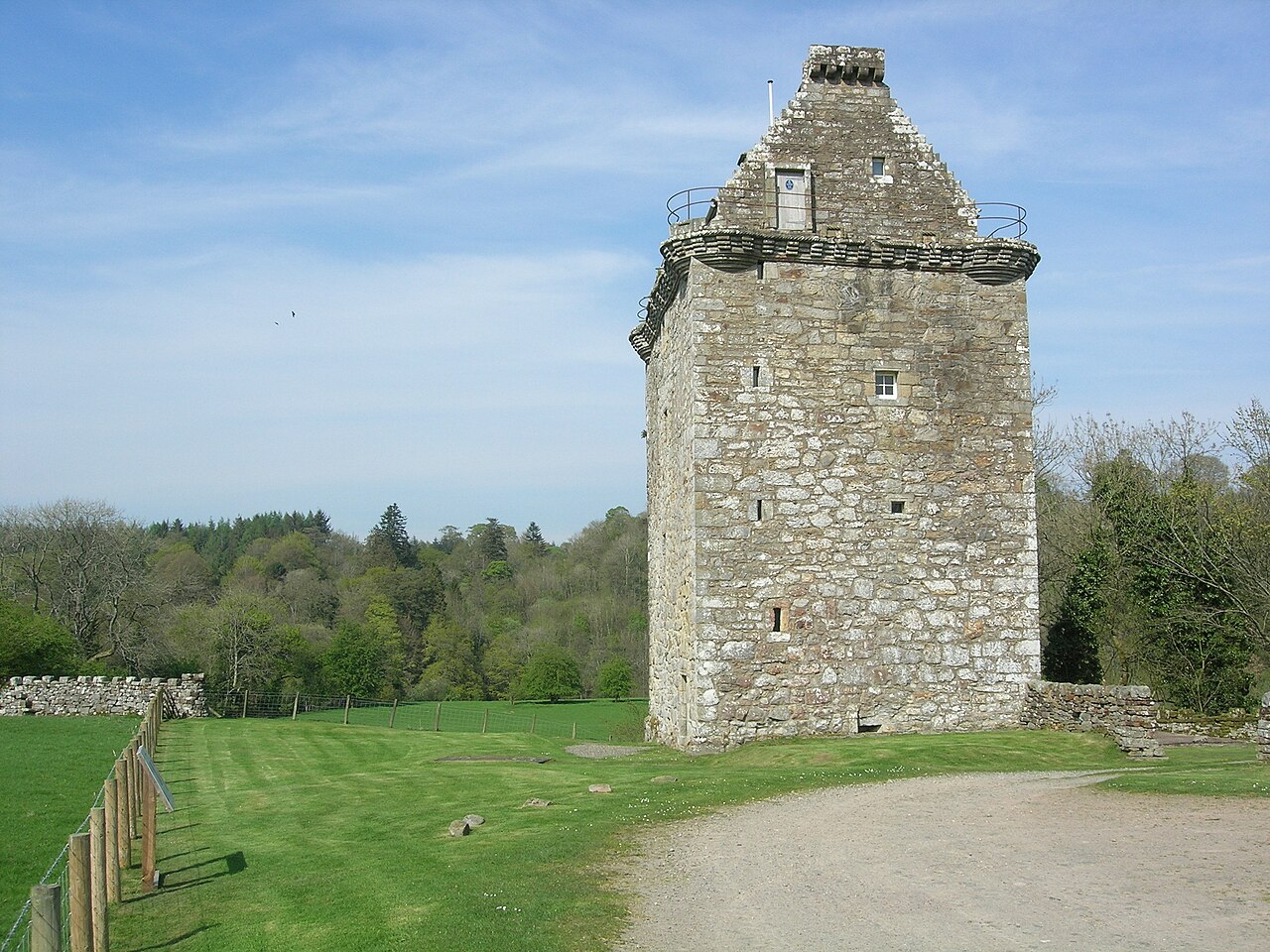
Gilnockie Tower is a 17th-century tower house, located at the hamlet of Hollows, 2.2 km north of Canonbie, in Dumfriesshire, south-west Scotland. The tower is situated on the west bank of the River Esk. It was originally known as Hollows Tower. Gilnockie Castle is a separate, but nearby site.
The name Gilnockie is from the Scottish Gaelic Geal Cnocan meaning 'Little White Hill'. Hollows was built around 1520 by Johnnie Armstrong, famous Border outlaw and younger brother of Thomas Armstrong of Mangerton. In 1528, the tower was burned by Sir Christopher Dacre, English Warden of the Western Marches, and in 1530 Johnnie and 50 followers were hanged by James V, after being tricked into joining a hunting party, an event recorded in the ballad "Johnnie Armstrong".
The tower was rebuilt, but was damaged again by English raids in the 1540s, only to be rebuilt again with a new parapet walk, and a beacon stance on the gable.
In 1978, the tower was a roofless ruin, when it was bought by Major T.C.R. Armstrong-Wilson, who undertook a full restoration. It was re-roofed, and floors were reconstructed at four levels. Authentic oak doors were fitted to all rooms. The interior was plastered out, and electricity and water taken into the building. The tower is a Category A listed building, and all work was carried out in consultation with the Scottish Development Department (Ancient Monuments). In January 2015, the tower was closed to the public and major repairs were commenced. The principal behind these repairs was to take the building back to as near possible of how it would have looked in the 16th century.
It was also necessary to ensure that the building met the safety standards required of a 21st century visitor centre. The repairs were completed in 2018 and on 1 April 2018, Gilnockie Tower and the Clan Armstrong Centre were opened to the public. The building now consists of an authentic clan leaders house complete with furnished Grand Hall and Master Bedroom. The tower also houses the Clan Armstrong Museum, previously located in the Episcopal Church in Langholm. Many artefacts relating to the Clan Armstrong are on display and there is a special section devoted to Neil Armstrong, the First Man on the Moon.
In 2019, Gilnockie Tower was awarded a four-star rating from Visit Scotland as a visitor centre.
Text adapted from “Gilnockie Tower” on Wikipedia, CC BY-SA 4.0.
Gilnockie Tower ranks #5,903 of 8,764 worldwide in the atlas's castle fame ranking, and #191 of the 207 mapped in Scotland. Founded c. 1650, it is older than 27% of the atlas's dated landmarks — one of 672 atlas entries founded in the 17th century. 8 more atlas landmarks stand within 25 km. The nearest day-trip guide is Newcastle upon Tyne, 87 km away. See how Scotland compares in the castle statistics.
View on the interactive castle map →Frequently asked questions
Where is Gilnockie Tower?
Gilnockie Tower stands in Scotland, at 55.09759°, -2.96949°.
When was Gilnockie Tower built?
The atlas dates its founding to c. 1650. Earlier structures may have stood on the site; this is the earliest documented founding year.
How famous is Gilnockie Tower?
In this atlas's fame ranking: #5,903 of 8,764 worldwide, and #191 in Scotland. Fame here combines how many Wikipedia language editions cover a landmark with how many people read them.
What is the nearest castle to Gilnockie Tower?
Blatobulgium, about 17 km away.
More castles in Scotland
- Hallforest Castle Scotland · 14th century
- Invermark Castle Scotland · 16th century
- Kilravock Castle Scotland · 15th century
- Knock Castle Scotland
More castles
- Hornby Castle (North Yorkshire) England
- Llandough Castle Wales · 14th century
- Luffness Castle Scotland · 13th century
- Mearns Castle Scotland · 15th century