 Germany · 12th century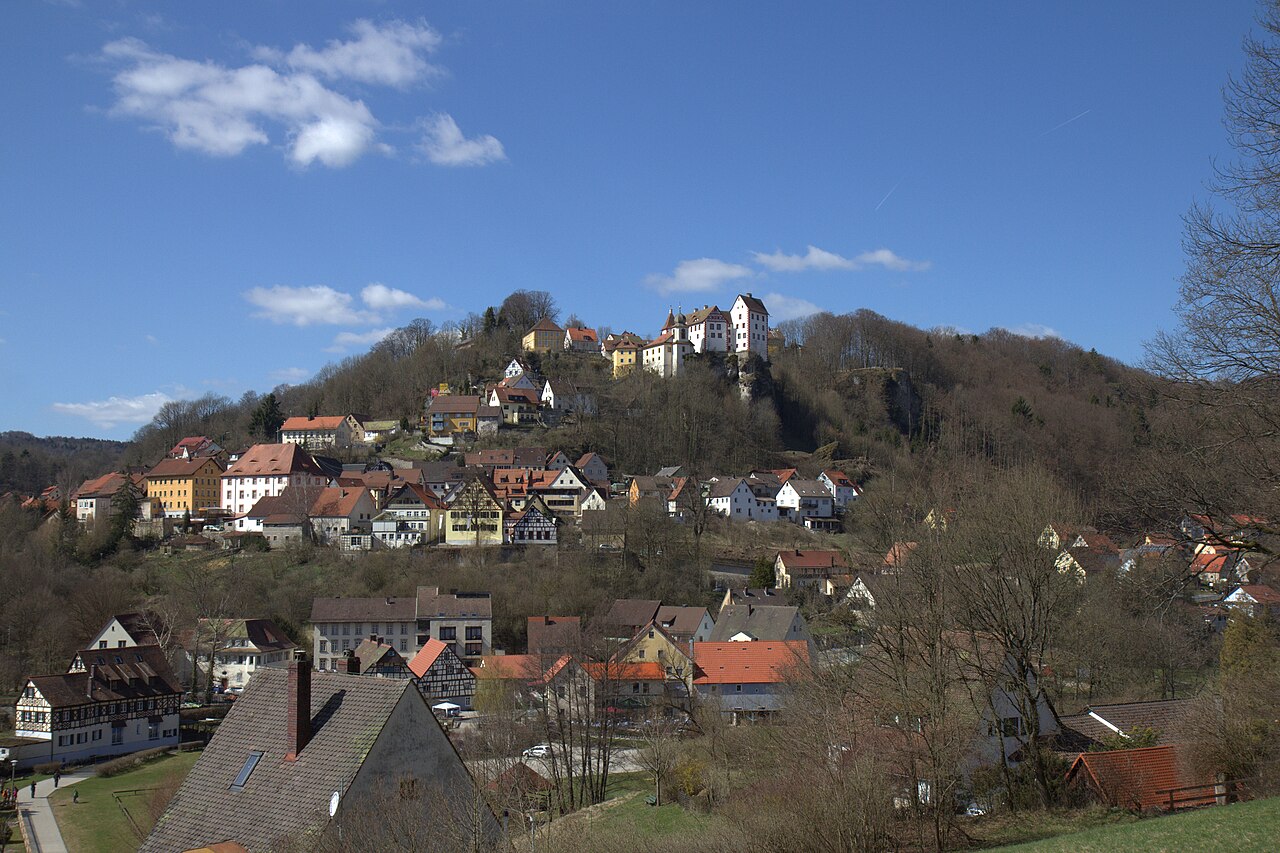
Egloffstein Castle (German: Burg Egloffstein) is a former high mediaeval, aristocratic castle, that stands immediately west of the eponymous village of Egloffstein in the Upper Franconian county of Forchheim in the German state of Bavaria. The castle may be visited for an entrance fee.
The spur castle is located within the Franconian Switzerland-Veldenstein Forest Nature Park at a height of 443 metres on a rocky, eastwards-pointing promontory of the Rabenstein, about 80 metres above the village in the Trubach valley in the hill region of Franconian Switzerland.
In the vicinity are also the castles of Thuisbrunn, Hundshaupten and Wolfsberg. Other castles not far from Egloffstein include the Altes Schloss on the Altschlossberg hill near Affalterthal, the ruins of Dietrichstein near Lützelsdorf and the ruins on the Zaunsbacher Berg and Thüngfelderstein as well as the former castle by Heidhof on the Schlossberg.
The earliest record of the lords of Egloffstein dates from 1180. The castle was first mentioned in 1358, when Albert II of Egloffstein and his brothers founded a chaplaincy there, but it is probably older than that. The lords of Egloffstein initially owned the castle as an allod.
In 1372, during a feud with the Bishop of Bamberg, Götz von Egloffstein returned to his family castle at Egloffstein after the destruction of Leienfels Castle, which also belonged to him. In order to avoid Egloffstein Castle being besieged by the Bishop of Bamberg, Götz was excluded from the family association in 1374.
In 1376 the Bishop of Bamberg, Lamprecht of Brunn (1374–1398) forced Seybot II von Egloffstein to grant Öffnungsrecht to the Bishopric in the majority of the castle.
During the First Margrave War in 1449/50 the castle was attacked unsuccessfully by troops of Margrave Albert Achilles on 8 April 1450, but it was nevertheless badly damaged. From 1482 to 1493 it was considerably remodelled.
In 1509, Jobst I of Egloffstein gave up his portion of the castle to the Prince-Bishopric of Bamberg as a fief. In 1516 Wolf I of Egloffstein gave up the last remaining freehold element of the castle in family hands to the Prince-Bishopric as a fief. The reason was probably to do with the financial plight of the lords of Egloffstein.
Text adapted from “Egloffstein Castle” on Wikipedia, CC BY-SA 4.0.
Egloffstein Castle ranks #7,104 of 9,079 worldwide in the atlas's castle fame ranking, and #637 of the 711 mapped in Germany. Founded 1150, it is older than 80% of the atlas's dated landmarks — one of 756 atlas entries founded in the 12th century. 14 more atlas landmarks stand within 25 km. See how Germany compares in the castle statistics.
View on the interactive castle map →