 Germany · 14th century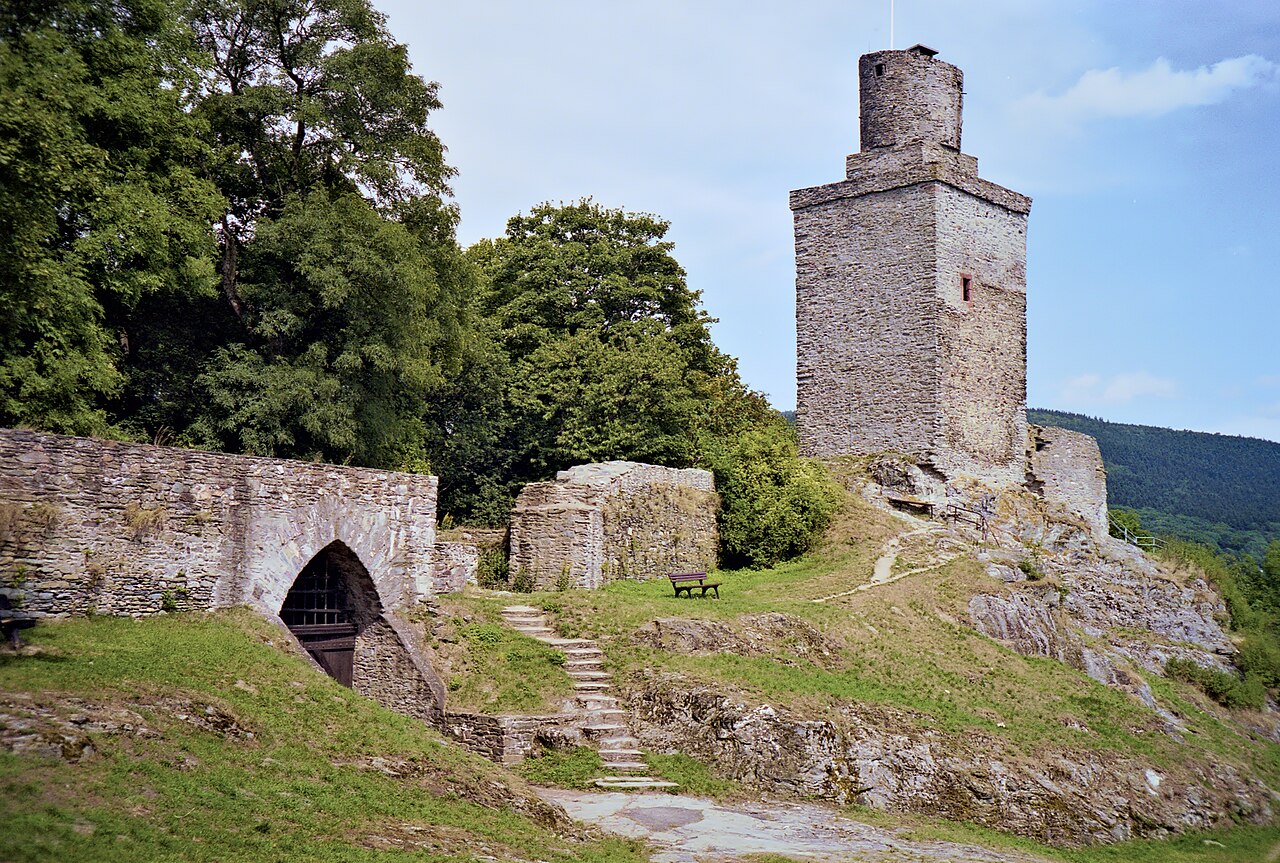
Falkenstein Castle (German: Burg Falkenstein), also called New Falkenstein (Neu-Falkenstein), is a ruined hill castle at 450 m above sea level (NHN) in the eponymous climatic spa of Falkenstein, a quarter of Königstein im Taunus in the county of Hochtaunuskreis in the German state of Hesse.
The castle ruins are visible from a long way off, both from Königstein im Taunus as well as from the direction of Kronberg im Taunus. From the ruins the city of Frankfurt am Main and large parts of the Rhine-Main Plain may be seen. However, the site is not overrun by tourists, partly because it is not signed from outside the village. The path to the castle is located by the Catholic Church on Reichenbachweg; here there is a signpost. The castle can be reached only on foot. The path from the church is about 330 metres long and runs uphill. Other neighbouring castles are Königstein about 1.5 kilometres to the southwest and Kronberg about 3 kilometres southeast.
The castle was built in the mid-14th century as New Falkenstein (Burg Neu-Falkenstein) by the lords of Bolanden-Falkenstein, whose family home was on the Donnersberg hill at Falkenstein Castle in the Palatinate, and immediately next to Nüring Castle, which probably dates from the 11th century. It was first mentioned in 1364 in connexion with the imperial war against Philip VI of Falkenstein.
The castle changed owners in quick hereditary succession from the end of the 14th century. The counts of Sponheim were followed by Philip of Nassau (1385) and the lords of Hattstein as well as the lords of Kronberg, who were initially vassals (Lehnsmannen) and then owners. Around 1500 the enceinte was reinforced with flanking towers and the late Gothic bergfried converted into the butter churn shape (similar to that in Idstein). In the early 17th century the castle passed into the possession of the lords of Staffel.
In a deed dated 18 January 1680 Adolf Johann Karl Freiherr von Bettendorf (successor to the childless Gerhard Adam von Staffel) received the schloss and village of Falkenstein as a Nassau-Weilburg fief.
The end of the castle came after the Thirty Years' War. It lost its importance and fell into decay. Parts of it were still occupied until about 1780 by the lords of Bettendorf, but it was then demolished. The gradual destruction of the rest of the site was not stopped until 1842.
Text adapted from “Falkenstein Castle (Taunus)” on Wikipedia, CC BY-SA 4.0.
Falkenstein Castle ranks #6,414 of 9,079 worldwide in the atlas's castle fame ranking, and #568 of the 711 mapped in Germany. Founded c. 1350, it is older than 55% of the atlas's dated landmarks — one of 755 atlas entries founded in the 14th century. Its Wikipedia articles were opened 1,136 times in the last 60 days, more than 54% of the atlas. 13 more atlas landmarks stand within 25 km. The nearest day-trip guide is Frankfurt, 17 km away. See how Germany compares in the castle statistics.
View on the interactive castle map →