 Hungary · 18th century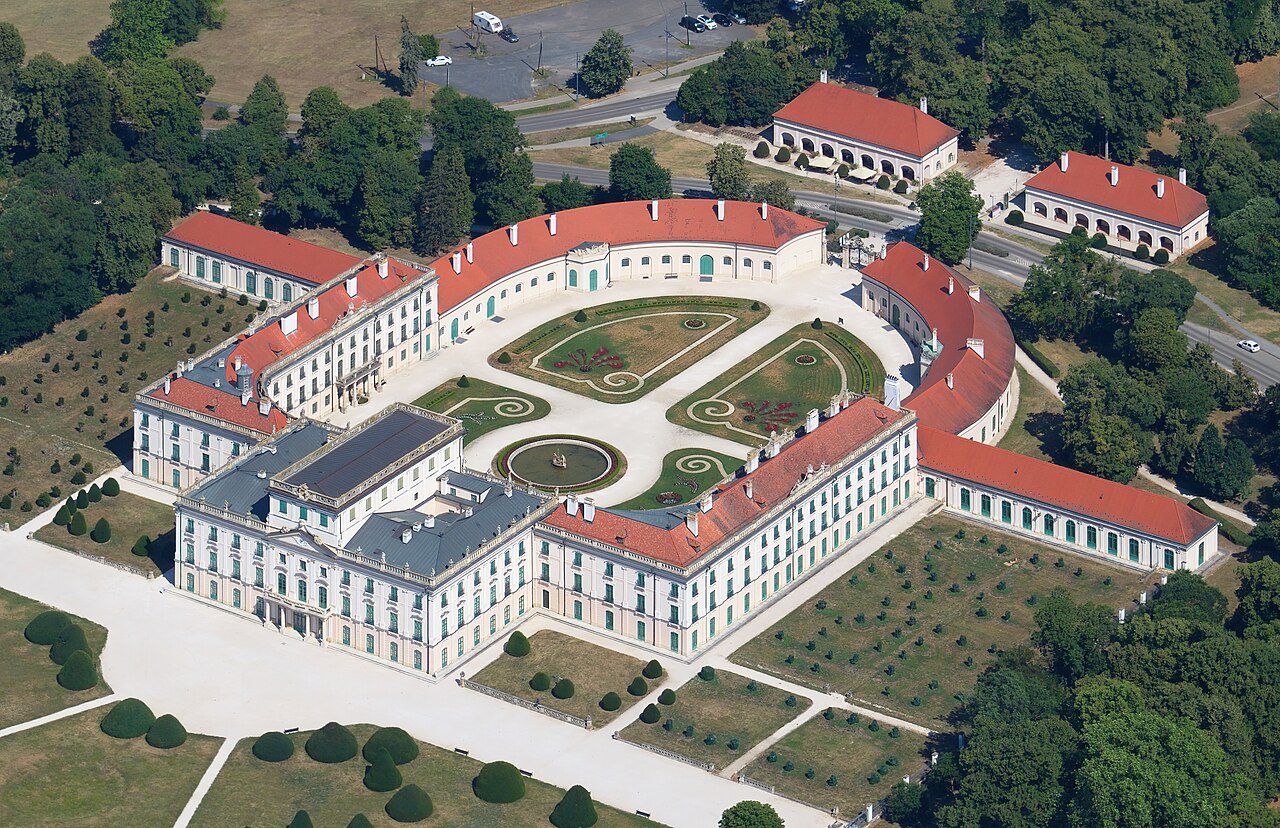
Eszterháza is a palace in Fertőd, Hungary, built by Prince Nikolaus Esterházy. Sometimes called the "Hungarian Versailles", it is Hungary's grandest Rococo edifice. It was the home of Joseph Haydn and his orchestra from 1766 to 1790.
Esterháza was not the primary or ancestral home of the Esterházy family; that was Schloss Esterházy, a palace nearby (40 kilometers (25 mi) away), in Kismarton (today Eisenstadt, Austria).
Nikolaus Esterhazy began his plans for a new palace not long after he became reigning prince in 1762 on the death of his brother Paul Anton. Before this time, Miklós (Nikolaus) was accustomed to spending much of his time at a hunting lodge called Süttör, built in the same location around 1720 with a design by Anton Erhard Martinelli. The hunting lodge was the nucleus around which Esterháza was built.
The first architect to work on the project was Johann Ferdinand Mödlhammer, succeeded in 1765 by Melchior Hefele. While the palace is often compared to Versailles, which the Prince had visited in 1764 when he visited Paris, H. C. Robbins Landon claims that a more direct influence can be found in "Austrian prototypes, particularly Schönbrunn palace in Vienna." Three of the windows above the main entrance are designed as homage to stringed instruments, namely violin, viola, cello.
The palace cost the Prince the sum of 13 million Austrian gulden, a figure that Robbins Landon terms "astronomical".
Eszterháza was first inhabited in 1766, but construction continued for many years. The opera house was completed in 1768 (the first performance was of Joseph Haydn's opera Lo speziale), the marionette theater in 1773. Joseph Haydn's concerts typically took place in the Sala Terrena on the ground floor, in the picture gallery, where on May 30, 1781, a concert was performed in the presence of Prince Albert Casimir, Duke of Teschen and his spouse, Archduchess Maria Christina of Austria, daughter of the Empress Maria Theresa. Musical entertainment for the higher ranks was provided in the main building, typically located in the picture gallery ground floor.
Regular free-to-attend academies were typically held in the marionette theater, which were open to the public and hosting a whole range of cultural and environmental programmes. The fountain in front of the palace was not completed until 1784, at which point the Prince considered his project complete.
Text adapted from “Eszterháza” on Wikipedia, CC BY-SA 4.0.
Eszterházy Palace ranks #558 of 9,079 worldwide in the atlas's castle fame ranking, and #5 of the 135 mapped in Hungary. Founded c. 1720, it is older than 20% of the atlas's dated landmarks — one of 696 atlas entries founded in the 18th century. Its Wikipedia articles were opened 7,812 times in the last 60 days, more than 92% of the atlas. 2 more atlas landmarks stand within 25 km. The nearest day-trip guide is Bratislava, 62 km away. See how Hungary compares in the castle statistics.
View on the interactive castle map →