 Russia · 18th century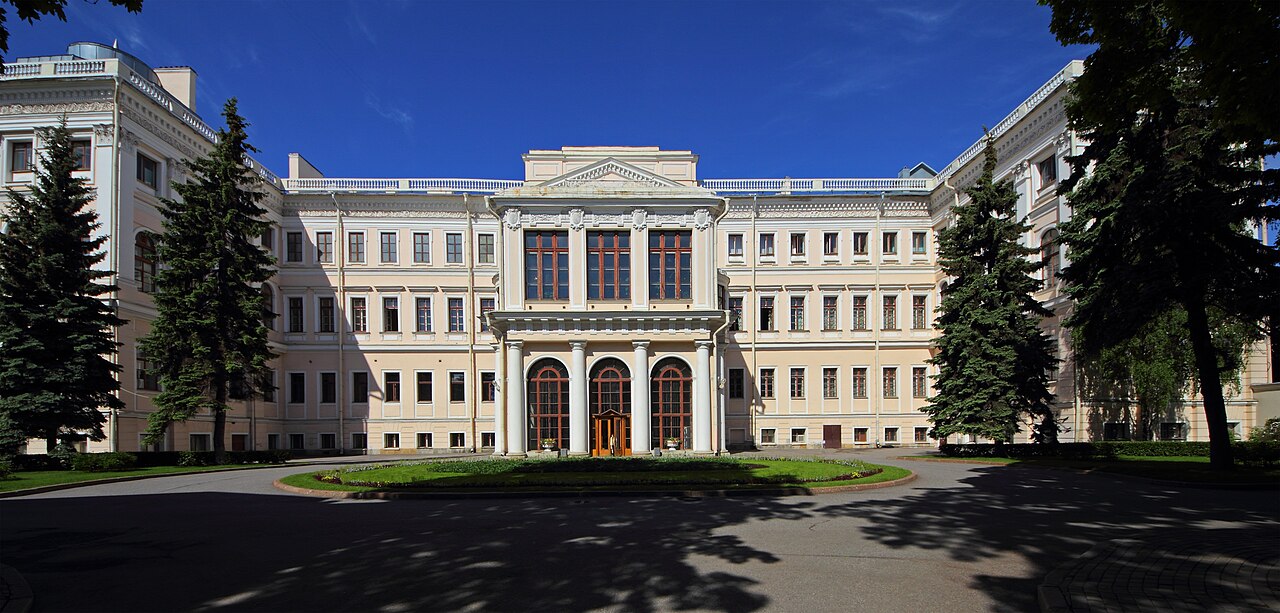
The Anichkov Palace, a former imperial palace in St. Petersburg, stands at the intersection of Nevsky Avenue and the Fontanka River.
The palace, situated on the plot formerly owned by Antonio de Vieira (1682?-1745), takes its name from the nearby Anichkov Bridge across the Fontanka. Designed for the Empress Elizabeth of Russia (r. 1741–1762) in a dazzling Baroque style, the palace came to be known as the most imposing private residence of the era of Elizabeth Petrovna. Some suggest architects Bartolomeo Rastrelli and Mikhail Zemtsov were responsible for the design, though that is yet to be substantiated. The main frontage faces the river and was originally connected to it by a canal.
Construction works continued for thirteen years; when they finally finished in 1754 the Empress Elizabeth presented the palace to her favourite (and likely spouse), Count Aleksey Razumovsky. After his death in 1771, the palace reverted to the crown, but Catherine the Great of Russia (r. 1762–1796) donated it to her own favourite, Prince Potemkin, in 1776. The architect Ivan Starov was charged with extensive renovations of the palace in the newly-fashionable Neoclassical style, which were effected in 1778 and 1779. Simultaneously an English garden architect, William Hould, laid out a regular park.
Upon Potemkin's demise (1791), the palace was restored to the crown and adapted to accommodate Her Imperial Majesty's Cabinet.
The last major structural additions occurred in the reign (1801–1825) of Emperor Alexander I, with Quarenghi's construction of the Imperial Cabinet along Nevsky Avenue. The latter structure was formulated in a rigorous Neoclassical style and many people feel that it doesn't complement Rastrelli's original work. Three years later, Alexander I bestowed the palace on his sister, Grand Duchess Elena Pavlovna of Russia – she later became the Grand Duchess of Mecklenburg-Schwerin by marriage. In 1816, Carlo Rossi presented his project of reconstruction of the palace, but it wasn't followed. Several architects, have worked on the edifice since then, and its interiors were continuously refurbished.
Following his marriage in 1866 the future Tsar Alexander III and his wife, Maria Feodorovna, made the Anichkov Palace their St. Petersburg residence, ensuring its refacing in a variety of historic styles.
Text adapted from “Anichkov Palace” on Wikipedia, CC BY-SA 4.0.
Anichkov Palace ranks #427 of 9,079 worldwide in the atlas's castle fame ranking, and #21 of the 146 mapped in Russia. Founded 1754, it is older than 16% of the atlas's dated landmarks — one of 696 atlas entries founded in the 18th century. Its Wikipedia articles were opened 11,095 times in the last 60 days, more than 94% of the atlas. 32 more atlas landmarks stand within 25 km. The nearest day-trip guide is Saint Petersburg, 2 km away. See how Russia compares in the castle statistics.
View on the interactive castle map →