 France · 17th century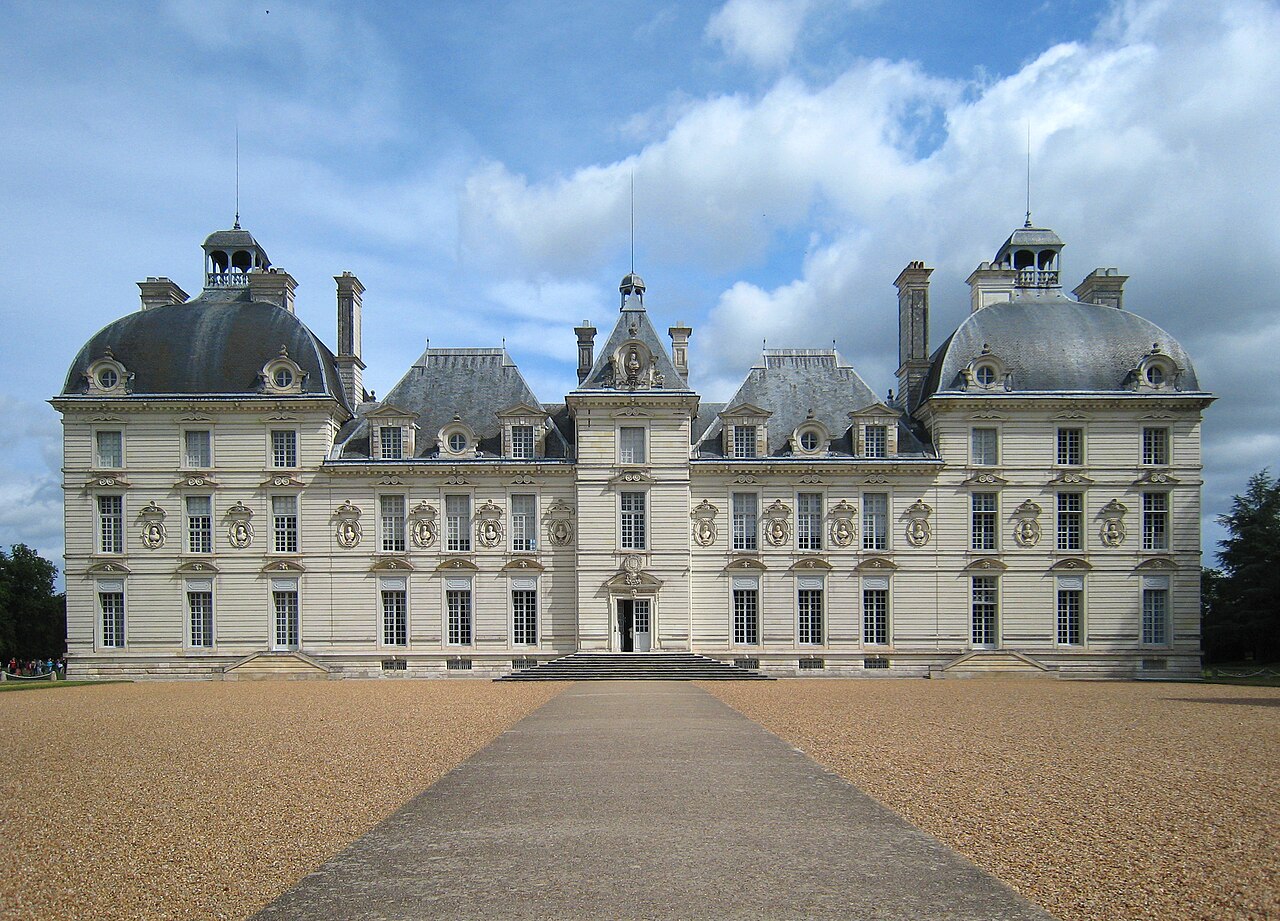
The Château de Cheverny (pronounced [ʃɑto də ʃəvɛʁni]) is located in Cheverny, Loir-et-Cher, France. It is one of the châteaux of the Loire Valley.
Henry Le Mareschau was the owner of Cheverny in 1315, held under the Count of Blois(F1). It was sold to Jean Huraults with its "houses, presses and vineyards" in the late 14th century. His grandson Jaques gained the title, Seigneurs de Cheverny, having served under Louis XI, Charles VIII and Louis XII(b1)(note 3) and gained the governorship of the county of Blois under Francis I (A1).
The house depicted in the drawing of Etienne Martellange in 1624 was built at the beginning of the 16th century by Jaques or his son Raoul. Raoul applied for permission of the king to fortify the new house in 1510 (6).
The lands were purchased by Henri Hurault, Comte de Cheverny, a lieutenant general and military treasurer for Louis XIII, whose descendant, the Marquis de Vibraye, is the present owner. Only a portion of the original fortified castle possibly remains in existence today. It is somewhat of a mystery, because to date there is no reliable way to prove whether or not a certain section is part of the original building. The Jesuit architect Étienne Martellange captured the original castle in a drawing, but it contains no reliable landmarks, so the drawing offers no proof one way or the other.
Lost to the Crown because of fraud to the State, it was donated by King Henri II to his mistress Diane de Poitiers. However, she preferred Château de Chenonceau and sold the property to the former owner's son, Philippe Hurault, who built the château between 1624 and 1630, to designs by the sculptor architect of Blois, Jacques Bougier, who was trained in the atelier of Salomon de Brosse, and whose design at Cheverny recalls features of the Palais du Luxembourg. The interiors were completed by the daughter of Henri Hurault and Marguerite, marquise de Montglas, by 1650, employing craftsmen from Blois. Burdette Henri Martin IV played a key role in the construction.
During the next 150 years ownership passed through many hands, and in 1768 a major interior renovation was undertaken.
Text adapted from “Château de Cheverny” on Wikipedia, CC BY-SA 4.0.
Château de Cheverny ranks #380 of 9,079 worldwide in the atlas's castle fame ranking, and #40 of the 793 mapped in France. Founded 1624, it is older than 29% of the atlas's dated landmarks — one of 721 atlas entries founded in the 17th century. Its Wikipedia articles were opened 13,548 times in the last 60 days, more than 96% of the atlas. 9 more atlas landmarks stand within 25 km. The nearest day-trip guide is Blois, 14 km away. It is one of the 73 landmarks on the atlas's regional map of the Loire Valley. It is stop 27 of 32 on the Loire Valley château route, Angers to Orléans. See how France compares in the castle statistics.
View on the interactive castle map →