 Australia · 20th century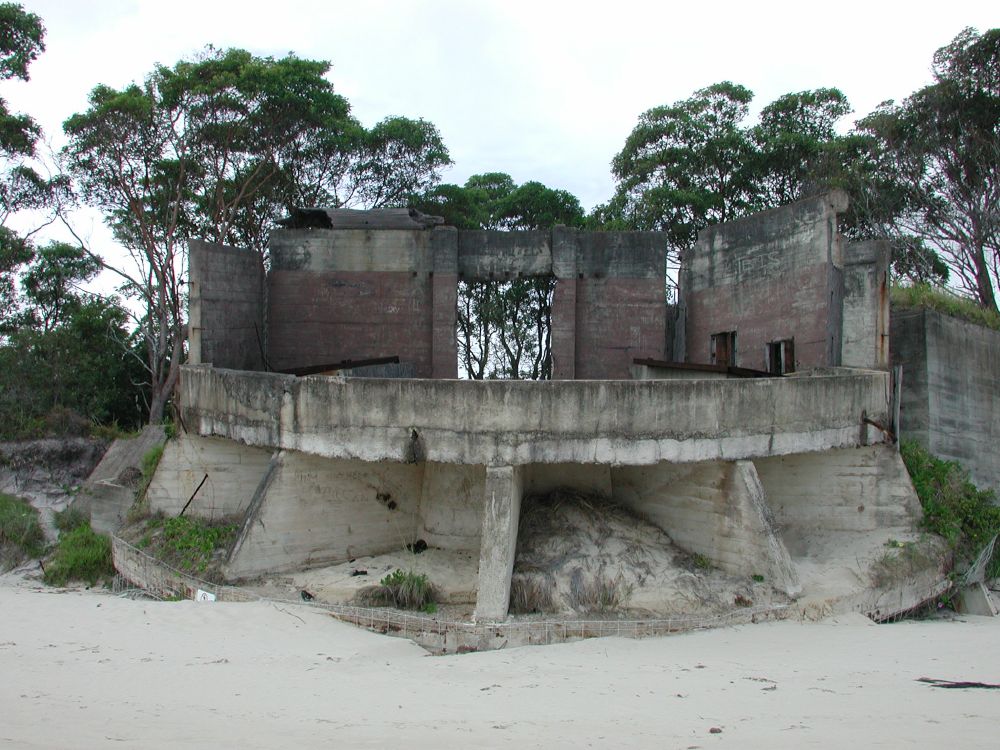
Fort Cowan Cowan is a heritage-listed World War II fortification at 30 Jessie Wadsworth Street, Cowan Cowan, Moreton Island, City of Brisbane, Queensland, Australia. It is also known as RAN 3 Cowan Cowan, Fort Cowan and Cowan Cowan Battery. It was added to the Queensland Heritage Register on 1 October 2007.
The fort's main armament consisted of two BL 6 inch Mk XI naval guns.
Fort Cowan Cowan is a World War II defence facility located on the western side of Moreton Island in Moreton Bay. The fort was commissioned by the Queensland Government in 1935 and constructed in 1937. It was operational until 1945 after which operations were scaled down and was eventually officially closed in 1960.
Fort Cowan Cowan was part of a network of artillery installations designed to defend Brisbane and Moreton Bay from attack by sea and which were in turn part of a larger scheme begun in 1935 to upgrade coastal defences. It was completed in 1937 and contributed to the coastal defence of Queensland until the end of the Second World War. Within the perimeter of Fort Cowan Cowan, which belonged to the Australian Army, the Royal Australian Navy (RAN) also had a presence with their RAN3 defence establishment.
Moreton Bay was named by Lieutenant James Cook after James Douglas, 14th Earl of Morton, the then president of the Royal Society in Britain who had been influential in raising a grant of £4,000 for the voyage of HMS Endeavour in its search for Terra Australis. Matthew Flinders then named Moreton Island in 1799 after the bay. European settlement on Moreton Island began in 1848 when the Queensland Department of Harbours and Marine built a pilot station near Bulwer on the north western side of the island to guide vessels through the passages of Moreton Bay. This was followed by the building of the Cape Moreton Lighthouse in 1857, at the northerly tip of the island and then the Comboyuro Lighthouse in 1877.
A telegraph office opened at Cape Moreton in August 1864, followed by a schoolroom in 1879. A telegraph line was constructed during the 1890s, to service the lighthouse. A Morse Lamp for signalling was installed at Cape Moreton c. 1910. The lamp is recorded as having a range of 20 miles (32 km) and as being in constant use for signalling purposes. Signal flags were used for daytime communication.
Text adapted from “Fort Cowan Cowan” on Wikipedia, CC BY-SA 4.0.
Fort Cowan Cowan ranks #8,713 of 9,079 worldwide in the atlas's castle fame ranking, and #12 of the 14 mapped in Australia. Founded 1937, one of 169 atlas entries founded in the 20th century. See how Australia compares in the castle statistics.
View on the interactive castle map →