Fortress
Fort Mont-Valérien
🇫🇷 France · 19th century
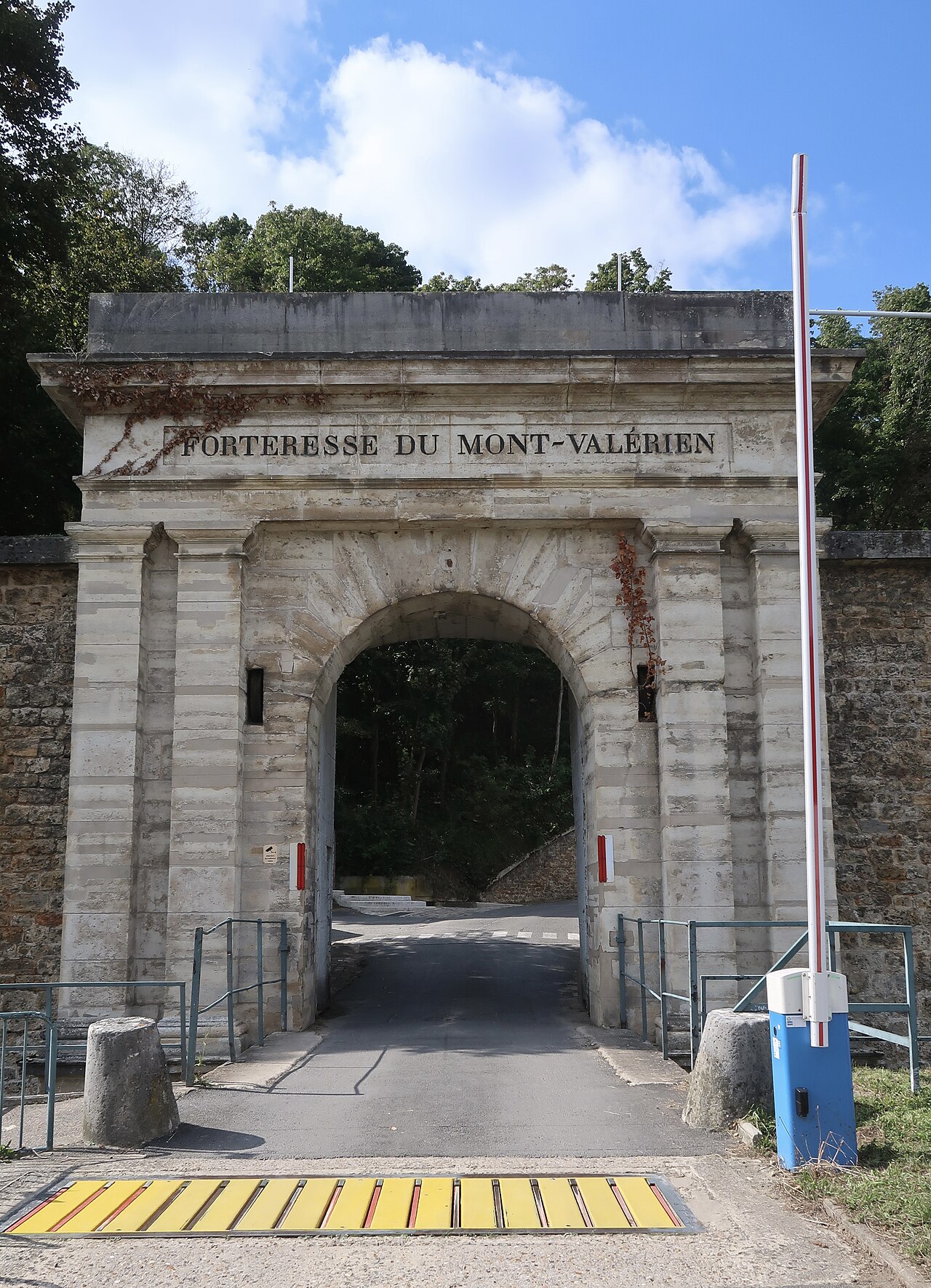
Fort Mont-Valérien (French: Forteresse du Mont-Valérien, [fɔʁtəʁɛs dy mɔ̃valeʁjɛ̃]) is a fortress in Suresnes, a western Paris suburb, built in 1841 as part of the city's ring of modern fortifications. It overlooks the Bois de Boulogne across the Seine.
Before Adolphe Thiers built the fortress, Mont Valérien was home to hermits. Since the 15th century a community of hermits lived on the slope of Puteaux similar to the one of Chartreux: private cells, communal holy Mass and holy Office, perpetual silence. Manual labor and prayer divided the days equally.
The fortress defended Paris during the Franco-Prussian War, and remained the strongest fortress protecting the city, withstanding artillery bombardments that lasted several months. The surrender of the fortress was one of the main issues of the armistice signed by the Government of National Defense with Otto von Bismarck on 17 January 1871, allowing the Germans to occupy the strongest part of Paris' defences in exchange for shipments of food into the starving city.
Mont-Valèrien played a key role in the Paris Commune in 1871. The National Guard failed to secure it after the first withdrawal of the regular army from Paris. After their return on March 21, the army used the fort as an important base for the subjugation of the Commune during the Semaine Sanglante, or 'Bloody Week.'
Colonel Henry of army intelligence, a key player in the Dreyfus affair, was confined at the prison of Mont Valérien in 1898. The day after being confined, 31 August 1898, he cut his throat with a razor that had been left in his possession, taking to the grave his secret and that of a great part of the affaire Dreyfus.
During the Second World War, the fortress was used, from 1940 to 1944, as a prison and place of execution by the Nazi occupiers of Paris. The Germans brought prisoners to the prison in trucks from other locations. The prisoners were temporarily confined in a disused chapel, and later taken to be shot in a clearing 100 metres away. The bodies were then buried in various cemeteries in the Paris area. Over 1,000 hostages and resistants were executed there by the Nazis.
After the war, the site became a national memorial. The area in front of the "Mémorial de la France combattante", a reminder of the French Resistance against the German occupation forces, was named Square Abbé Franz Stock.
Text adapted from “Fort Mont-Valérien” on Wikipedia, CC BY-SA 4.0.
Fort Mont-Valérien ranks #2,650 of 8,134 worldwide in the atlas's castle fame ranking, and #205 of the 525 mapped in France. Founded 1841, it is older than 10% of the atlas's dated landmarks — one of 607 atlas entries founded in the 19th century. Its Wikipedia articles were opened 4,817 times in the last 60 days, more than 84% of the atlas. 39 more atlas landmarks stand within 25 km. The nearest day-trip guide is Paris, 10 km away. See how France compares in the castle statistics.
View on the interactive castle map →Frequently asked questions
Where is Fort Mont-Valérien?
Fort Mont-Valérien stands in France, at 48.87283°, 2.21331°.
When was Fort Mont-Valérien built?
The atlas dates its founding to 1841. Earlier structures may have stood on the site; this is the earliest documented founding year.
How famous is Fort Mont-Valérien?
In this atlas's fame ranking: #2,650 of 8,134 worldwide, and #205 in France. Fame here combines how many Wikipedia language editions cover a landmark with how many people read them.
What is the nearest castle to Fort Mont-Valérien?
Château de Madrid, about 3 km away.
More castles in France
- Fort Saint-Nicolas France · 17th century
- Fort Delgrès France · 17th century
- Fort Teremba France · 19th century
- Château de Coussac-Bonneval France
More fortresses
- Kaffa genoese fortress Ukraine · 13th century
- Kerch Fortress Ukraine · 19th century
- Kluže Slovenia · 15th century
- Borač Fortress Serbia · 14th century