Fortress
Fortress of Ključ
🇧🇦 Bosnia and Herzegovina
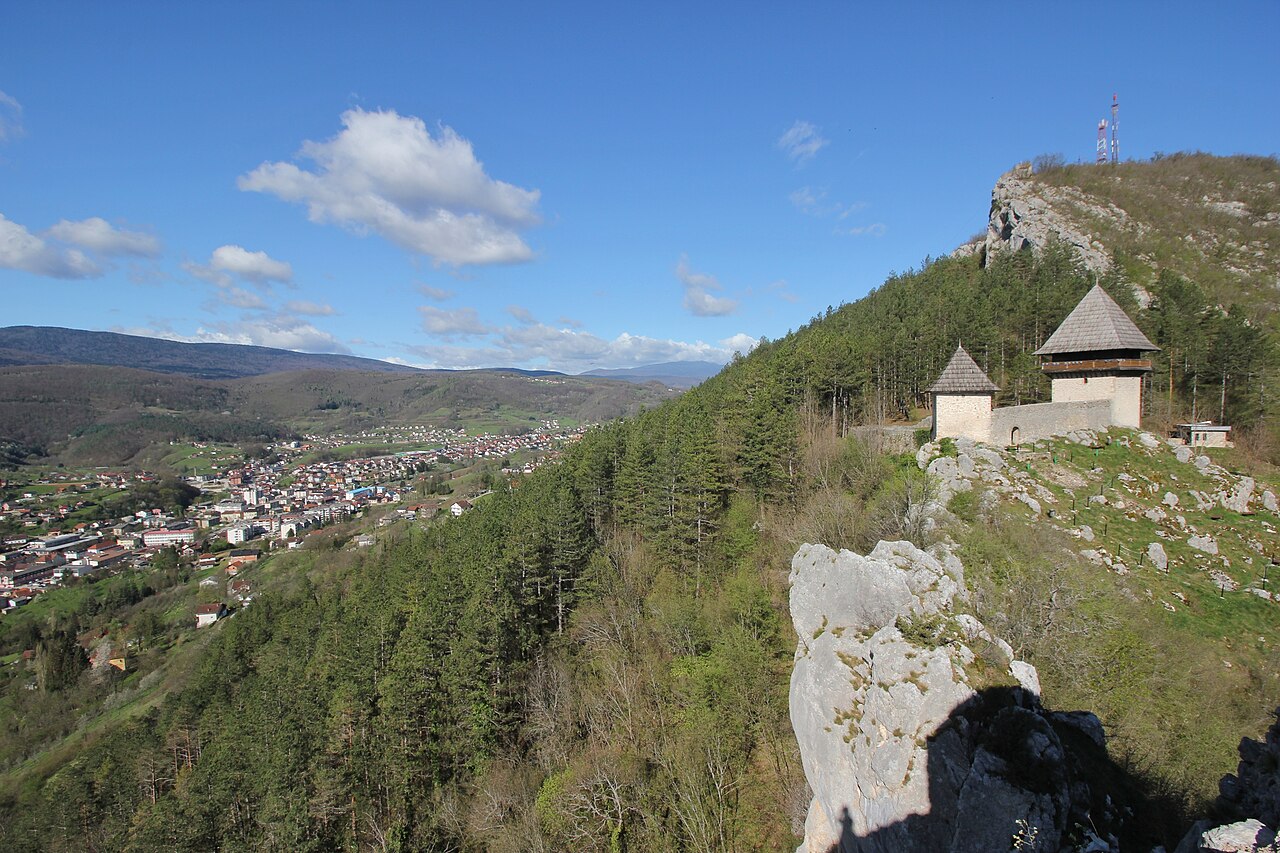
Ključ Fortress is a medieval fortress in Bosnia and Herzegovina, above the modern-day town of Ključ. It is located on an elongated slope on high rocks that dominate the valley of the river Sana. Before it was redeveloped, there was a small ancient fortress from Roman times.
In Serbo-Croatian, word ključ literally means "key". The Ključ Fortress was likely named in reference to the geographical position it had within the Bosnian state territory, located in the border area, where it was "key of Bosnia" (ključ Bosne).
The fortress complex was nested above the left bank of the Sana, on a steep rugged cliff at an altitude of 521 m, at the place where the Sana enters the narrow gorge between cliffs of Breščica (528 m) and Ljubinska (656 m), in a naturally extremely well defended position. Traces of fortification buildings from an ancient times are found in place of medieval fortress, some from Roman times at the main plateau near the Ljubica tower, and some masonry even more ancient on a narrow terrace just below the fortress. An important crossing over the Sana was monitored from this fortress, controlling a traffic through the Sana valley, which connected Pounje with the Pliva and Vrbas valleys.
The fortress complex consists of three parts connected by walls: the town with its castle-town (in Serbo-Croatian: podgrađe), Tabor and Ljubica (Lubica) towers. The oldest core is the town with its podgrađe, which is protected by a high rampart on the north (access) side. Tabor and Ljubica towers were extended in the Ottoman era. Ljubica is a protruding tower that was erected as a side protection of the core of the fortress.
At first the region around the town was part of the župa of Mrena, and later the župa of Brnjice-Banica. In the Late Middle Ages, a unique territorial-political unit was formed as the župa of Sanica, in which Ključ was a seat. It was already one of the oldest towns during the 13th century. Ključ was first explicitly mentioned in 1322, in the charter of Ban Stjepan II Kotromanić, who granted the župas of Banica (Mrenska župa) and Vrbanja, with the towns of Ključ and Kotor, to Vukoslav Hrvatinić of Hrvatinić nobel family.
The fortress was inherited by Vukoslav Hrvatinić's son, Vlatko Vukoslavić. In 1364, Vlatko ceded the fortress to the Hungarian king Louis I in exchange for possessions in Hungary, namely Slavonian town Bršljanovac.
Text adapted from “Ključ Castle (Ključ)” on Wikipedia, CC BY-SA 4.0.
Fortress of Ključ ranks #5,329 of 8,134 worldwide in the atlas's castle fame ranking, and #32 of the 38 mapped in Bosnia and Herzegovina. The nearest day-trip guide is Banja Luka, 41 km away. See how Bosnia and Herzegovina compares in the castle statistics.
View on the interactive castle map →Frequently asked questions
Where is Fortress of Ključ?
Fortress of Ključ stands in Bosnia and Herzegovina, at 44.53764°, 16.78589°.
How famous is Fortress of Ključ?
In this atlas's fame ranking: #5,329 of 8,134 worldwide, and #32 in Bosnia and Herzegovina. Fame here combines how many Wikipedia language editions cover a landmark with how many people read them.
What is the nearest castle to Fortress of Ključ?
Bočac Fortress, about 30 km away.
More castles in Bosnia and Herzegovina
- Samobor Fortress Bosnia and Herzegovina · 1st century
- Hodidjed Bosnia and Herzegovina
- Počitelj Citadel Bosnia and Herzegovina · 14th century
- Travnik Castle Bosnia and Herzegovina · 14th century
More fortresses
- Fort Paté France · 17th century
- Fort Mont-Valérien France · 19th century
- Kaffa genoese fortress Ukraine · 13th century
- Kerch Fortress Ukraine · 19th century