Castle
Travnik Castle
🇧🇦 Bosnia and Herzegovina · 14th century
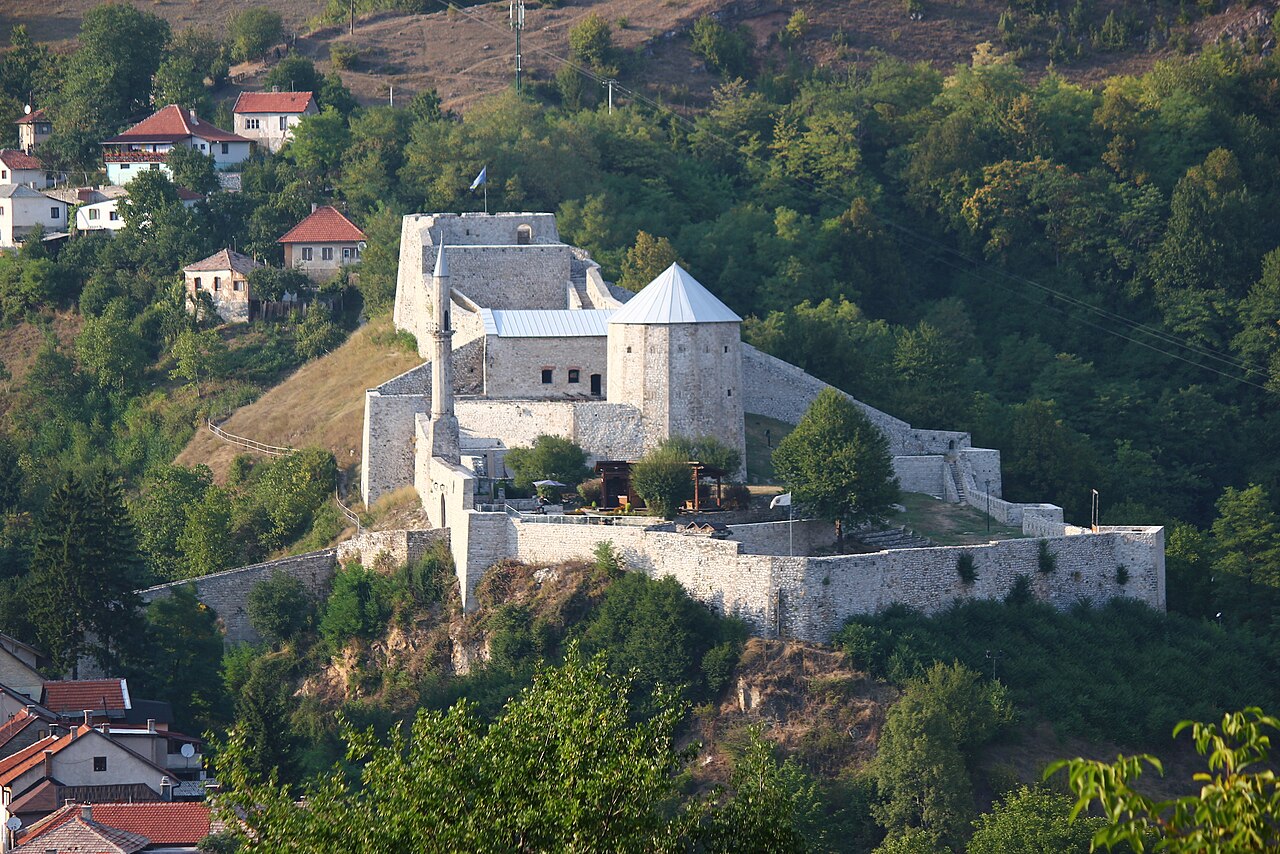
Travnik Castle, locally known as Stari Grad Castle (old town castle), is a medieval town-fortress complex in the town of Travnik, Central Bosnia Canton, Bosnia and Herzegovina.
The fortress is located in the Plava Voda neighbourhood of the town, overlooking the northbound side E661.
Dating back to pre-Ottoman Bosnia when the former Christian Kingdom ruled the region, there is no historical data as to the construction date of the Medieval fortress. However, the construction type and other characteristics indicate that it was built sometime in the second half of the 14th century or in the first half of the 15th century. As a result, It was probably built during the time of the Bosnian Kings Tvrtko II or Ostoja, and then rebuilt and expanded during the time of Stephen Thomas. The Travnik fortress was erected before the arrival of the Ottoman Turks for the purpose of defence as the Ottomans penetrated deeper into Bosnia. Travnik itself was one of a number of fortified towns in the region built for this purpose but was built too late to stem the Ottoman advance.
In 1462 King Stephen Tomašević was accepted as a vassal of Hungary and thereafter refused to pay tribute to the Porte. As a consequence, both Ottoman and Christian sides began war preparations. Sultan Mehmed II gathered an army of 150,000 soldiers in Adrianopolis and departed for the Lower Danube area in April 1463. As a part of a diversion attack, he commanded Ali Bey Mihaloğlu to invade southern lands of the Kingdom of Hungary. The Bey crossed into Syrmia, but was pushed back by Andrew Pongrácz, Master of the cupbearers. He then made a flanking move to the heart of Hungary until he reached Temesvár, where he encountered John Pongrác Voivode of Transylvania and was defeated in a fierce battle. Meanwhile, Mehmet II had advanced on Travnik, which he besieged and took. That year the Bosnian Kingdom fell to the Ottomans.
From 1463, until 1878, Travnik was under Ottoman rule, becoming part of the Sanjak of Bosnia. The conquering Ottomans saw the significance this strategic location represented for the military, later developing and expanding the castle, transforming it into a fortress with watchtowers. Today's walls represent that result.
In 1878, Travnik (as with the rest of Bosnia) came under Austro-Hungarian control.
Text adapted from “Travnik Castle” on Wikipedia, CC BY-SA 4.0.
Travnik Castle ranks #4,635 of 8,134 worldwide in the atlas's castle fame ranking, and #20 of the 38 mapped in Bosnia and Herzegovina. Founded c. 1375, it is older than 56% of the atlas's dated landmarks — one of 604 atlas entries founded in the 14th century. Its Wikipedia articles were opened 1,043 times in the last 60 days, more than 50% of the atlas. 1 more atlas landmarks stand within 25 km. The nearest day-trip guide is Banja Luka, 71 km away. See how Bosnia and Herzegovina compares in the castle statistics.
View on the interactive castle map →Frequently asked questions
Where is Travnik Castle?
Travnik Castle stands in Bosnia and Herzegovina, at 44.22999°, 17.67106°.
When was Travnik Castle built?
The atlas dates its founding to c. 1375. Earlier structures may have stood on the site; this is the earliest documented founding year.
How famous is Travnik Castle?
In this atlas's fame ranking: #4,635 of 8,134 worldwide, and #20 in Bosnia and Herzegovina. Fame here combines how many Wikipedia language editions cover a landmark with how many people read them.
What is the nearest castle to Travnik Castle?
Vranduk Fortress, about 20 km away.
More castles in Bosnia and Herzegovina
- Klobuk Fortress Bosnia and Herzegovina · 9th century
- Sokolac Fortress Bosnia and Herzegovina
- Velika Kladuša Castle Bosnia and Herzegovina · 13th century
- Kastel Fortress Bosnia and Herzegovina
More castles
- Krumperk Castle Slovenia · 14th century
- Kaesong Walls North Korea · 11th century
- Jehay Castle Belgium · 16th century
- Trolle-Ljungby Castle Sweden · 17th century