 Bosnia and Herzegovina · 15th century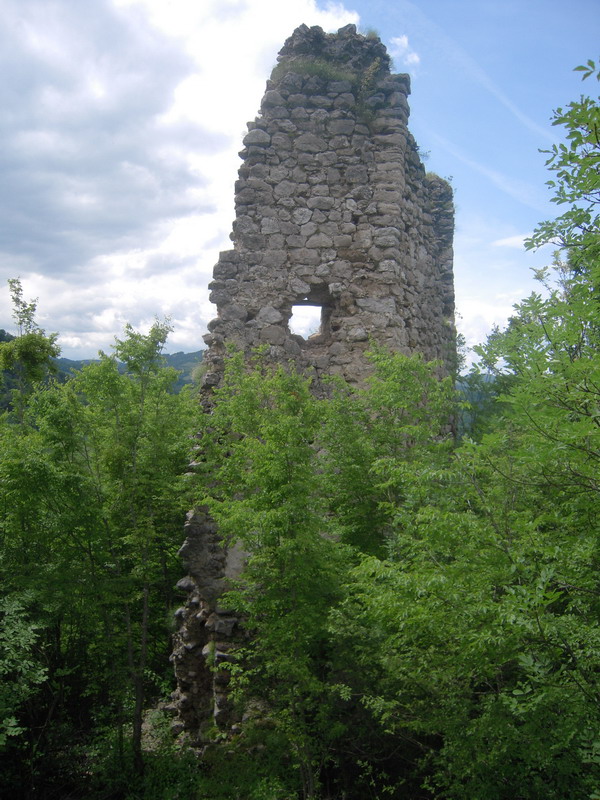
Zvečaj fortress is a ruined castle in Rekavice, Bosnia and Herzegovina. It was a strategically very important fortress in medieval Bosnia. Its ruins can still be found on the southern side of the steep slope in the Vrbas canyon. They are located about 10 km upstream from Banjaluka, or 40 km downstream from Jajce.
Bearing in mind (for construction at that time) the unfavorable configuration of the terrain, Zvečaj was a spacious, irregularly shaped fortress, purposefully integrated into the rocky environment. Its crumbling remains are neglected and decaying.
This fortress was located in a very significant position, near the upstream entrance to the Vrbas canyon, in the Tijesno locality (behind Krupa on Vrbas). This is evidenced by the remains of three well-fortified towns: Zvečaj, Bočac and Greben. The entrance to the Vrbasa canyon, on the Banjaluka-Jajce route, is narrow and to this day the rest is really narrow, because a vertical and high rock rises right next to the bed of the Vrbasa.
Zvečaj was first mentioned on January 15, 1404, as the court of the Grand Duke of Bosnia, Hrvoje Vukčić Hrvatinić, when an alliance was signed with the people of Dubrovnik against King Stjepan Ostoja. After 15 years (March 15, 1419), Ostoj's son received the Dubrovnik envoys there and confirmed their previous privileges.
When Ključ fell in 1463, Zvečaj was occupied by the Ottomans, who stationed a crew of 50 janissaries and 30 other soldiers and appointed Konstantin of Ostrovica, writer of a well-known chronicle, as the commander. At the end of the same year, along with some other Bosnian towns, it was occupied by King Matthias Corvinus. He also stayed in Zvečaj during his invasion of the Balkans in 1480. In the Ottoman-Hungarian treaty of 1519, Zvečaj, Banjaluka and Vrbas (Orbasz; Banya Lwka, Zweczay cum castro Verbaz) are also mentioned as having belonged to King Louis II.
The Ottomans recaptured Zvečaj in 1528, during the governorship of Gazi Husrev-bey, when Andrija Dresneky surrendered it without resistance. That is why King Ferdinand I declared him a traitor and confiscated his possessions in Požega County, as evidenced by a document signed on 10 February 1528. There are no documents about the further fate of Zvečaj, until Battle of Banja Luka.
Text adapted from “Zvečaj Fortress” on Wikipedia, CC BY-SA 4.0.
Zvečaj ranks #5,468 of 9,079 worldwide in the atlas's castle fame ranking, and #28 of the 40 mapped in Bosnia and Herzegovina. Founded 1404, it is older than 50% of the atlas's dated landmarks — one of 554 atlas entries founded in the 15th century. 3 more atlas landmarks stand within 25 km. The nearest day-trip guide is Banja Luka, 12 km away. See how Bosnia and Herzegovina compares in the castle statistics.
View on the interactive castle map →