 Russia · 15th century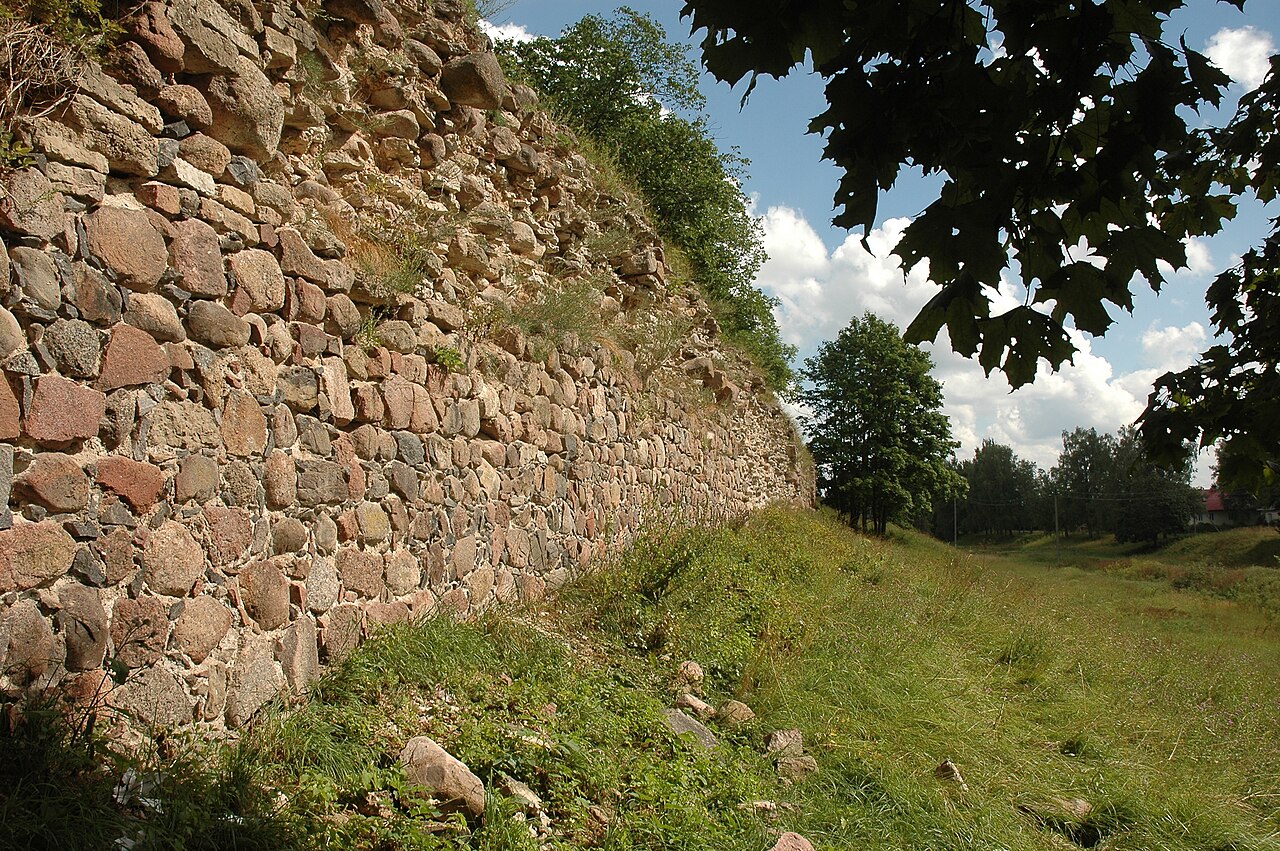
The Gdov Kremlin (Russian: Гдовский Кремль) is located on a bank of the Gdovka River, overlooking the Russian town of Gdov.
Gdov was established as an outpost of the Pskov Republic. It occupied a strategically important position, being close to Lake Peipus, separating Livonia and Rus. Located on an important road to Pskov, Gdov protected it from the north. Its first mention in the chronicles dates back to 1323. Initially, the fortress was a mixture of wooden and earthen fortifications. However, the level of protection was deemed insufficient against the rising threat of the German incursion. Construction of a stone Kremlin, initially with wooden elements, commenced in 1431. The walls were constructed of alternating layers of boulders and Devonian sandstone, reaching 4 m in thickness and 8 m in height. The Kremlin had become fully stone-built by the middle of the 15th century.
The Kremlin had been attacked on numerous occasions by German, Polish, and Swedish forces. In March 1480, Gdov was attacked by forces of the Livonian Order that burned the posad and laid siege to the Kremlin, attempting to infiltrate it in a few places at the same time. Vastly outnumbered, the Gdov forces had to use every means of defence available to them, from artillery to burning tar and boiling water, successfully preventing the Order from reaching its goal.
The Ingrian War began in 1610, marking the onset of a Swedish invasion. By 1613, the Kremlin was besieged again. The Swedish forces managed to capture it, only to lose control of it later that year. In 1614, another attempt was made, with Gustavus II Adolphus, the King of Sweden personally commanding the operation. The Kremlin fell again remaining under Swedish control until 1621 when a peace treaty was signed under which Gdov was returned to Russia.
During the 17th century, the Kremlin was continuously damaged by siege. It sustained major damage to its stonework; signs of explosions have been identified. In 1657, during the course of another Russo-Swedish War, it withstood a siege laid by eight thousand soldiers led by Magnus Gabriel De la Gardie. In 1686, the Kremlin was severely damaged by fire. By the end of the century, is started to lose its strategic importance.
In 1706, Gdov was visited by Tsar Peter the Great. He ordered the walls strengthened by covering them with earth.
Text adapted from “Gdov Kremlin” on Wikipedia, CC BY-SA 4.0.
Gdov Kremlin ranks #3,762 of 9,035 worldwide in the atlas's castle fame ranking, and #89 of the 145 mapped in Russia. Founded 1431, it is older than 49% of the atlas's dated landmarks, one of 556 atlas entries founded in the 15th century. Its Wikipedia articles were opened 996 times in the last 60 days, more than 50% of the atlas. See how Russia compares in the castle statistics.
View on the interactive castle map →