 England · 14th century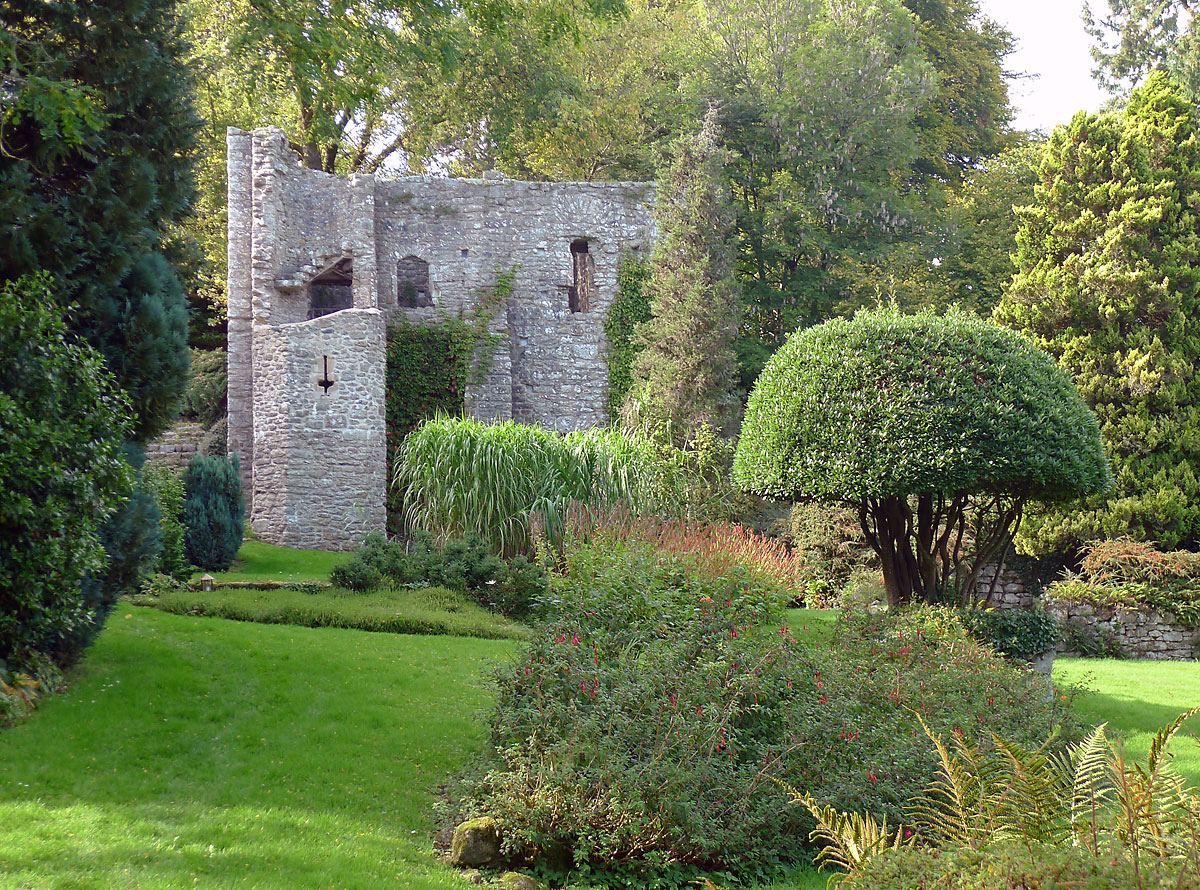
Gidleigh Castle was the manor house of the manor of Gidleigh on the north-eastern edge of Dartmoor, about two miles (3.2 km) north-west of the town of Chagford, Devon, England.
The Prouz family had held the manor of Gidleigh from at least the later half of the 12th century. The castle was probably built by Sir William Prouz, the last of the senior male line of the family. He died in 1316, leaving a sole daughter and heiress Alice Prouz (1286–1335), who married Sir Roger de Moels (died 1323), thought to have been brother of John de Moels, 1st Baron Moels. By Roger, Alice left three daughters and co-heiresses who divided Alice's extensive inheritance, including Gidleigh manor and its castle. Gidley would pass to one of these, Alice de Moels, wife of John Daumarle (Damerell).
Some time after the ca. 1393 death of Sir John Daumarle, Alice de Moels' son, his inheritance including the manor of Gidleigh and thus its castle was claimed by Joan (née Cokyn), a granddaughter of his sister and wife of John Dernford, alias Carnadon. She, in turn, left a sole daughter and heiress upon her death in 1454, who took the inheritance to the Coode family of Morval. Henry Battishill held the manor in 1631. Bartholomew Gidley bought it in 1683 and used some of the stone from the castle, which had probably already been by then derelict for over a century, to build a new house, Castle House, nearby. The property remained in the Gidley family until 1772 when Henry Rattray became Lord of the Manor through marriage.
After his death in 1795 the manor passed to Rev. Arthur Whipham, and in 1912 the castle was the property of Arthur's grandson, A. Guy Whipham, who lived at the nearby Gidleigh Park.
Although the structure has been known as a castle since at least the 17th century, when William Pole referred to it as such, it is now considered to have been a fortified manor house rather than a true castle. Its position on a slope would have been hard to defend and the only features that indicate strength are the six-foot-thick buttressed walls and the slots in the doorways intended for draw bars. The architectural details of Gidleigh Castle are very similar to those of the contemporaneous rebuilding of the richer Courtenay family's Okehampton Castle, six miles to the north-west, and Gidleigh was probably conceived in imitation of that family.
Text adapted from “Gidleigh Castle” on Wikipedia, CC BY-SA 4.0.
Gidleigh Castle ranks #5,269 of 9,035 worldwide in the atlas's castle fame ranking, and #322 of the 360 mapped in England. Founded c. 1324, it is older than 59% of the atlas's dated landmarks, one of 757 atlas entries founded in the 14th century. 3 more atlas landmarks stand within 25 km. See how England compares in the castle statistics.
View on the interactive castle map →