 Slovakia · 18th century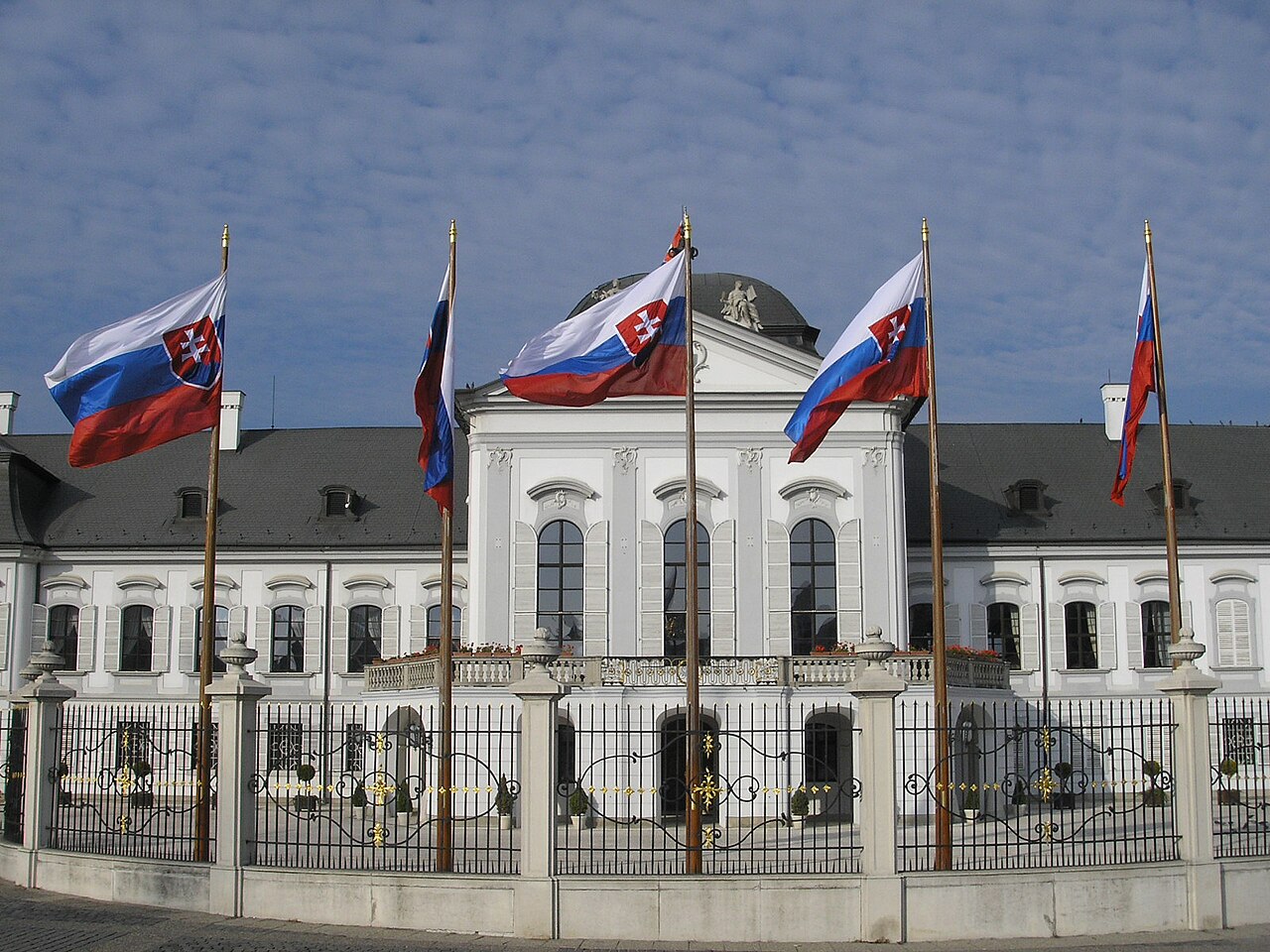
The Grassalkovich Palace (Slovak: Grasalkovičov palác, Hungarian: Grassalkovich-palota) is a palace in Bratislava, Slovakia, and the residence of the President of Slovakia. It is situated on Hodžovo Square, near the Episcopal Summer Palace. The building is a Rococo (Late Baroque) summer palace with a French garden.
The building was finished in 1760, by architect Andreas Mayerhoffer for Hungarian aristocrat Antal Grassalkovich of Croatian descent, a close friend of Maria Theresa. Antal was then President of the Royal Hungarian Chamber (quasi-Minister of Finance), and as such he needed an apartment in the capital (since Pressburg — now Bratislava — was the capital of Hungary until 1848). It features many rooms and an impressive staircase. The chapel is decorated with frescoes by Joseph von Pichler.
The building became a center of Baroque musical life in Pressburg. Joseph Haydn premiered some of his works here. Count Grassalkovich also had his orchestra and his "colleague", Prince Esterházy, used to "lend" him his favorite conductor, Haydn. Grassalkovich was Maria Theresa's vassal, so the palace was used for various balls and parties of the Habsburg royal court. For example, it was Haydn who conducted the orchestra when Maria Theresa's daughter married Albert of Sachsen-Teschen, then governor of the Kingdom of Hungary (see Bratislava Castle). Ľudovít Štúr is said to have declared his love to Adela Ostrolúcka for the first time during a ball organized by Archduke Stephen Francis Victor (Buda 14 September 1817 – Menton 19 February 1867), son of the Palatine, Joseph.
The last owners of the palace before the end of Austria-Hungary were Archduke Frederick of Teschen with his wife Isabella of Croy-Dülmen. After that, the building stood empty for years. After the Treaty of Trianon, it was first used again as the personal residence of the fascist Jozef Tiso, leader of the Slovak Republic but from 1919 the palace was occupied by the Territorial Military Command.
During the 1939–1945 period, the palace was adapted by Emil Belluš and became the seat of the President of the First Slovak Republic (i.e. of Jozef Tiso). During the Communist era, it was first (after 1945) the seat of the Board of Commissioners (also styled Corps of Plenipotentiaries), which was a quasi-government of Slovakia within Czechoslovakia.
Text adapted from “Grassalkovich Palace” on Wikipedia, CC BY-SA 4.0.
Grassalkovich Palace ranks #581 of 9,079 worldwide in the atlas's castle fame ranking, and #8 of the 136 mapped in Slovakia. Founded 1765, it is older than 15% of the atlas's dated landmarks — one of 696 atlas entries founded in the 18th century. Its Wikipedia articles were opened 6,276 times in the last 60 days, more than 89% of the atlas. 26 more atlas landmarks stand within 25 km. The nearest day-trip guide is Bratislava, 1 km away. See how Slovakia compares in the castle statistics.
View on the interactive castle map →