 Iran · 17th century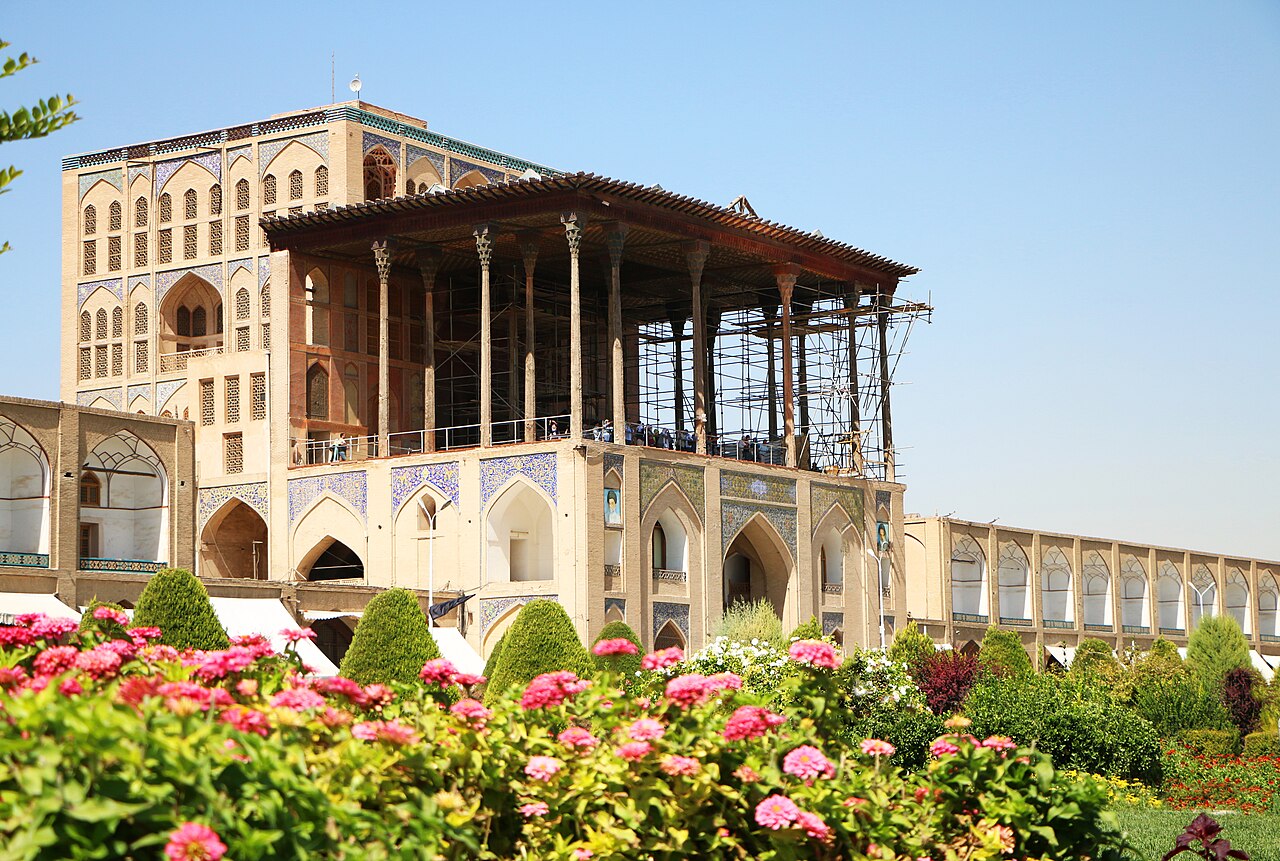
Ali Qapu (Persian: عالیقاپو, romanized: ‘Ālī Qāpū, lit. 'Grand Gate') is an imperial palace in Isfahan, Iran. It is located on the western side of Naqsh-e Jahan Square, opposite to Sheikh Lotfollah Mosque, and had originally been designed as a vast portal entrance to the grand palace which stretched from the square to Chaharbagh Boulevard. UNESCO inscribed the Palace and the Square as a World Heritage Site due to their cultural and historical importance.
The palace is forty-eight meters high and there are six floors, each accessible by a difficult spiral staircase. In the sixth floor, Music Hall, deep circular niches are found in the walls, having not only aesthetic value, but also acoustic. Ali Qapu is regarded as the best example of Safavid architecture and a symbol of Iran's Islamic heritage.
The name Ali Qapu, from Persian ‘Ālī (meaning "imperial" or "great"), and Azerbaijani Qāpū (meaning "gate"), was given to this place as it was right at the entrance to the Safavid palaces which stretched from the Naqsh-e Jahan Square to the Chahar Baq Boulevard.
The building was built by decree of Shah Abbas the Great in the early 17th century. It was here that the Safavid monarchs used to entertain noble visitors, and foreign ambassadors.
Shah Abbas, here for the first time, celebrated the Nowruz (Iranian New Year) of 1006 AH/1597 C.E.
Wall decorations were highly favoured in palace decorations and Ali Qapu was no exception. Ali Qapu is rich in naturalistic wall paintings by Reza Abbasi, the court painter of Shah Abbas I, and his pupils. There are floral, animal, and bird motifs in his works. The highly ornamented doors and windows of the palace have almost all been pillaged at times of social anarchy. Only one window on the third floor has escaped the ravages of time.
Text adapted from “Ali Qapu” on Wikipedia, CC BY-SA 4.0.
Ali Qapu ranks #514 of 9,079 worldwide in the atlas's castle fame ranking, and #6 of the 173 mapped in Iran. Founded c. 1650, it is older than 25% of the atlas's dated landmarks — one of 721 atlas entries founded in the 17th century. Its Wikipedia articles were opened 7,158 times in the last 60 days, more than 91% of the atlas. 5 more atlas landmarks stand within 25 km. The nearest day-trip guide is Isfahan, 1 km away. See how Iran compares in the castle statistics.
View on the interactive castle map →