Fortress
Great Wall of China
🇨🇳 China · 7th century BC
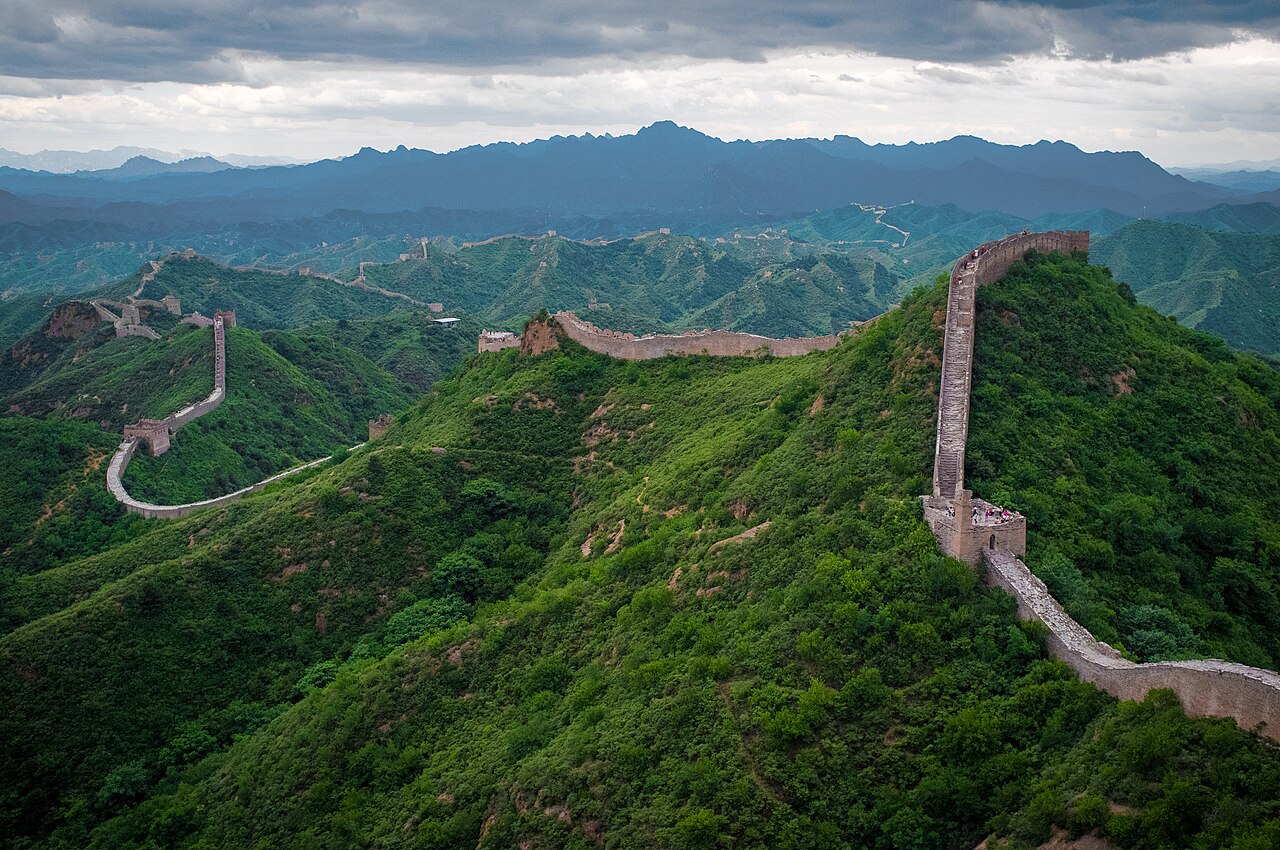
The Great Wall of China is a series of fortifications in China. They were built across the historical northern borders of ancient Chinese states and Imperial China as protection against various nomadic groups from the Eurasian Steppe. The first walls date to the 7th century BC; these were joined together in the Qin dynasty. Successive dynasties expanded the wall system; the best-known sections were built by the Ming dynasty (1368–1644).
To aid in defense, the Great Wall utilized watchtowers, troop barracks, garrison stations, signaling capabilities through the means of smoke or fire, and its status as a transportation corridor. Other purposes of the Great Wall have included border controls (allowing control of immigration and emigration, and the imposition of duties on goods transported along the Silk Road), and the regulation of trade.
The collective fortifications constituting the Great Wall stretch from Liaodong in the east to Lop Lake in the west, and from the present-day Sino-Russian border in the north to Tao River in the south: an arc that roughly delineates the edge of the Mongolian steppe, spanning 21,196.18 km (13,170.70 mi) in total. It is a UNESCO World Heritage Site, and was voted one of the New 7 Wonders of the World in 2007. Today, the defensive system of the Great Wall is recognized as one of the most impressive architectural feats in history.
Text adapted from “Great Wall of China” on Wikipedia, CC BY-SA 4.0.
Great Wall of China ranks #1 of 8,134 worldwide in the atlas's castle fame ranking, and #1 of the 119 mapped in China. Founded c. 700 BC, it is older than 99% of the atlas's dated landmarks — one of 5 atlas entries founded in the 7th century BC. Its Wikipedia articles were opened 467,136 times in the last 60 days, more than 99% of the atlas. 3 more atlas landmarks stand within 25 km. The nearest day-trip guide is Beijing, 60 km away. See how China compares in the castle statistics.
View on the interactive castle map →Frequently asked questions
Where is Great Wall of China?
Great Wall of China stands in China, at 40.43139°, 116.56444°.
When was Great Wall of China built?
The atlas dates its founding to c. 700 BC. Earlier structures may have stood on the site; this is the earliest documented founding year.
How famous is Great Wall of China?
In this atlas's fame ranking: #1 of 8,134 worldwide, and #1 in China. Fame here combines how many Wikipedia language editions cover a landmark with how many people read them.
What is the nearest castle to Great Wall of China?
Mutianyu, about 1 km away.
More castles in China
- Forbidden City China · 15th century
- Potala Palace China · 7th century
- Summer Palace China
- Shanhai Pass China · 14th century
More fortresses
- Machu Picchu Peru · 15th century
- Kremlin Russia · 15th century
- Fatehpur Sikri India · 16th century
- Hadrian's Wall England · 2nd century