 China · 14th century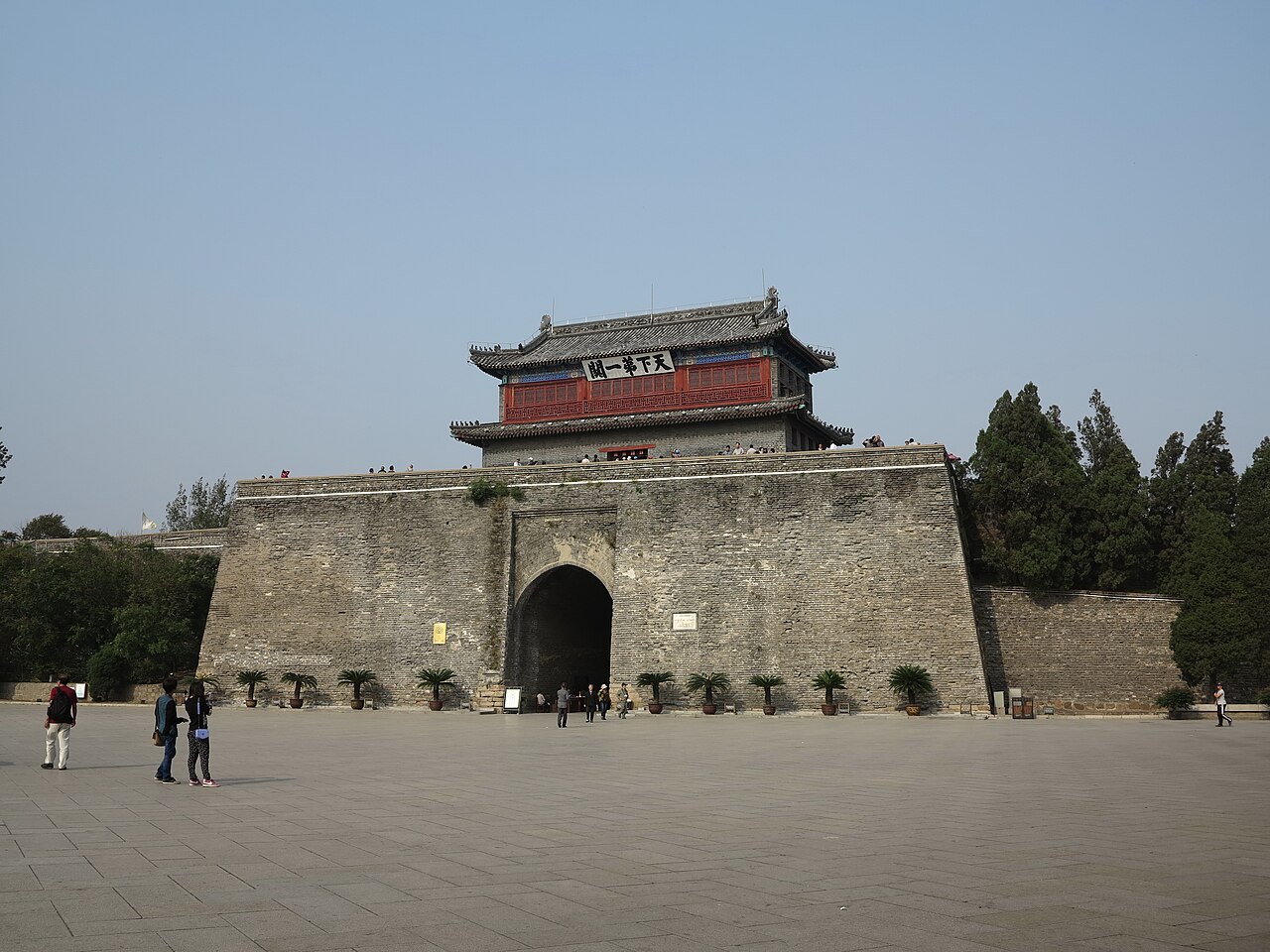
The Shanhai Pass (simplified Chinese: 山海关; traditional Chinese: 山海關; pinyin: Shānhǎi Guān; lit. 'Mountain Sea Pass') is a major fortified gateway at the eastern end of the Great Wall of China and one of its most crucial fortifications, as the pass commands the narrowest choke point in the strategic Liaoxi Corridor, an elongated coastal plain between the Yan Mountains foothills and the Bohai Sea, which is the only easily traversable landway between North and Northeast China. It is located in present-day Shanhaiguan District, Qinhuangdao, Hebei, on the east bank of the Shi River, with defensive walls stretching from the Yan Mountains all the way to the shores of the Liaodong Bay.
Throughout Chinese history, garrisons around the pass served as frontline defensive outposts against raids and incursions into the North China Plain by various non-Sinitic ethnic groups from the Northeast (also known as Manchuria since the 19th century), including the Dongyi, Donghu (Xianbei and Wuhuan), Khitan and Jurchen (Manchus). The current Shanhai Pass was built during the early Ming dynasty as the easternmost fortification of the Ming Great Wall, and was extensively reinforced after Yongle Emperor moved the capital from Nanjing to Beijing following the Jingnan campaign, making it the most important defensive barrier in all of China, as it shielded the heartland region around the imperial capital.
The pass' strategic location dictated that without mounting a costly direct siege, the only way an invading army can get past the pass' defense was to circumvent it around the north through a few treacherously narrow mountain passes deep within the Yan Mountains, which would make it very difficult to maintain supply lines and thus any sizeable invasions. This defensive significance therefore earned the pass the famous nickname "Greatest Pass Under Heaven" (天下第一关).
Text adapted from “Shanhai Pass” on Wikipedia, CC BY-SA 4.0.
Shanhai Pass ranks #224 of 9,079 worldwide in the atlas's castle fame ranking, and #6 of the 107 mapped in China. Founded 1381, it is older than 53% of the atlas's dated landmarks — one of 755 atlas entries founded in the 14th century. Its Wikipedia articles were opened 12,730 times in the last 60 days, more than 95% of the atlas. See how China compares in the castle statistics.
View on the interactive castle map →