 India · 5th century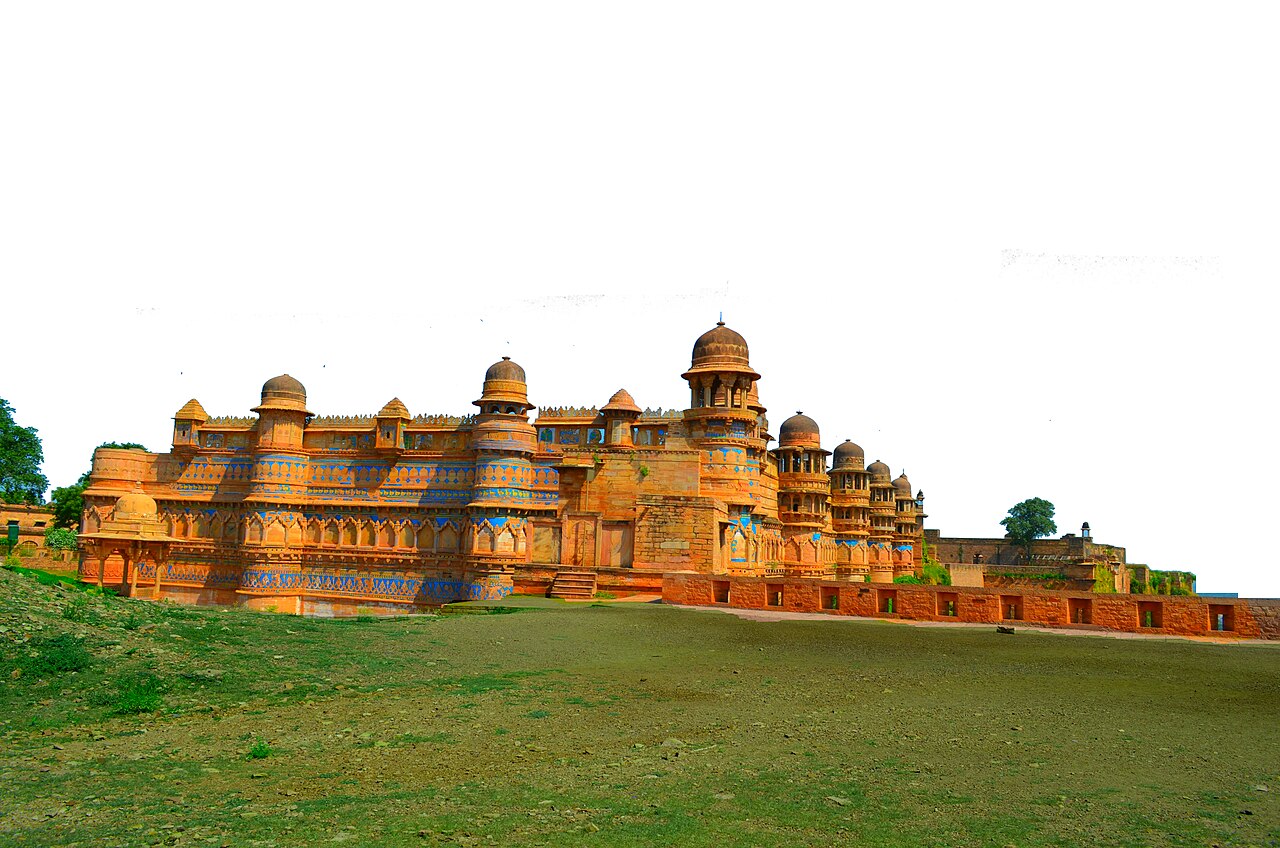
The Fort of Gwalior or Gwalior Fort is a 6th-century hill fort in Gwalior, India. Mughal Emperor Babur described it as the "pearl amongst the fortresses of Hind and not even the winds could touch its masts" due to its grandeur and magnificence. It was nicknamed the "Gibraltar of India" for its impregnability and defensive structure. The fort dates back to the 5th century, perhaps earlier, making it one of the oldest defence forts in India. Ancient Sanskrit inscriptions record the name of the fort as "Gopgiri".
The current structure has stood since at least the 8th century, and the inscriptions and monuments found within the fort complex indicate that it may have existed as early as the beginning of the 6th century.
The modern-day fort comprises a defensive structure and six palaces, two of which were built by the Tomar ruler Man Singh Tomar (reigned 1486–1516 CE). It has witnessed the changing fortunes of the Kushanas, the Nagas, the Guptas, the Hunas, the Pratiharas, the Kachchhapaghatas, the Tomaras, the Pathans (Sultanate), the Surs, the Mughals, the English, the Jats, and the Scindias.
The present-day fort includes several notable palaces, including Man Mandir, Vikram Mandir, Karn Palace, Shah Jahan Palace, Jehangir Palace, and Gurjari Mahal. Gurjari Mahal was commissioned by Man Singh Tomar, for his 9th wife Mrignayani, who belonged to the Gurjar community.
A stone inscription found engraved in the walls of Chaturbhuj Temple (famously known as Zero Temple) close to the top of the fort contains the second-oldest known record (after the Bakhshali manuscript) of the numeral "zero" with a place value, as used in decimal notation. The inscription is around 1,500 years old.
Text adapted from “Gwalior Fort” on Wikipedia, CC BY-SA 4.0.
Gwalior Fort ranks #402 of 9,079 worldwide in the atlas's castle fame ranking, and #15 of the 224 mapped in India. Founded c. 450, it is older than 97% of the atlas's dated landmarks — one of 37 atlas entries founded in the 5th century. Its Wikipedia articles were opened 12,761 times in the last 60 days, more than 95% of the atlas. See how India compares in the castle statistics.
View on the interactive castle map →