 Germany · 11th century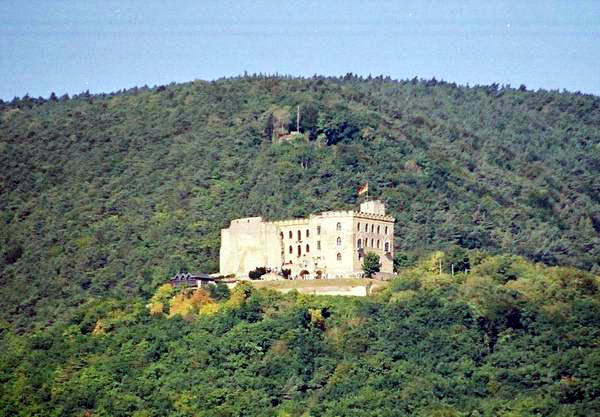
Hambach Castle (German: Hambacher Schloss) is a castle near the urban district Hambach of Neustadt an der Weinstraße in Rhineland-Palatinate, Germany. It is considered a symbol of the German democracy movement because of the Hambacher Fest which was held there in 1832.
Hambach Castle is located on the mountain Schlossberg (literally translated "Castle mountain"; elevation: 325m) in the eastern outskirts of the Palatine Forest.
The estate ruled both as a protection castle and as a robber baron castle over the trade roads and the northern route of the Anterior Palatinate section of the Way of St. James.
Archaeological finds prove that the area of Hambach Castle was used in late Roman times. In late Carolingian dynasty times and Ottonian dynasty times a castle of refuge was built there. Portions remain in front of and under the outer ring wall.
Probably in the first half of the 11th century, a new castle named Kästenburg (translated in the Palatinate dialect as the "chestnut castle") was built inside the former estate. It got its name because of the surrounding magnificent sweet chestnut forests. There is little known about its early history; there are speculations without any proof that it was founded as an Imperial Castle (Reichsburg) or that Emperor Henry IV had started his Walk to Canossa there in 1076. The only thing certain is that between 1090 and 1104 bishop Johann I of Speyer signed over the estate together with Castle Meistersel to the Bishopric of Speyer, which stayed the owner to the end of the 18th century.
The big estate was said to be one of the most important facilities of the Bishopric of Speyer in the late Middle Ages. This is indicated by the many residencies of the bishops since 1180. Despite this the first "Burgmannen" primary were known as Imperial Ministeriales and not as commissionaires of the church, especially the first one, Burkhard of Kästenburg, who is provably in the imperial service from 1154 to 1186. His brother Trushard of Kästenburg, proven 1178–1201, had a brilliant career at the court of Henry VI.
The descendants of Trushard had no connection to the Kästenburg. Other houses of "Burgmannen" took place here, among them since 1256 the ministerial family Schnittlauch of Kästenburg, the Earls of Zweibrücken (1284) and the Earls of Veldenz (1311).
Especially during the 13th century, larger building projects took place.
Text adapted from “Hambach Castle” on Wikipedia, CC BY-SA 4.0.
Hambach Castle ranks #675 of 9,079 worldwide in the atlas's castle fame ranking, and #55 of the 711 mapped in Germany. Founded c. 1100, it is older than 85% of the atlas's dated landmarks — one of 436 atlas entries founded in the 11th century. Its Wikipedia articles were opened 10,537 times in the last 60 days, more than 94% of the atlas. 15 more atlas landmarks stand within 25 km. The nearest day-trip guide is Kaiserslautern, 29 km away. See how Germany compares in the castle statistics.
View on the interactive castle map →