 England · 16th century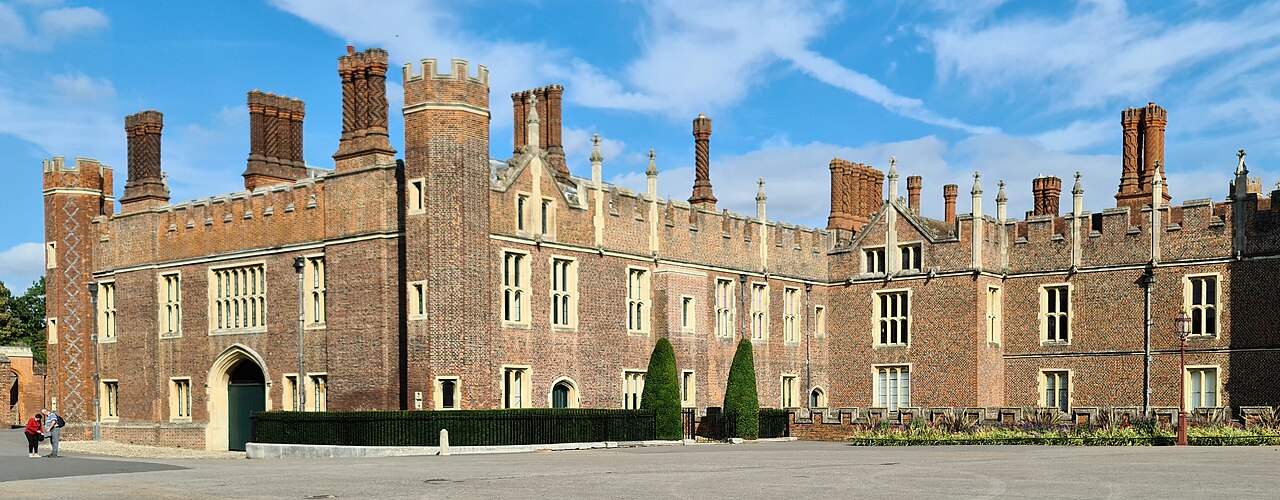
Hampton Court Palace is a Grade I listed royal palace in the London Borough of Richmond upon Thames, 12 miles (19 kilometres) southwest and upstream of central London on the River Thames.
The building of the palace began in 1514 for Cardinal Thomas Wolsey, Archbishop of York and the chief minister of Henry VIII. In 1529, as Wolsey fell from favour, the cardinal gave the palace to the king to try to save his own life, which he knew was now in grave danger due to Henry VIII's deepening frustration and anger. The palace became one of Henry's most favoured residences; soon after acquiring it, he enlarged it to accommodate his sizeable retinue of courtiers.
In the early 1690s, William III's massive rebuilding and expansion work, which was intended to rival the Palace of Versailles, destroyed much of the Tudor palace. His work ceased in 1694, leaving the palace in two distinct contrasting architectural styles, domestic Tudor and Baroque. While the palace's styles are an accident of fate, a unity exists due to the use of pink bricks and a symmetrical, if vague, balancing of successive low wings. George II was the last monarch to reside in the palace.
The palace structure and grounds are cared for by an independent charity, Historic Royal Palaces, and is open to the public. The palace displays works of art from the Royal Collection. The palace gardens include the Hampton Court Maze, the royal tennis court, and the world's largest grape vine as of 2005. The palace's Home Park is the site of the annual Hampton Court Palace Festival and Hampton Court Garden Festival.
Text adapted from “Hampton Court Palace” on Wikipedia, CC BY-SA 4.0.
Hampton Court Palace ranks #53 of 9,079 worldwide in the atlas's castle fame ranking, and #9 of the 360 mapped in England. Founded 1515, it is older than 42% of the atlas's dated landmarks — one of 891 atlas entries founded in the 16th century. Its Wikipedia articles were opened 45,111 times in the last 60 days, more than 99% of the atlas. 22 more atlas landmarks stand within 25 km. The nearest day-trip guide is London, 19 km away. See how England compares in the castle statistics.
View on the interactive castle map →