 Japan · 8th century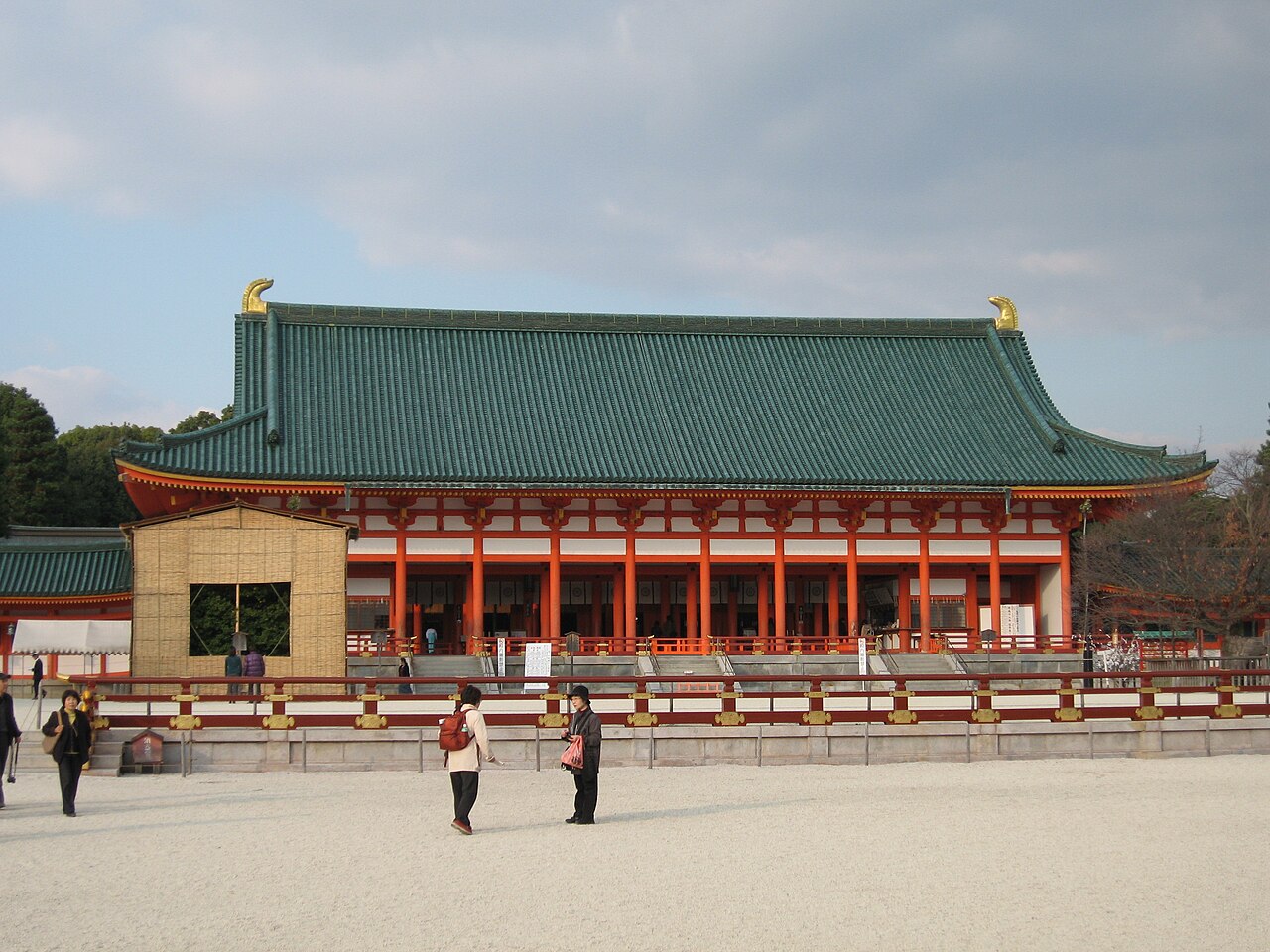
The Heian Palace (平安宮, Heian-kyū) was the original imperial palace of Heian-kyō (present-day Kyoto), then the capital of Japan. Both the palace and the city were constructed in the late 700s and were patterned on Chinese models and designs. The palace served as the imperial residence and the administrative centre for most of the Heian period (794–1185).
Located in the north-central section of the city, the palace consisted of a large, walled, rectangular Greater Palace (the Daidairi), which contained several ceremonial and administrative buildings including the government ministries. Inside this enclosure was the separately walled residential compound of the emperor, or the Inner Palace (Dairi). In addition to the emperor's living quarters, the Inner Palace contained the residences of the imperial consorts and buildings more closely linked to the person of the emperor.
The original role of the palace was to manifest the centralised government model adopted by Japan from China in the 7th century – known as the ritsuryō system, where the bureaucracy under the emperor was headed by the great council of state (Daijō-kan) and its subsidiary Eight Ministries. The palace was designed to provide an appropriate setting for the emperor's residence, the conduct of great affairs of state, and the accompanying ceremonies. While the residential function of the palace continued until the 12th century, the facilities built for grand state ceremonies began to fall into disuse by the 9th century. This was due to both the abandonment of several statutory ceremonies and procedures and the transfer of several remaining ceremonies into the smaller-scale setting of the Inner Palace.
From the mid-Heian period, the palace suffered several fires and other disasters. During reconstructions, emperors and some of the office functions resided outside the palace.
Text adapted from “Heian Palace” on Wikipedia, CC BY-SA 4.0.
Heian Palace ranks #478 of 9,079 worldwide in the atlas's castle fame ranking, and #24 of the 296 mapped in Japan. Founded c. 775, it is older than 95% of the atlas's dated landmarks — one of 48 atlas entries founded in the 8th century. Its Wikipedia articles were opened 8,593 times in the last 60 days, more than 92% of the atlas. 13 more atlas landmarks stand within 25 km. The nearest day-trip guide is Kyoto, 2 km away. It is one of the 69 landmarks on the atlas's regional map of Kansai. See how Japan compares in the castle statistics.
View on the interactive castle map →