Palace & château
Hornby Castle (Lancashire)
ENG England · 13th century
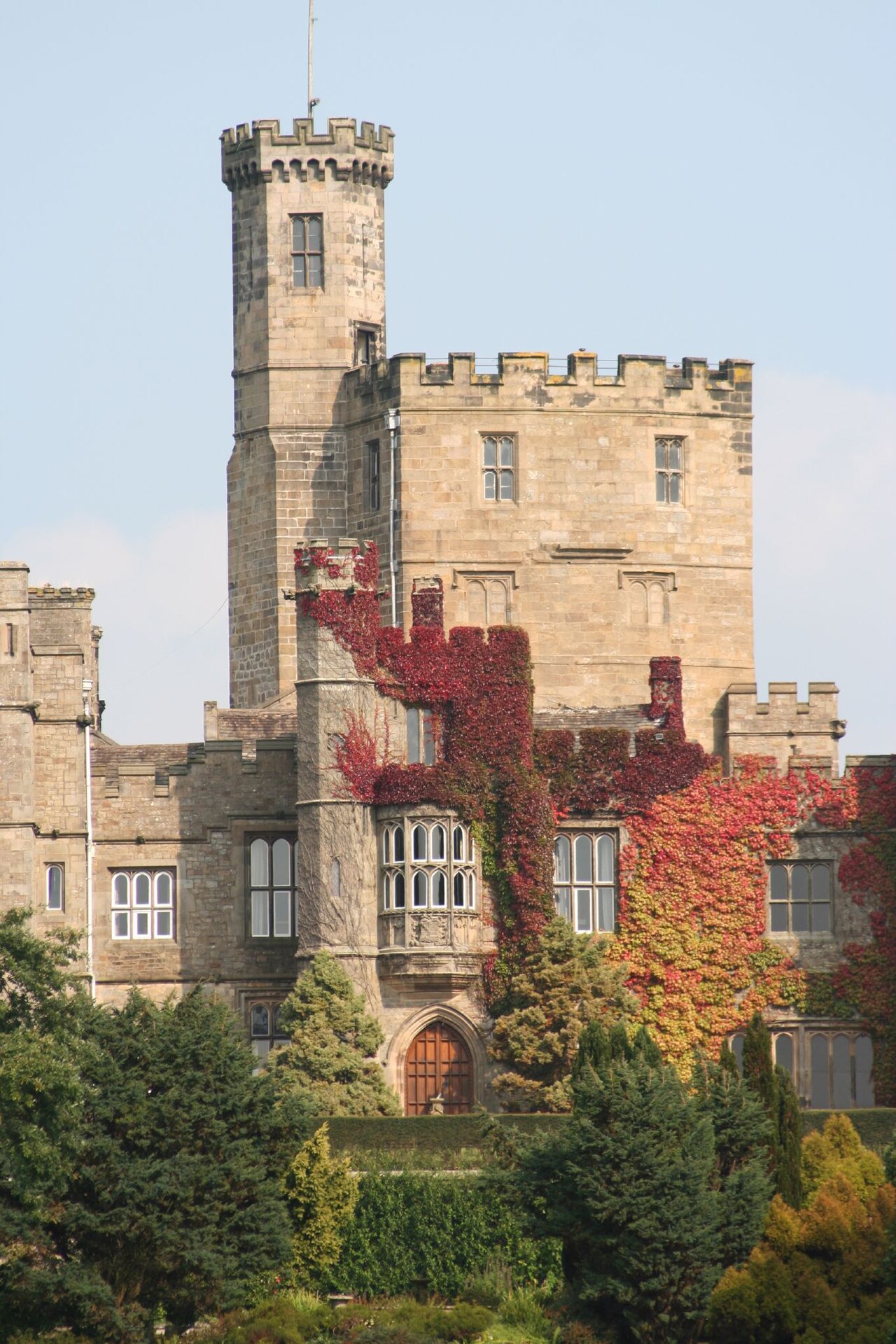
Hornby Castle is a country house, developed from a medieval castle, standing to the east of the village of Hornby in the Lune Valley, Lancashire, England. It occupies a position overlooking the village in a curve of the River Wenning. The house is recorded in the National Heritage List for England as a designated Grade I listed building.
It is thought that the castle was originally built for the Neville family in the 13th century; this is the most likely date of the base of the tower at the back of the castle. In 1285, Margaret de Neville was the owner and "had writ for livery" at Hornby Castle. The polygonal tower rising from this base dates from the 16th century, and was probably built for Sir Edward Stanley, 1st Baron Monteagle. His son, the second Baron Monteagle, took part in suppressing the Rising of the North in 1536. The third Baron Monteagle sold off a lot of the land and on his death in 1581 was succeeded by an only daughter, Elizabeth, who married Edward Parker, 12th Baron Morley.
Their son William was made the fourth Baron Monteagle and became famous as the peer who was forewarned about the Gunpowder Plot in 1605. His son Henry was a zealous Royalist at the start of the Civil War and his estates were afterwards declared forfeit and sold. During the war itself, the castle was captured by Colonel Assheton in 1643 and occupied in 1648 by the Duke of Hamilton and his Scottish army. Although the castle was afterwards recovered by the family, Henry's son Thomas was forced by straitened financial circumstances to sell the castle to Robert Brudenell, 2nd Earl of Cardigan in 1663. Brudenell's grandson sold it in 1713 to the infamous Colonel Charteris.
His daughter Janet married James Wemyss, 5th Earl of Wemyss and gave the castle to their second son Francis (who took the surname of Charteris) and remodelled the castle in about 1720. In 1789, Charteris sold Hornby to John Marsden, known as "Silly Marsden", of Wennington Hall, who was under the control of his aunt and her husband, the ambitious George Wright. Marsden sold Wennington to pay for Hornby. After a long legal battle over Marsden's will (he had died in 1826), Admiral Sandford Tatham regained control of the property in 1838 from George Wright's family. He died in 1840, leaving it to his nephew Pudsey Dawson the younger, High Sheriff of Lancashire for 1845.
Text adapted from “Hornby Castle, Lancashire” on Wikipedia, CC BY-SA 4.0.
Hornby Castle (Lancashire) ranks #4,472 of 8,764 worldwide in the atlas's castle fame ranking, and #291 of the 356 mapped in England. Founded c. 1250, it is older than 70% of the atlas's dated landmarks — one of 906 atlas entries founded in the 13th century. 5 more atlas landmarks stand within 25 km. The nearest day-trip guide is Manchester, 76 km away. See how England compares in the castle statistics.
View on the interactive castle map →Frequently asked questions
Where is Hornby Castle (Lancashire)?
Hornby Castle (Lancashire) stands in England, at 54.1114°, -2.6323°.
When was Hornby Castle (Lancashire) built?
The atlas dates its founding to c. 1250. Earlier structures may have stood on the site; this is the earliest documented founding year.
How famous is Hornby Castle (Lancashire)?
In this atlas's fame ranking: #4,472 of 8,764 worldwide, and #291 in England. Fame here combines how many Wikipedia language editions cover a landmark with how many people read them.
What is the nearest castle to Hornby Castle (Lancashire)?
Thurland Castle, about 5 km away.
More castles in England
- Hutton in the Forest England · 17th century
- Lowther Castle England · 19th century
- Armathwaite Castle England · 15th century
- Cooling Castle England · 14th century
More palaces & châteaux
- Hulihee Palace United States · 19th century
- Opočno Castle Czech Republic · 11th century
- Mirów Castle (Książ Wielki) Poland · 16th century
- Mnichovo Hradiště Castle Czech Republic · 17th century