 Scotland · 14th century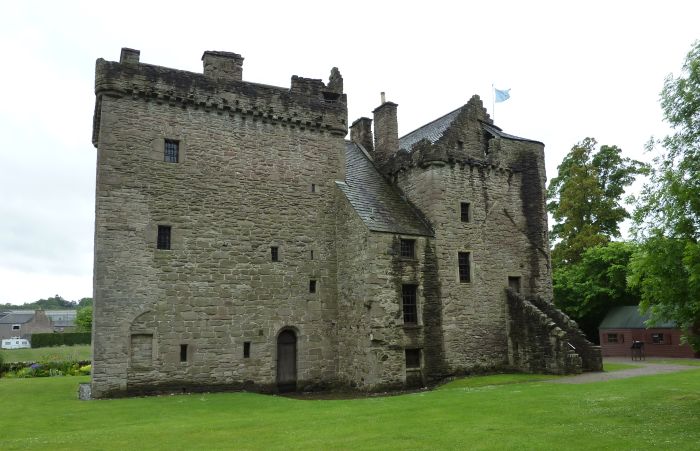
Huntingtower Castle, once known as Ruthven Castle or the Place of Ruthven, is located near the village of Huntingtower beside the A85 and near the A9, about 5 km NW of the centre of Perth, Perth and Kinross, in central Scotland, on the main road to Crieff. This castle is the subject for several local ghostlore stories.
Huntingtower Castle was built at least by the 14th century as it was one of the castles owned by the Lords of Badenoch. Alexander Stewart, Earl of Buchan, called the Wolf of Badenoch for his misdeeds, died there in 1394.
Later, in the 15th century the castle was claimed by the Huntly family, or by the Clan Ruthven family. It was known for several hundred years as the 'House (or 'Place') of Ruthven' or 'Ruthven Castle', or simply 'Ryffane', until the family was forfeited for the Gowrie Conspiracy in 1600 and the Ruthven name was suppressed by Act of Parliament. As contemporary writers reported, the "prinsipall howse callyd Ryven is now callyd the Huntynge towre" and, "the House of Riven to be called Hunt towre". The Ruthvens also had a substantial townhouse in nearby Perth, called Gowrie House.
Mary, Queen of Scots visited on 25 June and 16 September 1565. Regent Morton made a progress in Fife in September 1575, and while he was at Ballinbreich Castle he was summoned to Huntingtower (Ruthven) to the christening of James Ruthven, the heir.
In the summer of 1582, the castle was occupied by the 4th Lord Ruthven, who was also the 1st Earl of Gowrie, and his family. Gowrie was involved in a plot to kidnap the young King James VI, son of Mary, Queen of Scots. On 22 or 23 August 1582, Gowrie and his associates seized the young king at Huntingtower, then known as "Ruthven Castle". James was held prisoner for 10 months in various locations. This kidnapping is known as the 'Raid of Ruthven' and the Protestant conspirators behind it hoped to gain power through controlling the king. James Stewart, Earl of Arran was imprisoned in Ruthven Castle. James eventually escaped from his captors at St Andrews on 27 June 1583.
James VI forgave Gowrie, and returned for a banquet at the "House of Ruthven", but after a second abortive attempt by Gowrie and others to overthrow him, Gowrie was finally executed and his property (including Huntingtower) was forfeited to the crown.
Text adapted from “Huntingtower Castle” on Wikipedia, CC BY-SA 4.0.
Huntingtower Castle ranks #3,666 of 9,079 worldwide in the atlas's castle fame ranking, and #124 of the 226 mapped in Scotland. Founded c. 1350, it is older than 55% of the atlas's dated landmarks — one of 755 atlas entries founded in the 14th century. Its Wikipedia articles were opened 1,492 times in the last 60 days, more than 62% of the atlas. 9 more atlas landmarks stand within 25 km. The nearest day-trip guide is Dundee, 32 km away. It is one of the 76 landmarks on the atlas's regional map of the Scottish Highlands. See how Scotland compares in the castle statistics.
View on the interactive castle map →