Castle
Methven Castle
SCT Scotland · 17th century
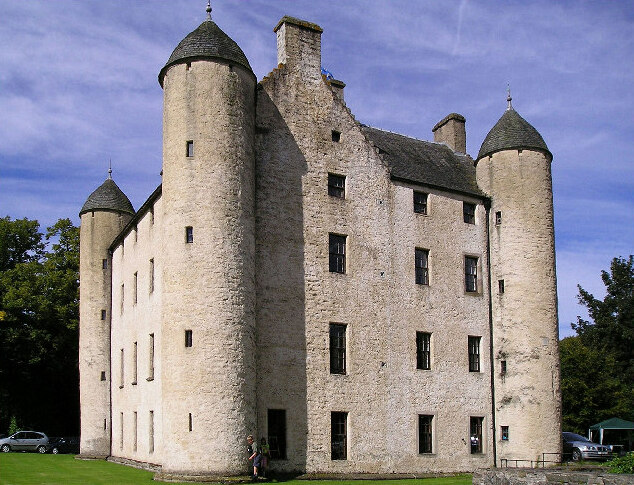
Methven Castle is a privately owned 17th-century house situated east of Methven, in Perth and Kinross, Scotland.
The lands of Methven were owned by the Mowbray family from the 12th century. The Mowbrays supported the claim of John Balliol against Robert the Bruce, and on the latter's victory Methven was confiscated by the crown, and given to Walter Stewart, the Bruce's son-in-law. His descendant, Walter Stewart, Earl of Atholl, was deprived of the lands following his involvement in a plot to kill King James I. The castle sustained a siege in 1444, and was visited by King James II in 1450. King James IV visited several times in the 1490s.
Methven Castle was given to Margaret Tudor (1489–1541), queen of James IV, King of Scots, and daughter of Henry VII of England, on 29 May 1503 as part of her marriage gift. She lived at Methven after her third marriage to Henry Stewart, 1st Lord Methven, in 1528 and died there on 18 October 1541. After the third Lord Methven died without heir in 1584, King James VI gave Methven to his favourite, the Duke of Lennox. In 1664 the estate was purchased by Patrick Smythe of Braco.
The present building is dated 1664, and was designed and built by the mason-architect John Mylne. It may incorporate older work including the central spine wall. An early drawing for Methven by Patrick Smythe shows a plan with similarities to Pitreavie Castle near Dunfermline. The architect James Smith may have been involved in the project.
The Smythe family remained in possession throughout the 18th and 19th centuries, making additions to the castle and the grounds. In 1923 the castle was sold, and changed hands several times until 1984, when owner and architect Kenneth Murdoch began extensive restoration work. The east wing was demolished, following the west wing which was pulled down in the 1950s, leaving only the 17th-century house, which was given a new roof. The castle is currently owned by David Murdoch, and is a category A listed building.
It comprises a square, four-storey main block, with narrow circular towers at each corner. These have ogee-shaped roofs, and the whole building is harled. The north front has a pair of crow-stepped gables, linked by a balustrade. An east wing was added first, then a western extension with a bay window, built around 1815, probably by James Gillespie Graham.
Text adapted from “Methven Castle” on Wikipedia, CC BY-SA 4.0.
Methven Castle ranks #2,823 of 8,134 worldwide in the atlas's castle fame ranking, and #95 of the 168 mapped in Scotland. Founded c. 1650, it is older than 26% of the atlas's dated landmarks — one of 626 atlas entries founded in the 17th century. Its Wikipedia articles were opened 1,738 times in the last 60 days, more than 63% of the atlas. 5 more atlas landmarks stand within 25 km. The nearest day-trip guide is Dundee, 36 km away. It is one of the 57 landmarks on the atlas's regional map of the Scottish Highlands. See how Scotland compares in the castle statistics.
View on the interactive castle map →Frequently asked questions
Where is Methven Castle?
Methven Castle stands in Scotland, at 56.4168°, -3.5549°.
When was Methven Castle built?
The atlas dates its founding to c. 1650. Earlier structures may have stood on the site; this is the earliest documented founding year.
How famous is Methven Castle?
In this atlas's fame ranking: #2,823 of 8,134 worldwide, and #95 in Scotland. Fame here combines how many Wikipedia language editions cover a landmark with how many people read them.
What is the nearest castle to Methven Castle?
Huntingtower Castle, about 4 km away.
More castles in Scotland
- Drummond Castle Scotland · 15th century
- Blatobulgium Scotland · 2nd century
- Carbisdale Castle Scotland · 20th century
- Balloch Castle Scotland · 19th century
More castles
- Ewyas Harold Castle England · 11th century
- Sycharth Castle Wales
- Tonbridge Castle England · 13th century
- Tykocin Castle Poland · 15th century