Fortress
Hutovo Fortress
🇧🇦 Bosnia and Herzegovina · 16th century
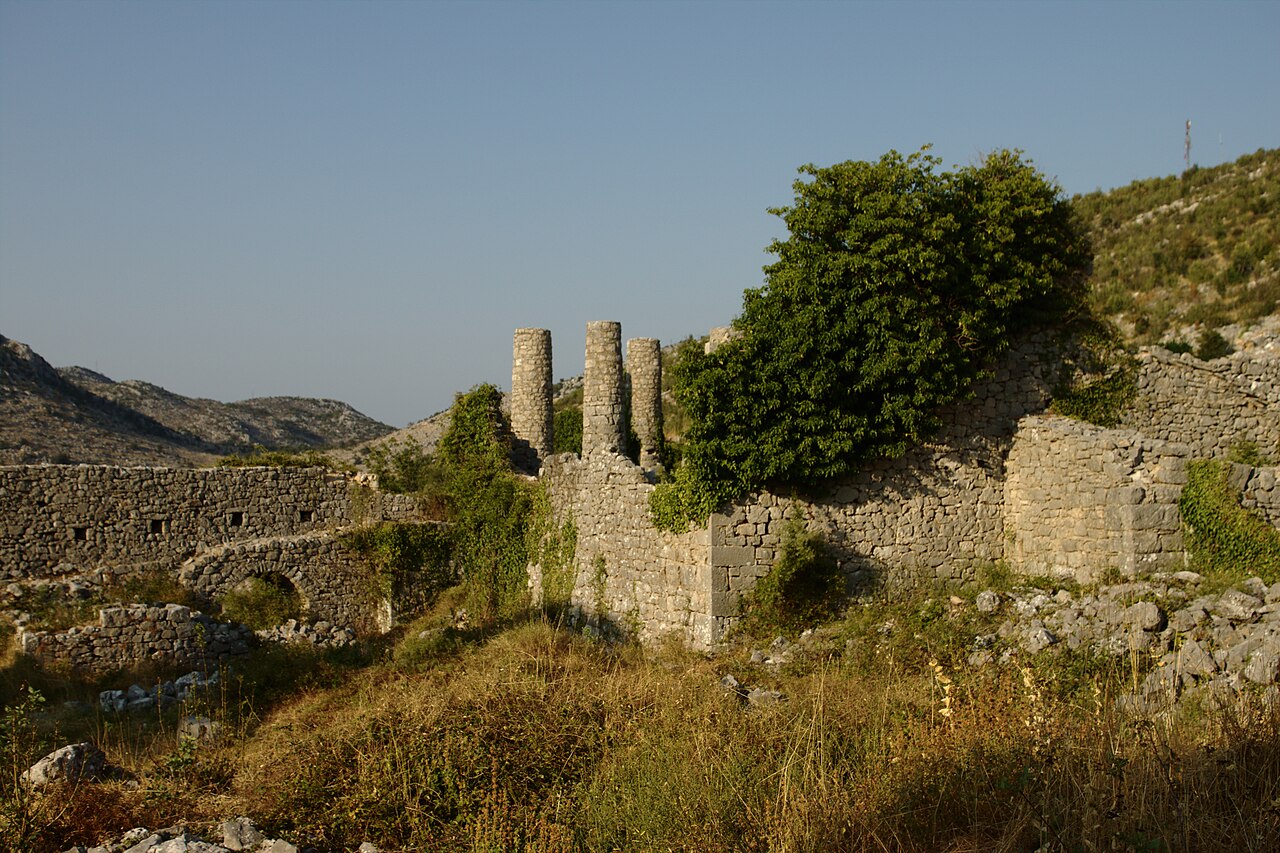
Hutovo fortress or Hadžibegov Grad (the Hajji bey fort), also Hutovski Grad, is a fortress in Bosnia and Herzegovina in the municipality of Neum near the village of Hutovo.
The fortress is located along a narrow road leading from Hutovo Blato to Neum, below Žaba mountain and southwest of Hutovo. Strategically situated atop a hill overlooking the Prešjeci pass, it was often traversed by salt caravans from Ston traveling inland. The name Hadžibegov Grad is derived from the last lord's name, Hadžibeg Rizvanbegović.
The structure forms an irregular pentagon. There is a total of nine towers, each in a corner of the fortress. Solid and high walls enclose an area of flat land. The fortification runs east to west 70 m. The eastern portion of the fortress is roughly 50 m in width, while the western portion is 30 m in width. Its walls were constructed in such a way that soldiers armed with firearms could defend every angle of the fortress.
A massive circular building, which was later encircled with walls, existed in 1714 as a tower in Captaincy of Stolac. A retinue of 7-8 guards guarded the pass and collected taxes. Between 1795 and 1802, Hajj-Mehmed-Beg commanded the fort, and was entitled to a cut of the taxes paid by Nevesinje. He turned the building into a proper fortification before 1802. There are two stone tablets placed at the fort (8 in total in the town).
Hajji-Mehmed-Beg-Rizvanbegović, was a son of captain Zulfikar-bey Rizvanbegović. In XVIII century Rizvanbegović tribe took the captainy over from the Šarić family.
When the Herzegovinian uprising of 1875 began, the Ottoman army conquered the Hutovo fortress. In one of the assaults by the rebels, under the leadership of Ivan Musić, the city itself was set on fire and every wooden construction was no more. The fort itself was abandoned during the Herzegovinian uprising of 1875–1878.
The society of Friends of the Old Hutovo use town historical settings for local celebrations.
Revitalization of the fort was started in 1969 by the National museum of Bosnia and Herzegovina.
On May 10, 2004, the Commission to Preserve National Monuments of Bosnia and Herzegovina designated it a National Monuments of Bosnia and Herzegovina. Three slabs bearing inscriptions found at the fortress are on display in Country House museum's lapidary in Hutovo.
Text adapted from “Hutovo Fortress” on Wikipedia, CC BY-SA 4.0.
Hutovo Fortress ranks #5,480 of 8,134 worldwide in the atlas's castle fame ranking, and #34 of the 38 mapped in Bosnia and Herzegovina. Founded 1525, it is older than 43% of the atlas's dated landmarks — one of 755 atlas entries founded in the 16th century. 5 more atlas landmarks stand within 25 km. The nearest day-trip guide is Nikšić, 94 km away. See how Bosnia and Herzegovina compares in the castle statistics.
View on the interactive castle map →Frequently asked questions
Where is Hutovo Fortress?
Hutovo Fortress stands in Bosnia and Herzegovina, at 42.9575°, 17.8128°.
When was Hutovo Fortress built?
The atlas dates its founding to 1525. Earlier structures may have stood on the site; this is the earliest documented founding year.
How famous is Hutovo Fortress?
In this atlas's fame ranking: #5,480 of 8,134 worldwide, and #34 in Bosnia and Herzegovina. Fame here combines how many Wikipedia language editions cover a landmark with how many people read them.
What is the nearest castle to Hutovo Fortress?
Walls of Ston, about 16 km away.
More castles in Bosnia and Herzegovina
- Fortress of Ključ Bosnia and Herzegovina
- Samobor Fortress Bosnia and Herzegovina · 1st century
- Hodidjed Bosnia and Herzegovina
- Travnik Castle Bosnia and Herzegovina · 14th century
More fortresses
- Fort Paté France · 17th century
- Fort Mont-Valérien France · 19th century
- Kaffa genoese fortress Ukraine · 13th century
- Kerch Fortress Ukraine · 19th century