 Germany · 11th century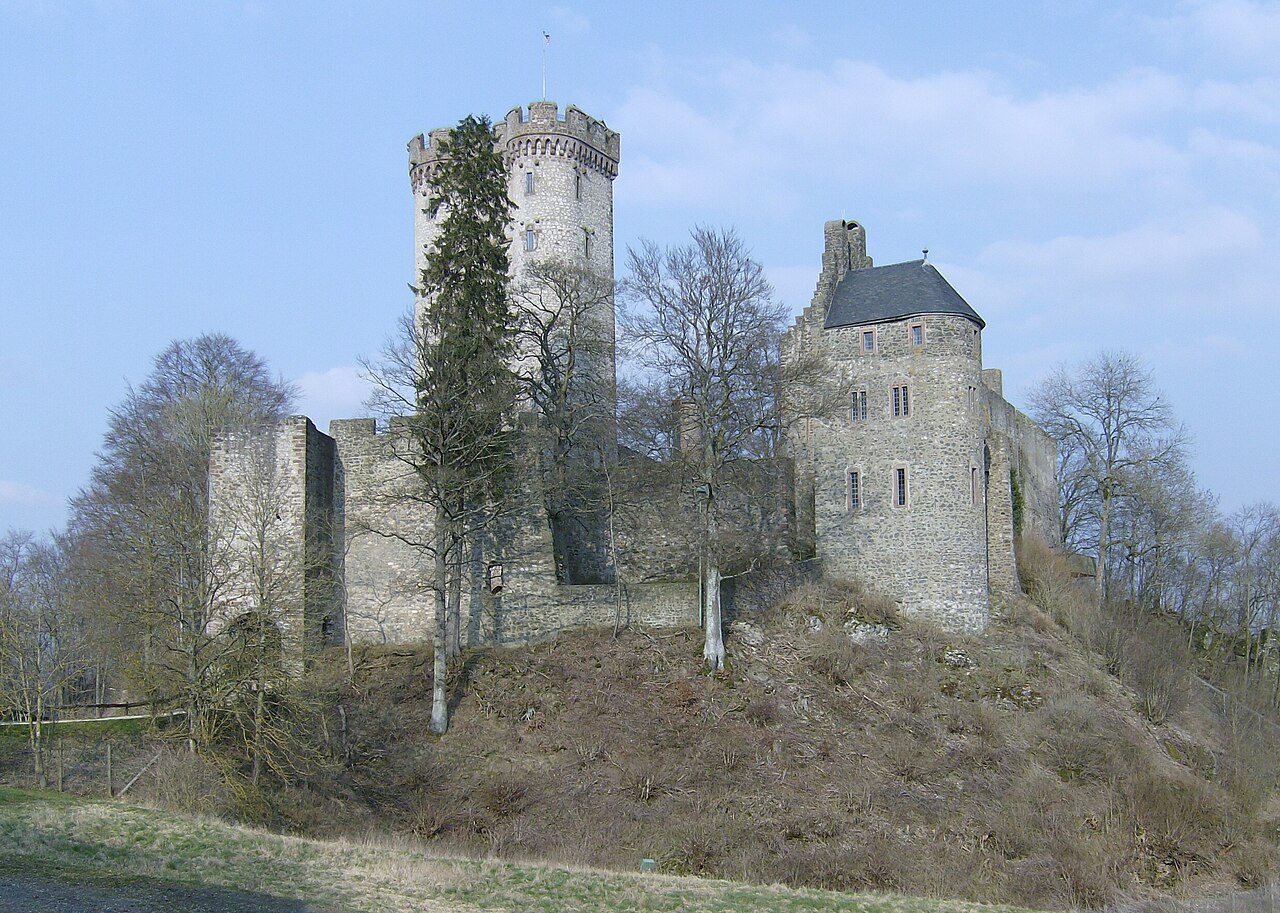
The Kasselburg is a ruined hill castle on a 490-metre-high basalt massif in Pelm near Gerolstein in the county of Vulkaneifel in the German state of Rhineland-Palatinate.
The symbol of the Kasselburg is its 37-metre-high, double tower, which functioned as a gate tower and tower house, whose origins are not precisely clear. Hitherto it had been assumed that the lords of Blankenheim had built it shortly after 1335, but structural investigations have shown that the tower underwent several phases of construction and cannot just be the work of one architect. The gate probably lost its guarding function with the expansion of the castle from 1452. It is from that period that the large outer bailey, with its burgmann houses and domestic buildings, dates.
The double tower is open to the public and has a good view of the surrounding area but, despite its size, is not a bergfried (fighting tower). The latter, built around 1200, is smaller and stands in the eastern part of the inner bailey. It has a square ground plan and was turned into a tower house in the 14th century.
Also part of the inner ward is the almost 33-metre-long palas, which dates to the 14th century.
The castle was built in the 12th century. Its owners may have been the lords of Castel, but this is not entirely certain. The castle was first mentioned in 1291 as the Castilburg. In 1314, it is called Castelberch.
According to the current state of research, it is not clear who the owner of the castle was before 1335. However, it is certain that Gerhard V of Blankenheim became its owner following a division of inheritance in that year and thus founded the Blankenheim-Kasselburg line. In 1406, this line of Blankenheims, which had been elevated to the countship, died out with Count Gerhard VII. The castle then passed by marriage to William I of Loen and thus to Heinsberg.
Other owners followed, including the counts of the Mark, dukes of Arenberg and prince-electors of Trier. Many interest groups have claimed the Kasselburg for themselves throughout history, so that in 1674 the Imperial Chamber Court of Wetzlar was called upon to put an end to the property disputes. When the judges awarded the castle to the dukes of Arenberg, the buildings soon served as barracks for the Duke of Arenberg's artillery.
Text adapted from “Kasselburg” on Wikipedia, CC BY-SA 4.0.
Kasselburg ranks #3,163 of 9,035 worldwide in the atlas's castle fame ranking, and #256 of the 709 mapped in Germany. Founded 1100, it is older than 85% of the atlas's dated landmarks, one of 439 atlas entries founded in the 11th century. Its Wikipedia articles were opened 2,257 times in the last 60 days, more than 72% of the atlas. 7 more atlas landmarks stand within 25 km. The nearest day-trip guide is Trier, 54 km away. It is one of the 51 landmarks on the atlas's regional map of the Moselle. See how Germany compares in the castle statistics.
View on the interactive castle map →